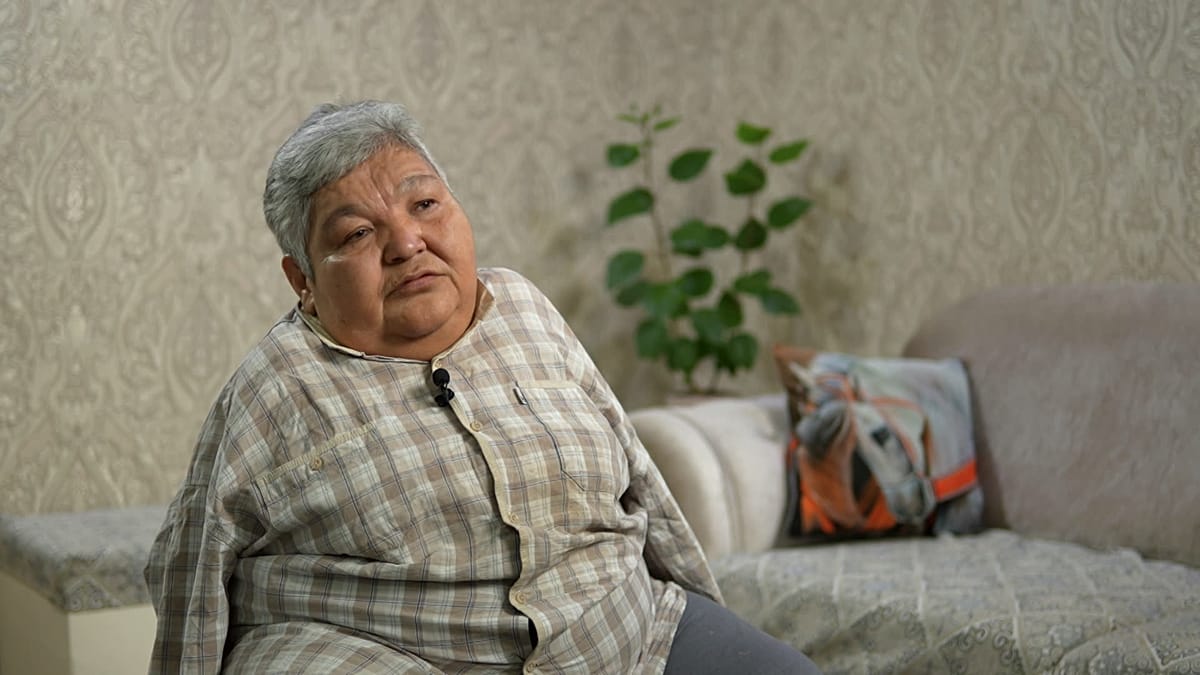
In a modest apartment in Almaty, behind a door marked “Art Studio,” Karipbek Kuyukov leans over a canvas, a brush held firmly in his mouth. He rocks back in his chair to study the composition, then moves in again to add a stroke. The painting shows an autumn road lined with fallen leaves, leading toward the Balkantau mountains, about a hundred kilometres from the former Semipalatinsk nuclear test site in eastern Kazakhstan.
“I love painting landscapes. I want to show that wherever humans appear, they end up spoiling nature,” he says.
Kuyukov was born in the nearby village of Yegindybulak without arms. His mother’s first sight of her newborn was a shock. “When I was born, they showed me to my mother, and she saw that I had no arms. It was very difficult for her,” he recalls.
Between 1949 and 1989, the Soviet Union conducted 456 nuclear tests at Semipalatinsk. Kuyukov remembers the ground shaking after explosions, shockwaves spreading like ripples in water. Many children in the area, he says, were born with disabilities.
From an early age, he learned to use his feet for everyday tasks. One day he found a box of coloured pencils and began to draw, holding the pencils with his toes. That childhood experiment became the foundation of a life in art.
Art as protest
In 1989, Kazakh poet Olzhas Suleimenov founded the Nevada–Semipalatinsk anti-nuclear movement, and Kuyukov soon joined. His first painting on the subject, “The First Explosion,” depicts a family inside a yurt caught in the force of a blast. “The blast blows the yurt away, turning everything upside down. I wanted to show what the people living there went through and how the nuclear tests affected them,” he explains.
He went on to create works such as “Nuclear Mushroom,” “Atomic Childhood,” “Radiation,” and “Fear,” each exploring the human cost of nuclear testing. His art has taken him to the United Nations, where he has addressed high-level meetings about the legacy of Semipalatinsk.
This year marks 35 years since the test site was closed in 1991. Kuyukov was invited to speak at the UN General Assembly, where he delivered a stark message to nations that still brandish nuclear threats. “I wanted to shout, not just speak, because the time has come to make the whole world hear us,” he says.
His activism resonates beyond Central Asia. As European leaders debate security and disarmament, the lessons of Semipalatinsk remain relevant. The UN talks in Geneva on autonomous weapons, for instance, touch on the same fundamental question of how to prevent catastrophic harm. Kuyukov’s story is a reminder that the human cost of nuclear weapons is not abstract.
A life in his own words
Kuyukov has just published his autobiography, a project he began 35 years ago. With financial support from supporters, he recorded his memories as voice messages, which editors turned into a manuscript. Recounting his life brings him to tears; his sister Saule gently wipes them away. He calls her his “guardian angel.”
At the book launch, people queue for signed copies. Kuyukov signs each one with a pen in his mouth, having lost the ability to use his feet for drawing and writing as he aged.
Back in his apartment, he takes a break for tea. A specially designed stand holds the bowl at chin level, allowing him to drink without assistance. Saule is often by his side, though she prefers not to be interviewed.
Today, Kuyukov increasingly turns to landscapes, painting mountains and scenes untouched by humans. But his commitment to a world free of nuclear weapons remains unchanged. He continues to share his story through his art and public appearances, a quiet but persistent voice against the forces that shaped his life.