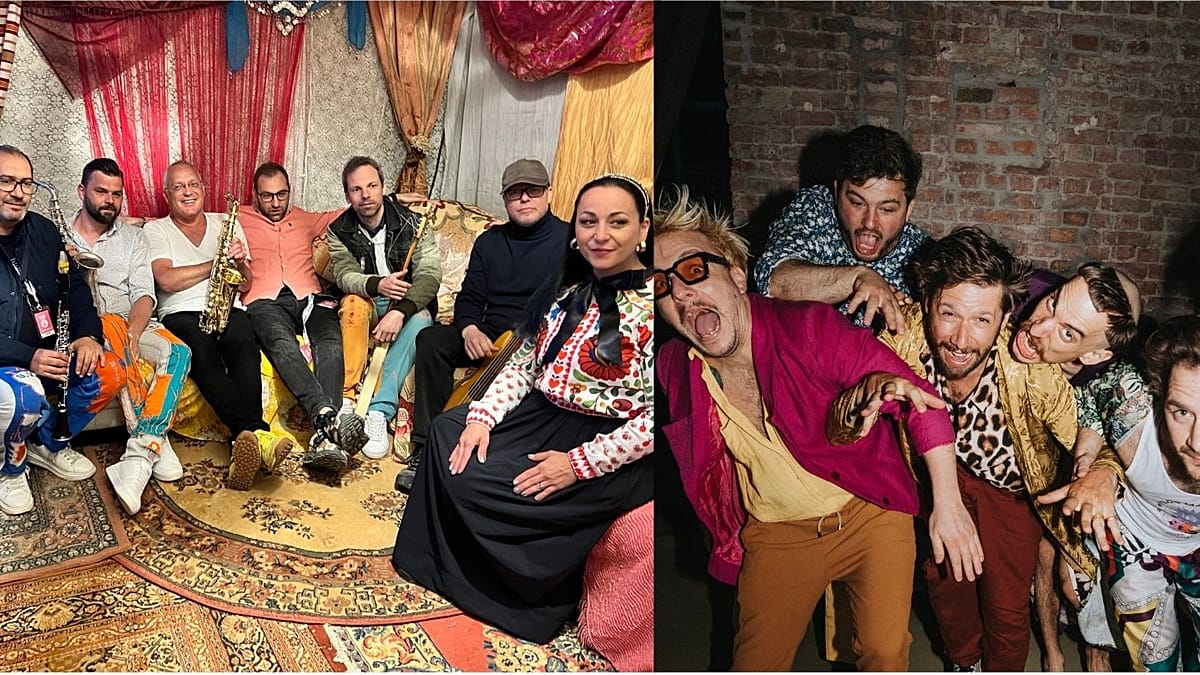
Two of Hungary's most dynamic world music acts are set to share a stage for the first time in Brussels, delivering a 90-minute set that promises to blur the lines between Central European and Balkan musical traditions. Besh o droM and Bohemian Betyars will perform together on Friday at the Beurse, at the invitation of the Balkan Trafik festival.
Both bands have carved out devoted followings in Hungary and beyond, yet their sounds are distinctly their own. Besh o droM, formed in Budapest in 1999, has built a reputation for virtuosic, danceable music that weaves Hungarian, Romanian, Roma, and Balkan threads with Greek, Turkish, and Middle Eastern accents. Bohemian Betyars, on the other hand, describe their style as "speed-folk-freak-punk," a combustible mix of Hungarian folk, Roma and Balkan melodies, punk, ska, and psychedelic rock.
Gergely Barcza, a founding member of Besh o droM, told Euronews Culture that audiences should prepare for a celebration. "Over the past 27 years, Besh o droM has always built on partying, dancing and a great atmosphere, and that has worked very well," he said. "Bohemian Betyars bring a very similar energy."
Barcza acknowledged the kinship between the two groups, even if the younger band pushes the envelope further. "The two bands are very similar, with a similar energy level. They are crazier than we are, though. What they do on stage is really intense," he added.
Brothers in sound
Both bands enjoy cross-generational appeal in Hungary, and their music resonates well beyond the country's borders. There is steady demand for Balkan sounds across Europe and further afield, a trend that Barcza sees as a sign of cultural convergence.
Yet the road to international recognition was not always smooth. Barcza recalled that in the early 2000s, Besh o droM faced resistance from traditional folk-music circles in Hungary. "We felt strong resistance from the traditional music profession: why we were treating Hungarian folk music disrespectfully, and why we were taking this abroad," he said.
Despite the criticism, the band remained committed to its mission. "Besh o droM reworks Hungarian folk music and Hungarian folk songs. All our songs are in Hungarian or Romani. We represent Hungary, and we take Hungarian music abroad," Barcza explained.
From a Western perspective, the cultures of Central Europe and the Balkans may seem interchangeable, but Barcza believes that people in the region could benefit from recognizing their shared heritage. "When we are at home, we feel a big difference between Romanian, Serbian or Bulgarian culture and our own. But once you step outside this region, there is not such a big difference anymore," he said.
He added that attending concerts abroad can shift perspectives. "After people return home from concerts abroad they can also feel that these peoples and cultures form one team," Barcza said. "We can be proud of this, we can like one another, we can like our neighbours, because we come from the same culture."
The Brussels show is part of a broader cultural exchange that has been gaining momentum across the continent. As new flight routes connect more European cities, such collaborations are likely to become more common. For now, the focus is on the dance floor, where two bands will prove that music can bridge even the most subtle cultural divides.