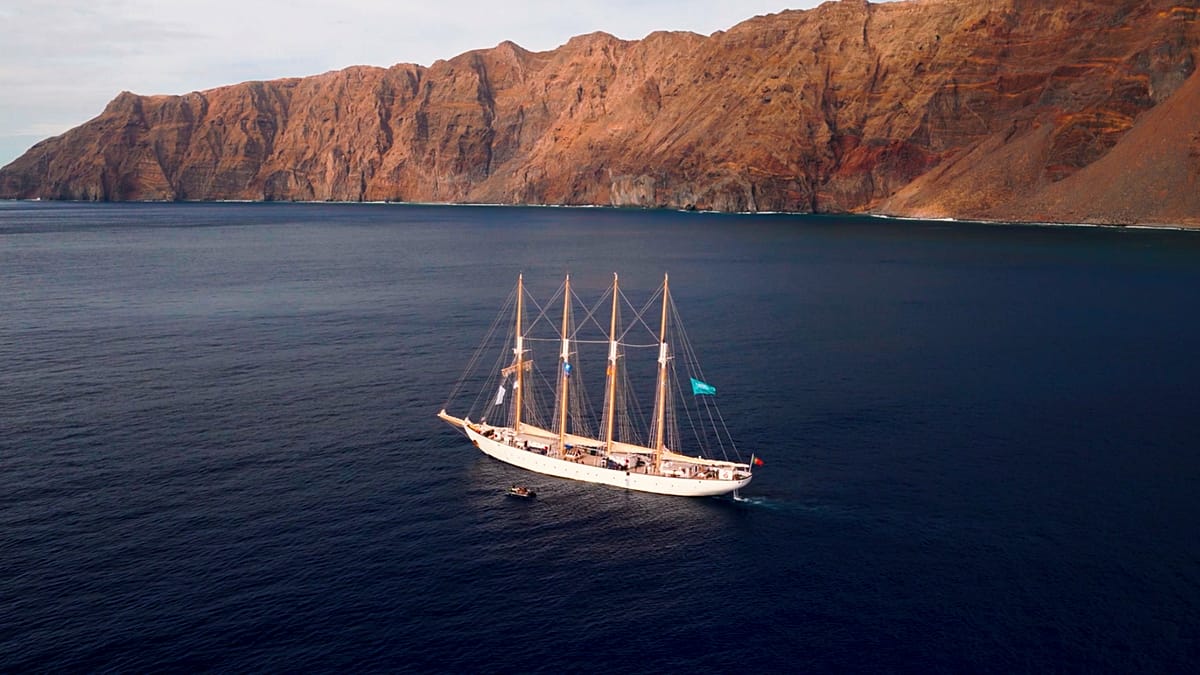
For decades, the waters around Madeira have been a known haven for migrating whales, seabirds, and turtles, as well as home to cold-water corals and one of the world's rarest seals. Yet much of this marine realm remained scientifically unexplored. The Madeira Ocean Expedition, which ran throughout October, aimed to change that by conducting the most comprehensive health check of the archipelago's seas to date.
The expedition brought together more than 200 specialists from the regional government, the Oceano Azul Foundation, National Geographic Pristine Seas, the regional research agency ARDITI, and the Oceanário de Lisboa. Working from the historic tall ship Santa Maria Manuela and a fleet of smaller vessels, the team conducted nearly 500 dives, deployed over 300 baited cameras, filtered seawater for environmental DNA, mapped shorelines with drones, and sampled microplastics across Madeira, Porto Santo, and the Desertas Islands.
Early signs that protection works
Initial results suggest that Madeira's marine protected areas are delivering tangible benefits. Limpets—grazing sea snails harvested as a local delicacy—were larger and more abundant inside protected zones, indicating that collection limits are effective. The largest groupers were also recorded in these areas. "The good news is that we have the science to show us that when we fully protect the ocean, the ocean responds," said Emanuel Gonçalves, chief scientist at the Oceano Azul Foundation.
The recovery of the Mediterranean monk seal offers another encouraging example. Hunted for centuries, the species had dwindled to just six to eight individuals around Madeira by the late 1980s. The designation of the Desertas Islands as a nature reserve in 1990, partly to protect the seal, has helped the population slowly increase. "It is a beacon of hope," Gonçalves noted, adding that the growth is slow because monk seals breed infrequently.
The expedition also achieved a first: satellite tagging a Blainville's beaked whale in the North-East Atlantic. Early tracking data show the animal favoring waters south of the Desertas, close to the fully protected area—a promising sign for the species' habitat use.
Concerning scarcity of sharks
However, one finding stands out for the wrong reason. Across the entire expedition, fewer than 10 sharks were recorded. The organizers describe this scarcity as concerning and consistent with broader worries about shark populations in the Atlantic. The low numbers highlight the need for continued monitoring and potentially expanded protections.
João Canning-Clode, director of the MARE-Madeira research centre, emphasized the importance of understanding before acting: "We cannot protect without understanding how the biodiversity functions and works." The expedition's findings will inform decisions on managing and expanding Madeira's marine protected areas, as the region works toward protecting 30% of its sea by 2030, with at least 10% fully protected.
Exploring the deep sea
Madeira is predominantly a deep-ocean territory, which presents unique challenges. "It's an ocean state, a deep ocean state," said Diva Amon, a marine scientist on the Oceano Azul Foundation's board. "And the deep sea is a very difficult place to study." Drift cameras developed by researchers in the Azores, lowered from a fishing boat, reached depths of 1,060 meters, revealing sponge fields and large black corals that may be several hundred years old—alongside lost fishing lines and a glass bottle.
Closer to the surface, the habitat-mapping team's highlight was a dense black coral garden off Porto Santo, nicknamed "Ariel's Garden" after the team's pink underwater robot. "Our torpedo is pink, so by majority vote it's called Ariel, after the little mermaid from the Disney film," said João Monteiro, a researcher at MARE-Madeira and the University of Madeira.
The expedition also fostered collaboration with local fishermen, who for the first time saw live images of the biodiversity they fish. "The fishermen could see for the first time live images of some of the biodiversity that they are actually fishing," Canning-Clode said. "On the other hand, the scientific community can see firsthand how difficult their life is."
A second expedition is planned for 2027 to explore the deepest waters. Amon hopes it will reveal "places that are as iconic as the Grand Canyon or the Okavango Delta." For Paul Rose, head of expeditions at National Geographic Pristine Seas, Madeira's location matters for public engagement: "People think about ocean protection, they think about the Pacific... It all seems a bit remote. But if they see huge, beautiful, functioning, proven marine protected areas in Europe, it's closer to home."
The expedition's results come as Europe grapples with broader environmental challenges, from data centre emissions to the need for protecting coastal tourism. Madeira's experience offers a model for how regional cooperation and scientific rigor can guide ocean stewardship.