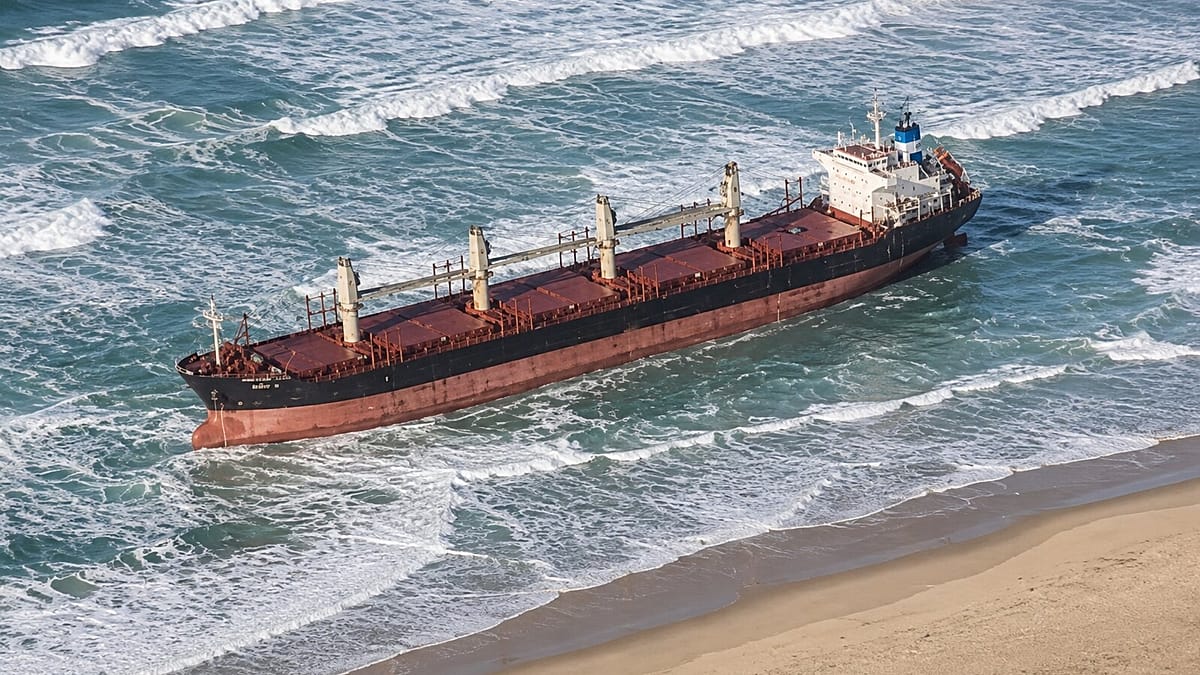
French maritime authorities are racing to stabilise a stranded cargo ship off the Atlantic coast, after the vessel ran aground in severe weather and threatened to spill its fuel into the sea. The Maltese-flagged MIRO G, a 169-metre freighter, ran onto a sandbank near Cap de l'Homy in the Landes department, close to the village of Lit-et-Mixe, shortly before 1am on Friday.
The ship had been battling wind gusts of around 90km/h when it lost control and drifted towards the shore. Despite dropping anchor in an attempt to hold position, the vessel was pushed onto the bank, where it has remained stuck ever since.
All 30 people who had been on board are now safe. Nineteen crew members were rescued shortly after the grounding, while the remaining eleven – including the captain, two other crew members, and several salvage experts and company representatives – were airlifted to safety by helicopter on Saturday as conditions deteriorated. No injuries have been reported.
Fuel on board raises pollution concerns
The MIRO G was not carrying any cargo, but its fuel tanks hold more than 100 tonnes of heavy oil, raising fears of an environmental disaster if the hull is breached. Aerial surveillance by the French Navy has so far detected no signs of pollution in the surrounding waters, but the risk remains as long as the vessel is stranded.
Salvage teams have been assessing the best way to refloat the ship, but the operation has been complicated by technical failures and the continuing rough weather. The ship's two main generators, which are needed to power the pumps that would remove water from the ballast tanks, have both failed. Engineers are working to restore an alternative electricity supply so that the tanks can be emptied, making the vessel lighter and easier to pull free.
In the meantime, the ballast tanks have been deliberately filled with seawater to increase the ship's stability and prevent it from capsizing or shifting further towards the beach. This is a delicate balancing act: the added weight helps keep the vessel upright, but it also makes it harder to refloat.
The French salvage tug Abeille Bretagne has arrived on the scene, carrying a 1,000-metre towline. However, the shallow waters around the sandbank mean the tug cannot approach closer than about 900 metres, making the towing operation particularly challenging.
Officials have warned that the operation could take several days or longer, depending on the weather. Strong winds and rough seas are forecast to continue, and the maritime authorities said they would take advantage of the first suitable weather window, but stressed that there was no guarantee the refloating would succeed.
Access to the beach at Cap de l'Homy has been restricted while the emergency response continues, and local authorities have urged the public to stay away from the area.
The incident is a reminder of the risks that shipping poses to Europe's coastlines, even in relatively benign conditions. The MIRO G is not the first vessel to run into trouble in these waters, and the salvage operation will be watched closely by environmental groups and local residents alike.