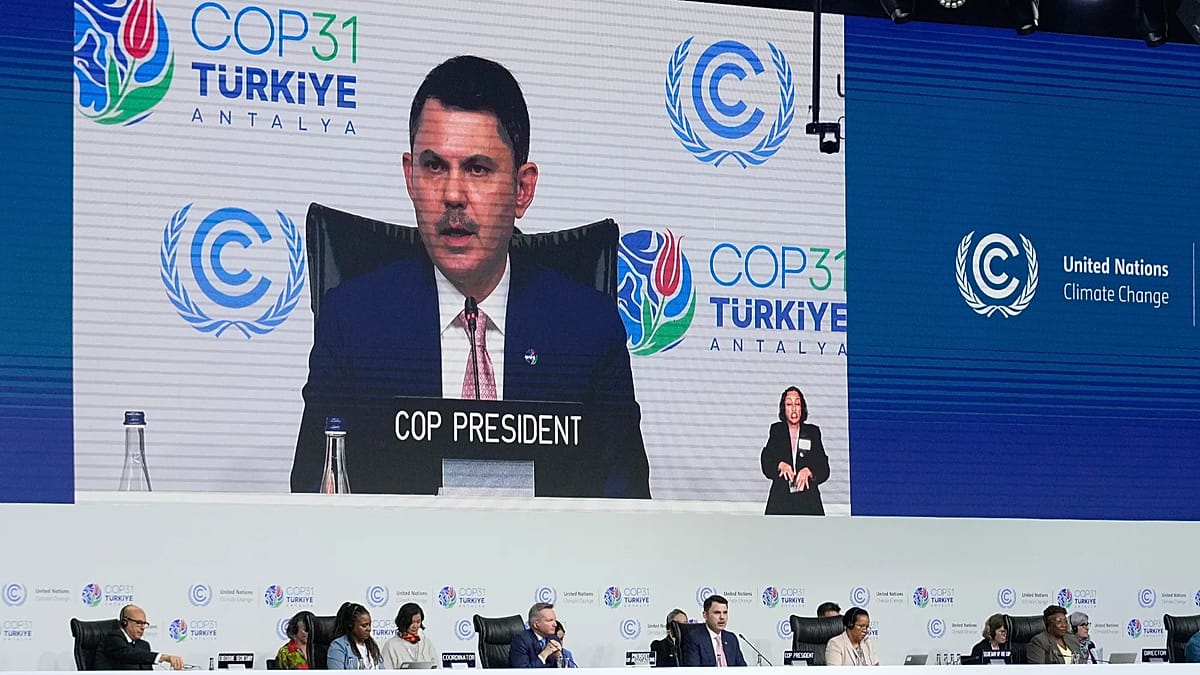
The COP31 climate summit in Antalya, Turkey, has stretched into Saturday as negotiators from nearly 200 countries struggle to bridge deep divisions over fossil fuels and climate finance. A revised draft text released on Thursday stripped out all mentions of phasing out fossil fuels, prompting an immediate backlash from European capitals and island nations.
“We are close to the finish line, but we are not there yet,” COP31 President and Turkish Environment Minister Murat Kurum told delegates late on Friday. A new agreement is expected to be published on Saturday, though officials admit the path remains uncertain.
EU warns of a ‘fossil summit’
The European Union reacted sharply to the revised draft, with a spokesperson warning that it risked “turning this climate COP into a fossil summit.” The original text, unveiled earlier in the week, had called for an accelerated phaseout of coal, oil and gas. Its removal has forced negotiators back to the table.
France and Panama were among the countries that circulated a letter on Friday insisting that any final deal must include “a clear transition away from fossil fuels.” Panama’s environment minister, Juan Carlos Navarro, went further, accusing a “petroleum mafia” of blocking progress and threatening to walk away from the talks.
Australian Climate Minister Chris Bowen, who is leading the negotiations, said he would work “for as long as it takes, to get the job done.” His comments reflect the growing frustration among many delegations that a handful of oil-producing nations are stalling a consensus.
The standoff echoes the tensions seen at previous COPs, where fossil fuel language has become the central battleground. For the EU, which has pushed for ambitious climate action, the removal of such language is a red line. The bloc’s negotiators are now working behind the scenes to restore stronger wording, but they face resistance from OPEC members and Russia.
OPEC’s Secretary General Haitham al-Ghais met with Russian climate envoy Ruslan Edelgeriev on the sidelines of COP31, according to a post on X. The two discussed “the importance of inclusive and balanced approaches across all multilateral environmental fora” and enhancing cooperation between OPEC and Russia to advance international climate action. Critics see this as an attempt to dilute the summit’s ambition.
The outcome of these talks will have significant implications for Europe’s climate diplomacy. A weak deal would undermine the EU’s credibility as a leader on climate action, especially as it prepares to host the next round of negotiations. The bloc has also been navigating other foreign policy challenges, including uneasy parallels drawn at APEC and security talks in Berlin.
As the clock ticks past the original deadline, the mood in Antalya is a mix of exhaustion and determination. Delegates from small island states and European climate advocates are pressing for a strong outcome, while oil producers remain adamant that any transition must be “inclusive” and “balanced.”
The final text, when it emerges, will be a test of whether the world can still agree on the most contentious issue in climate politics. For Europe, the stakes are high: a failure to secure a clear commitment to move away from fossil fuels would be a setback not just for the planet, but for the continent’s role as a global standard-setter.