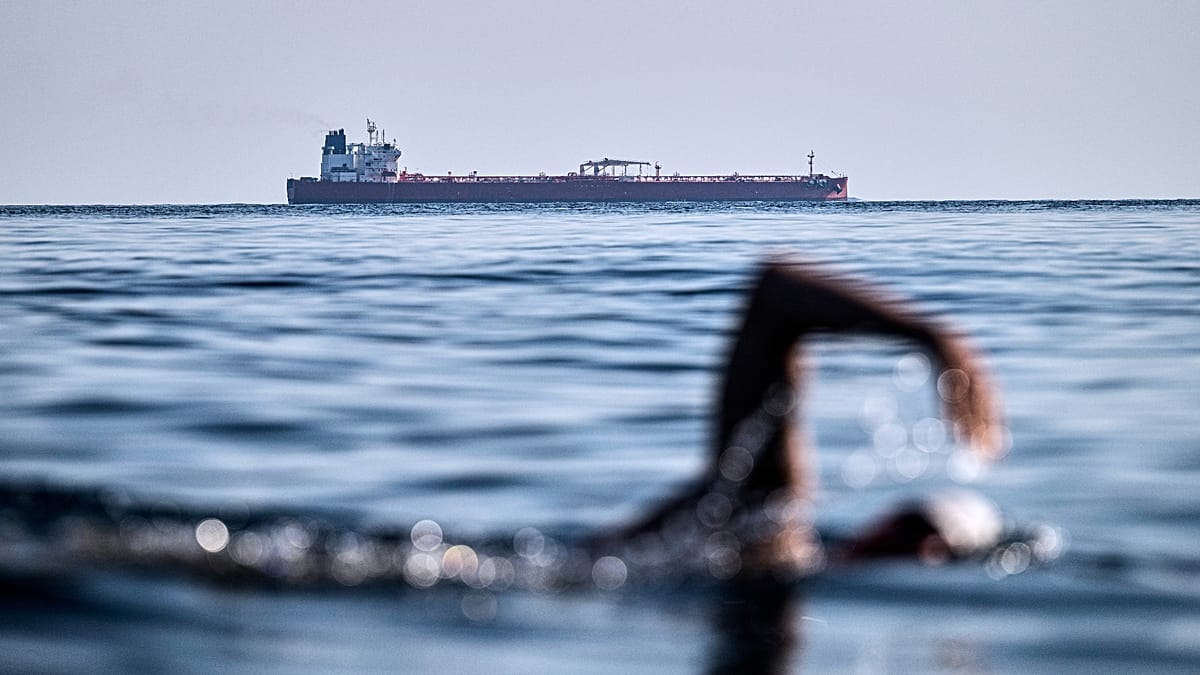
In a striking act of protest, British endurance swimmer Lewis Pugh has completed a 15-kilometre swim through the Strait of Hormuz, a waterway now transformed into a war zone. Over three days in November 2026, Pugh navigated waters where explosions echoed and tankers burned nearby, his mission to draw global attention to the environmental devastation wrought by the ongoing conflict with Iran.
Pugh, known for his extreme swims in the world's most fragile ecosystems, described the experience as surreal and harrowing. "I've swum in the Arctic and the Antarctic, but nothing prepared me for this," he said in a statement. "The water was thick with oil, and the sky was lit by fires. It's a nightmare that we are allowing to happen."
A swim against the tide of war
The Strait of Hormuz, a narrow passage between the Persian Gulf and the Gulf of Oman, is one of the world's most critical oil chokepoints. Recent hostilities have turned it into a battlefield, with US strikes on Iranian islands and exchanges of heavy fire following mine attacks on shipping. The environmental toll is mounting: oil spills, burning tankers, and the release of toxic fumes are poisoning marine life and coastal communities.
Pugh's swim was not a stunt but a deliberate act of witness. He chose the route to mirror the path of oil tankers, hoping to make the invisible visible. "We talk about the human cost of war, but the planet is also a victim," he said. "This swim is a plea to see the bigger picture."
The swimmer, who has previously campaigned for marine protected areas, was accompanied by a support boat and a team of divers. He wore a wetsuit, but the water temperature and pollution levels posed serious risks. "Every stroke felt heavy," Pugh admitted. "But I kept going because I knew that stopping would mean giving up on the message."
Environmental experts have warned that the conflict could cause long-term damage to the region's biodiversity. The Strait of Hormuz is home to coral reefs, dolphins, and migratory birds, all of which are now under threat. "The oil spills alone could take decades to clean up," said Dr. Elena Rossi, a marine biologist at the University of Genoa. "The impact on local fisheries and the livelihoods of people in Iran, Oman, and the UAE will be profound."
Pugh's swim comes at a time when Europe is increasingly concerned about the security of energy supplies and the environmental consequences of conflict. The European Union has called for a ceasefire and for the protection of civilian infrastructure, including the natural environment. "This is not just a regional crisis," said a spokesperson for the European External Action Service. "The environmental damage in the Strait of Hormuz affects us all."
The swimmer's feat has drawn comparisons to his previous expeditions, such as his crossing of the Arctic Ocean in 2007 and his swim in the Antarctic in 2015. But Pugh insists that this was different. "In the polar regions, I was swimming to protect pristine places," he said. "Here, I was swimming through a disaster that we are actively creating. It's a different kind of urgency."
Pugh's team documented the swim with video and photographs, which they plan to use in a campaign to pressure governments to address the environmental costs of war. "We need to hold those responsible to account," he said. "The ocean is not a weapon, and it should not be a casualty."
The swim has also sparked discussions about the role of athletes in political and environmental activism. "Lewis Pugh is using his platform in a way that few others would dare," said sports journalist Mark Thompson. "It's a reminder that sport can be a force for more than entertainment."
As the conflict in the Strait of Hormuz continues, Pugh's message is likely to resonate beyond the region. His swim is a stark reminder that war has consequences that extend far beyond the battlefield, and that the environment is often the silent victim. "I hope that people will look at these images and ask themselves: is this the world we want to leave behind?" Pugh said.
For now, the swimmer is recovering and planning his next move. But he has made it clear that this will not be his last act of protest. "The ocean has given me so much," he said. "I will keep fighting for it, no matter what."