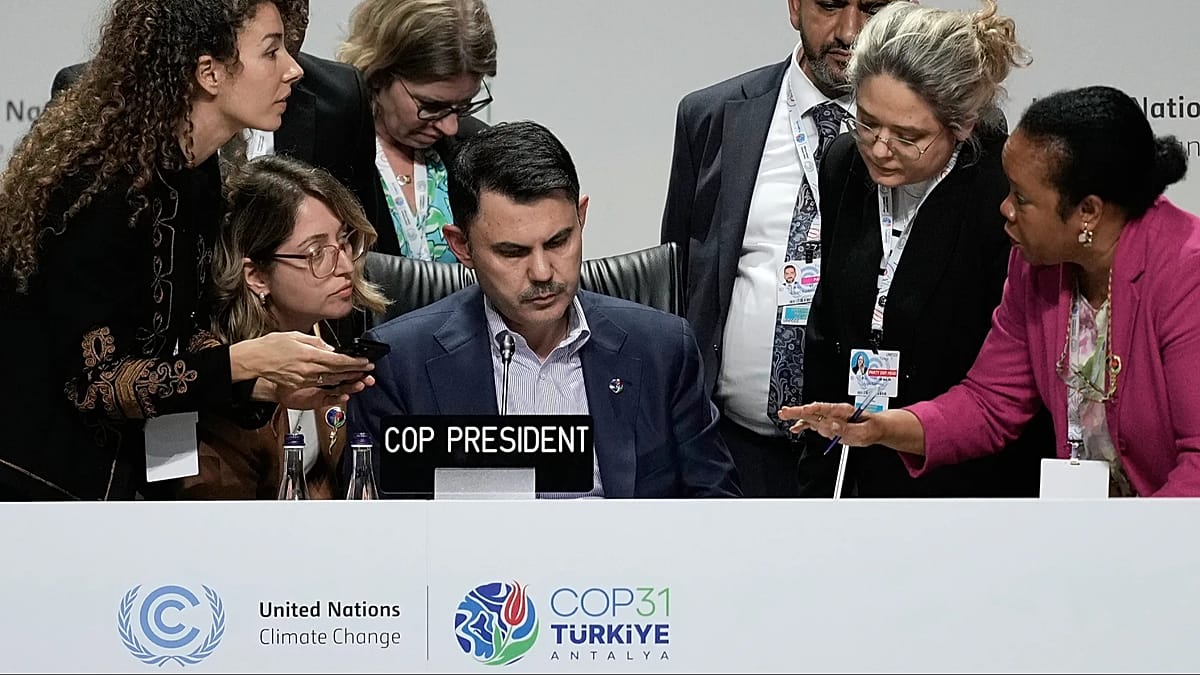
Negotiators at the COP31 climate summit in Antalya, Turkey, were handed a fresh draft agreement early on Sunday, but the text has done little to bridge the deep divisions that have pushed the talks into overtime. The latest proposal retains a widely supported goal of electrifying the global economy, yet it conspicuously avoids any direct mention of fossil fuels — the very issue that has become the main sticking point.
The draft, which requires consensus from nearly 200 countries, was released as delegates prepared for a closing plenary later in the day. But early reactions from European officials were blunt. One EU official told AFP that the text represented a "backwards" step and warned of a "very real possibility" that the summit could end without a deal. "I am more pessimistic today than I was yesterday," the official said.
A German official echoed that gloom, saying: "The situation is difficult, and the outcome is uncertain. The oil-producing countries are putting up a fierce fight."
Fossil fuels remain the flashpoint
The battle over how to address fossil fuels has defined this year's talks, set against a backdrop of soaring energy prices and heightened geopolitical tensions linked to the Iran war. An earlier draft released earlier in the week had called for an accelerated phase-out of fossil fuels, but a revised version on Thursday stripped out all references to them, forcing negotiators back to the table.
A coalition of countries, including France and Panama, issued a letter on Friday insisting that any final deal must include "a clear transition away from fossil fuels." The latest draft acknowledges a previous global commitment to move away from fossil fuels but stops short of naming them explicitly — a compromise that has satisfied neither side.
The text also retains a contentious push to expand carbon capture and storage, a technology championed by the fossil fuel industry but dismissed by critics as expensive and largely ineffective at cutting emissions. Environmental groups and several developing nations argue that relying on such unproven methods would let polluters off the hook.
Michael Joseph, the environment minister of Antigua and Barbuda, expressed deep disappointment with the draft. "I can't honestly say that I'm okay with it passing," he told AFP, adding that the text was "quite silent" on fossil fuels.
The standoff has already forced the summit into overtime, with negotiations spilling past their scheduled close. The outcome remains uncertain, and the possibility of a collapse looms large.
For Europe, the stakes are high. The EU has positioned itself as a leader in climate diplomacy, and a failure in Antalya would be a significant setback. Yet the bloc is also navigating internal tensions over energy security and the pace of the green transition, as member states grapple with the economic fallout of the energy crisis.
Some observers point to signs of progress on other fronts, such as renewable energy targets and adaptation funding, even as the fossil fuel impasse dominates headlines. But those gains could be overshadowed if the summit ends in deadlock.
As the clock ticks down, all eyes are on the Turkish presidency and the major oil-producing nations. Whether a last-minute compromise can be forged remains unclear, but the mood in Antalya is increasingly grim. "We are very far from a deal," one European negotiator said on condition of anonymity. "The next few hours will be critical."