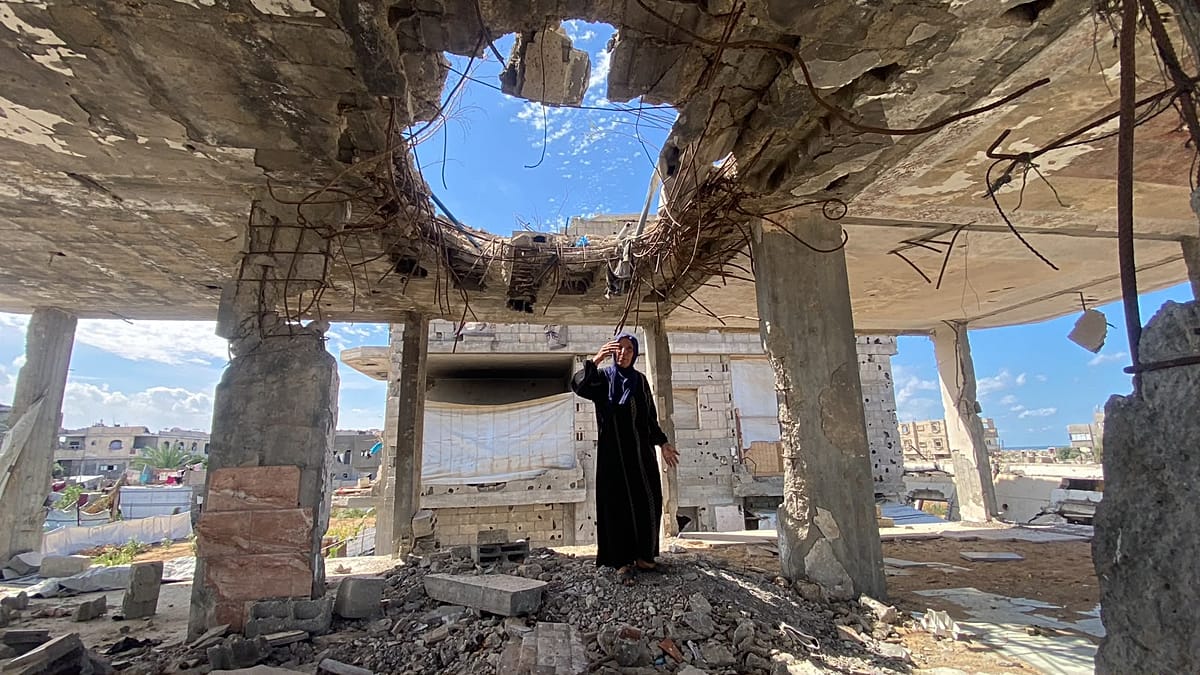
When the rain begins, Abdullah Siyam moves his family's bedding to the only corner of his house in Al-Mughraqa, central Gaza, where the roof does not leak. Bombardment that struck neighbouring homes left cracks in the ceiling, and there is no alternative. “We move our mattresses there and sleep. That is the solution,” he told European Pulse.
More than 4,000 damaged buildings across Gaza need full or partial demolition, including over 2,300 that are still inhabited by nearly 44,000 people, according to preliminary estimates in this month's report by the UN Office for the Coordination of Humanitarian Affairs (OCHA). As the fourth winter since the war began approaches, families are bracing for the rainy season in fragile structures and worn-out tents.
Living with leaks and rising costs
Siyam's neighbour, Mariam Abu Hazein, spends rainy days pushing water out of her home before her blankets soak through. She borrowed three blankets from her daughter after her own became waterlogged, then returned them once they dried. “Water falls in the rooms and the bathroom. We have placed containers on the floor to collect it and use a floor wiper to push it outside. It is as if we were in the street,” she said.
Mohammed Bardawil, from the same area, said he fears facing the upcoming winter with worn-out tarpaulins that he cannot afford to replace. “Honestly, we really do not want winter to come,” he told European Pulse, adding that wind and rain create hardship “whether we are in houses or in tents.”
At the Deir al-Balah market, tarpaulin prices have risen from 120 to 180 shekels (€35 to €53), with larger sizes around 230 shekels (€68). A dome tent now costs 1,700 shekels (€502), up from 1,300 shekels (€384). Ahmed al-Siqali, displaced from Khan Younis, said equipping and reinforcing his tent cost him around 1,200 shekels (€355), covering timber for beams and two tarpaulins, a sum he raised with his brother's help from outside the strip.
According to a June assessment cited by the Norwegian Refugee Council, 71% of families surveyed in damaged buildings said they could not afford repair materials. The 2023-2025 Israel-Hamas war, which has killed more than 70,000 Palestinians—mostly women and children—has left large parts of the territory in ruins and triggered one of the worst humanitarian crises in the region's recent history, with aid agencies warning of famine conditions and a near-total collapse of the health infrastructure.
Risk of collapse
The danger in some structures goes beyond leaks. On 16 September, the Al-Saada residential building in Gaza City collapsed, killing 21 Palestinians, including 12 children and five women. Gaza civil defence said residents had received prior warnings but stayed because no alternative shelter was available, and that structural damage from the last war caused the collapse.
Civil defence spokesman Mahmoud Basal warned on 17 September that damaged towers collapsing in crowded areas could threaten both residents and people in surrounding tents. He said the service received around 150 distress calls from people in dangerous buildings within 24 hours. Gaza's Government Media Office announced a plan on 20 September to evacuate and demolish around 255 buildings at risk of collapse and provide temporary shelter for affected families, but noted shortages of heavy machinery, funding and safe land, and said some families had not left despite warnings.
UN humanitarian coordinator Ramiz Alakbarov called for the urgent delivery of rescue equipment, machinery, fuel, tents and tarpaulins to the most vulnerable groups within four weeks after the Al-Saada collapse.
Aid blocked at the border
The response faces a supply blockage. The Norwegian Refugee Council said Israeli authorities approved 36,960 pieces of timber and 660 emergency shelter kits in August, then blocked their entry on 26 August and 2 September and later rejected a renewed UN coordination request. Israel's Coordinator of Government Activities in the Territories (COGAT) told international media in September it would not allow heavy equipment or reconstruction materials to enter before Hamas was disarmed, accusing it of exploiting aid, a charge the group denies.
As of 18 September, the UN Shelter Cluster had received only 26% of its required funding, amounting to $193.7 million. A UN report in late September counted around 17,000 tents, tarpaulins and shelter kits across organisations' stocks and ongoing purchases, expected to support around 50,000 families—supplies at various stages of readiness rather than items waiting at crossings.
With winter approaching, the situation remains dire. As Ukraine's frontline cities fight to survive another winter, Gaza's families face a similar struggle with no end in sight. The international community's response, as seen in EU efforts to secure winter gas supplies, contrasts sharply with the lack of urgent action for Gaza's shelter crisis.