The waters around the Strait of Hormuz are again the focus of a tense military standoff. The Institute for the Study of War (ISW) reported on Thursday that Iran had targeted at least 24 commercial vessels in the area over a two-week period, while two US aircraft carriers operate in the Arabian Sea and officials on both sides warn that large-scale hostilities could resume.
Britain's Maritime Trade Operations (UKMTO), the Royal Navy unit that monitors merchant shipping safety, logged at least seven further incidents between Monday and Wednesday. The attacks demonstrate that Tehran retains the ability to strike shipping despite US air raids on its military infrastructure, the Washington-based think tank said. A US military official told ISW that Iranian naval forces have adapted by using small boats and spotters to identify vessels after their radar systems suffered significant damage.
Tehran's warnings
In Tehran, senior commanders have issued increasingly blunt statements. Major General Mostafa Izadi, deputy commander of the Islamic Revolutionary Guard Corps (IRGC), said on Thursday that Iran "is advancing with strength and is ready to carry out the most powerful operations." Guards spokesman Hossein Mohibi said a new war against Iran "would be irrational for the United States" but that "the possibility of such a conflict absolutely exists."
Iranian army commander-in-chief Amir Hatami said the armed forces were ready for "any battle" and warned that any attack on Iranian infrastructure would bring proportional strikes on Israeli and allied targets. Mohsen Rezaei, secretary of the Supreme National Security Council, told Press TV on Sunday that US targets including data centres and AI infrastructure would be "within range" if hostilities resumed, and described Washington's latest diplomatic response as insufficient.
US naval build-up
The US Naval Institute confirmed on Tuesday that the aircraft carriers George Washington and George HW Bush are operating in the Arabian Sea. The Bush returned after a port visit to Thailand's Phuket; the Washington had previously relieved the carrier Abraham Lincoln. Their simultaneous presence is notable, though it does not by itself signal an imminent operation given the regular cycle of carrier rotations.
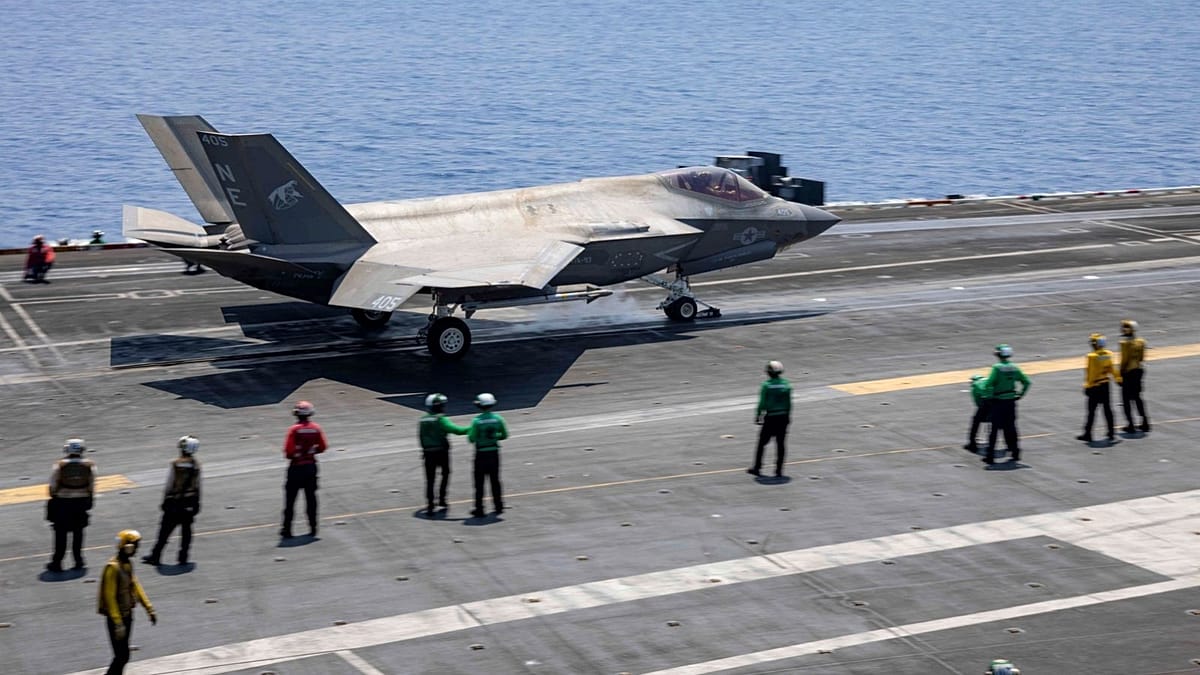
US Central Command (CENTCOM) has released images of an F-15E being refuelled mid-air by a KC-135 over the Middle East, flight operations from the George Washington, and an F-35B taking off from the amphibious assault ship Boxer. CENTCOM also said US forces had altered the routes of 130 commercial vessels under the naval blockade of Iran as of 5 October. That figure comes solely from the US military and has not been independently verified.
President Donald Trump said in an interview earlier this month that intensifying air strikes against Iran after the US midterm elections on 3 November was possible, although he declined to detail any military plans. Asked about reports that his administration was considering renewed use of the GBU-43/B — the Massive Ordnance Air Blast bomb, known as the "mother of all bombs" — Trump did not dismiss the idea, saying it "is not nuclear; it is simply a very large bomb." He also said future nuclear disarmament talks with Iran involving Russia and China were a possibility.
Logistics and troop movements
Specialist flight-tracking account IntelSky reported on Wednesday that US Air Force tanker sorties over the region in the first 14 days of October were running at roughly 50% above the daily rate recorded in September. The account reported a similar increase in transport aircraft activity. IntelSky's figures have not been independently verified, as publicly available tracking systems do not capture all military aviation, and changes in radar coverage can affect such comparisons.
On 1 October, reports claimed that the US military was sending around 9,000 troops and sailors to the region with the USS Theodore Roosevelt carrier strike group and the amphibious ready group centred on the Makin Island. A US official told AP on condition of anonymity that the deployment could bring the total number of American sailors and Marines in the region above 20,000. As of Wednesday, the Theodore Roosevelt had not yet reached the Arabian Sea, according to the Naval Institute.
Israel's Channel 12 reported on Thursday, citing security sources, that Western countries had detected new and unusual military movements inside Iran, but that current events did not necessarily require immediate military action.
The situation has direct implications for European energy security and maritime trade. The Strait of Hormuz is a chokepoint for oil and gas shipments to Europe, and any disruption would be felt in Brussels, Berlin, and Paris. The recent tanker blaze near Hormuz underscores the risks. European navies, including the French Navy, have been active in the region, with interceptions of shadow fleet tankers in the Indian Ocean. The IRGC's expansion of attacks beyond Hormuz is a worrying trend that could draw European forces into a wider conflict. As the US and Iran trade threats, the European Union has called for restraint, but with no clear diplomatic channel open, the risk of miscalculation remains high.