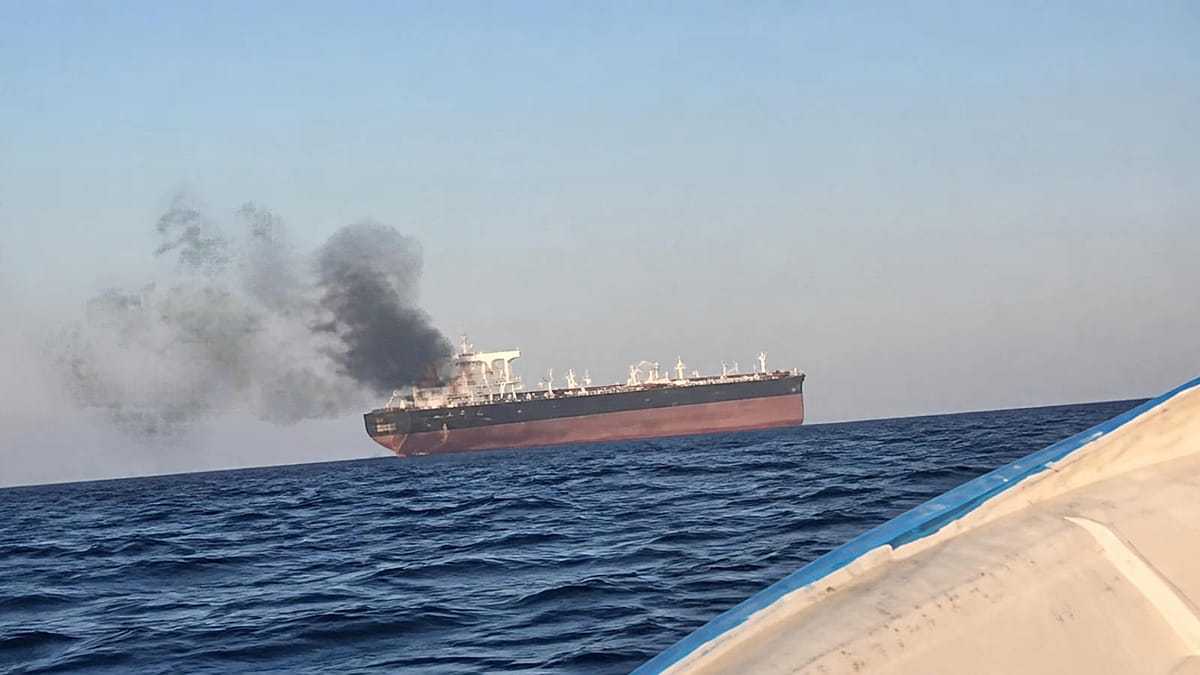
An oil tanker caught fire in the Gulf of Oman on Thursday after entering what Iran's navy described as a prohibited zone with its tracking systems disabled, according to Iranian state-run media. The incident marks the second such event in the area within 24 hours and adds to mounting tensions in one of the world's most critical shipping lanes.
Iran's navy said monitoring teams patrolling the eastern sector of the Strait of Hormuz detected the tanker ablaze in the restricted area, as reported by the Mehr news agency. The name, flag, and condition of the crew were not immediately known, nor was the cause of the fire.
On Wednesday, Iranian domestic media reported a fire on another tanker near the strait after it also switched off its tracking equipment. That incident followed the sinking of two commercial vessels in the same waters in recent days.
Two ships sunk, one crew member killed
The container ship GFS Pride sank on Wednesday after catching fire. All 21 crew members were rescued. Iran's Islamic Revolutionary Guard Corps (IRGC) said the vessel struck a sea mine, while maritime sources cited an unidentified projectile. The cargo ship Cape Dao, which had previously been struck by a projectile, also sank, with one crew member killed in the initial attack.
Videos circulating on social media appeared to show cargo including mobile phones and luxury goods floating in the water near the Strait of Hormuz, with people in small boats collecting items. Multiple international media outlets published the footage, as well as separate footage of containers and debris in waters reportedly near the strait. Euronews could not independently verify its veracity.
US Central Command (CENTCOM), which oversees US military operations in the region, had not commented on Thursday's incident as of publication.
Iran's expanded ban in place
Iran's IRGC declared the waters leading to the Strait of Hormuz a prohibited zone in September, following remarks by Mohsen Rezaei, secretary of the Supreme National Security Council. IRGC spokesman Hossein Mohbi said the zone covered part of the Gulf of Oman and part of the Arabian Sea along the approach to the strait.
Ali Azmayi, commander of the IRGC naval force, said Tehran exercises "smart control" over the strait and that all vessels seeking to transit the route must obtain permission, in response to US statements that the waterway remains open and under Washington's control. Tehran has said vessels violating the rules in the area face penalties. Iran declared the Strait of Hormuz closed in late February at the start of the war with the US, which Washington followed up with its own naval blockade of the key waterway.
The escalating incidents have raised concerns among European shipping and energy firms, which rely heavily on the strait for oil and gas supplies. The reported attacks have already stoked supply fears, pushing oil prices higher. European navies, including the French and British, have increased patrols in the region, and the French Navy recently intercepted a shadow fleet tanker in the Indian Ocean, highlighting the broader security challenges facing maritime trade.
Analysts note that the situation near Hormuz is part of a wider pattern of hybrid threats to European interests. As NATO warns of escalating hybrid attacks across Europe, the incidents in the Gulf underscore the vulnerability of global supply chains and the need for coordinated responses.