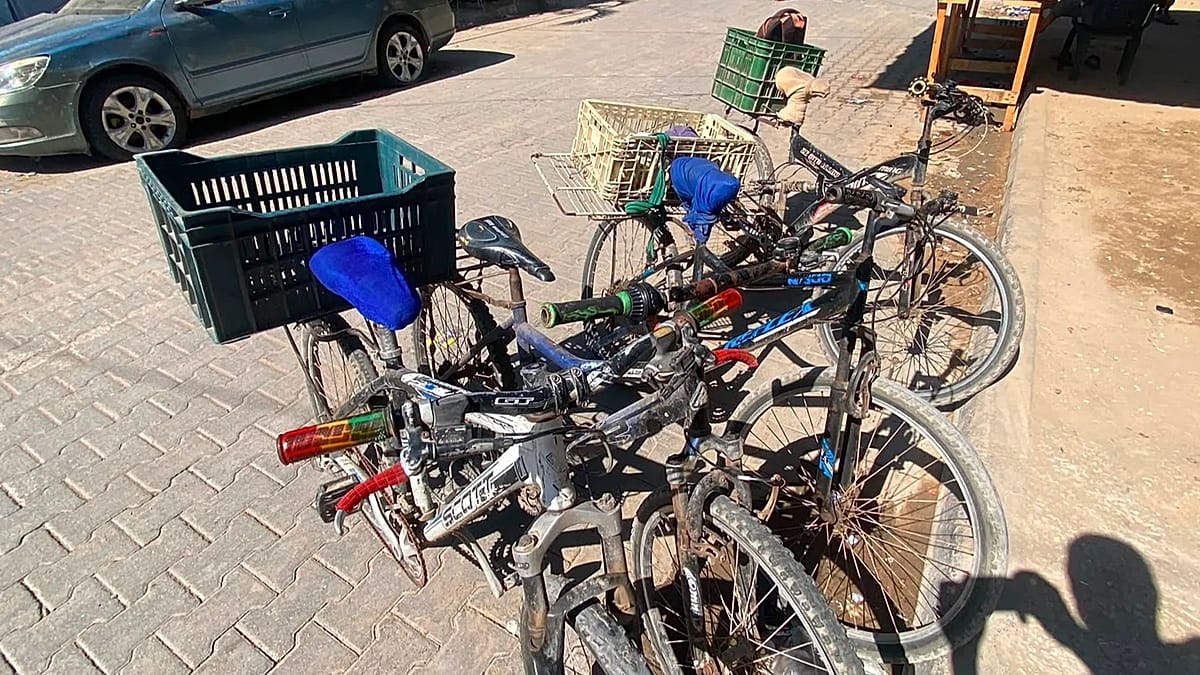
In the Maghazi neighbourhood of central Gaza, Mohammed Abu Amra pedals his bicycle through rubble-strewn streets, delivering parcels and shop orders for the local company Barq. What once took him under ten minutes by motorbike now takes half an hour or more, as heat, rain, and the ruined road network turn every trip into an ordeal.
Abu Amra is one of hundreds of couriers across the Strip who have switched to bicycles—known locally as “baskleet”—after fuel shortages and the destruction of 74% of Gaza's road network made motorised delivery impossible. A joint assessment published in April 2026 by the World Bank, the European Union and the United Nations estimated that around 4,500 kilometres of roads have been destroyed, with another 13% partially damaged. The total damage to the transport sector is put at approximately $3.21 billion (€2.97 billion), with losses of $1.18 billion (€1.09 billion).
Pittance pay, punishing costs
Abbas Al-Souri, another courier, says he earns between 50 and 60 shekels (€12 to €14) a day, depending on the number of orders. But a single puncture repair costs 30 to 40 shekels (€7 to €10). “If I earn 50 shekels and pay 40 to fix a tyre, I'm left with 10 shekels—about €2,” he explains. Larger repairs, such as fixing wheels, hubs or pedals, can run from 200 to 500 shekels (€48 to €120). Spare parts are scarce, so workers cannibalise broken bikes to keep others running. “From broken bikes to other bikes—it's patchwork on top of patchwork,” Al-Souri says.
Tareq Abu Zekri, who founded Barq during the second ceasefire in January 2025, says the company now employs more than 50 riders across three branches in Gaza City, central Gaza and Khan Younis. When he advertised for couriers, 109 applications arrived within a day and a half, many from university graduates with few other options in the Strip's shattered labour market. Orders are transferred between areas by whatever means are available before local riders complete the final leg.
Bicycle delivery is not new to Gaza—a pilot scheme began in Rafah in March 2021—but since October 2023 it has become the norm. Barq tried to introduce electric bicycles to ease the physical strain, but the experiment stalled because charging costs around 30 shekels (€7) per cycle, roughly half a day's earnings.
Deadly risks on every route
The danger is ever-present. On 29 August, Raed Adel Mohammed Alyan, a courier for the Hamama delivery company, was killed alongside Abdel Fattah Abu Al-Eesh when a strike hit an electric bike in the Tel al-Hawa neighbourhood of south-west Gaza City, according to local reports. Three others were wounded, one critically. Jamil Al-Yazji, Hamama's director, says that between 40 and 50 of his bicycle couriers have been killed during the Israel-Hamas war, yet around 400 continue to work. Abu Zekri also reports that some of his riders were wounded in a strike in Khan Younis, and others narrowly escaped shelling near them in the Al-Jalaa area of Gaza City.
Despite the losses, both companies keep hiring. For Abu Zekri, the project is partly about providing income when other options have vanished. What his workers need to keep going, he says, is straightforward: passable roads, repairable bikes and available parts. Until then, they will keep pedalling through the rubble, earning a pittance and risking their lives to deliver goods to a population in desperate need.