The Gdańsk Shipyard, where Lech Wałęsa led the strikes that helped topple communism in Poland, is once again at a crossroads. This time, the transformation is not political but commercial: private developers are moving in to build housing and office space on the vast post-industrial grounds. In the midst of this change, a small art collective is fighting to keep the memory of the shipyard's heroic past alive.
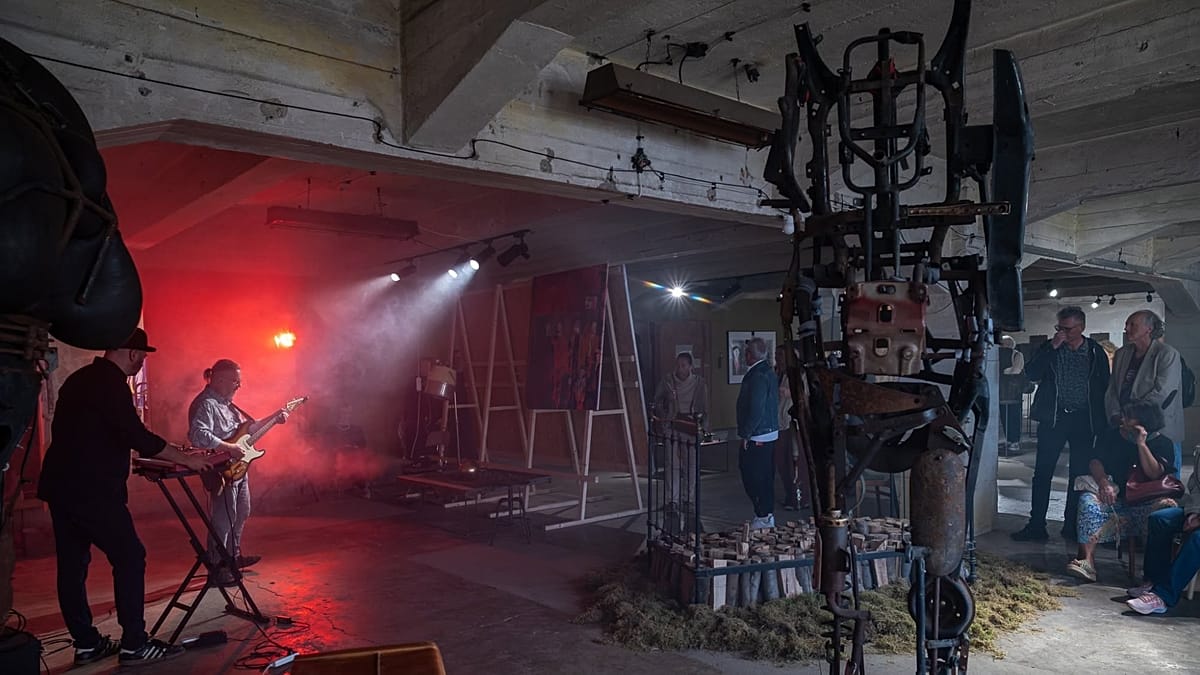
WL4, an independent art space founded by artist Adriana Majdzińska and her husband, sculptor Czesław Podleśny, occupies a workshop within the shipyard's sprawling complex. Majdzińska, a professor at the Gdańsk Academy of Fine Arts, and Podleśny, who creates human-shaped sculptures from rusting ship parts, have turned the space into a hub for creative expression. Their goal is to ensure that the shipyard's cultural and historical significance is not erased by the cranes and concrete of modern redevelopment.
"WL4 is a group of independent artists not affiliated with any institution, for whom art is the paramount value," reads a statement on the collective's website. "Our circle includes both established artists and those just beginning their creative journey, working across different fields of art. Our diversity is our strength."
Since its founding, WL4 has hosted exhibitions, symposiums, workshops, concerts, and performances. Among its most notable guests was Lech Wałęsa himself, the Nobel Peace Prize laureate and former Polish president, whose presence underscored the site's deep connection to the Solidarity movement and the fall of the Iron Curtain.
A new threat: redevelopment
But the collective's future is now in jeopardy. Polish developer Develia has signed an agreement to purchase the plot where WL4 is based, with plans to build 3,000 apartments. The artists fear they will eventually be forced to leave, losing not only their workspace but also a piece of living history.
"Of course, we hope and expect that the new owner, a major Polish development company, will be favorable toward culture and art," Majdzińska told Euronews. "But that might not happen, and in that case, we'll have to leave this place."
The stakes extend beyond the artists themselves. Piotr Grzelak, Gdańsk's deputy mayor, argues that WL4 is essential to the character of the area. "I can't imagine shaping this part of the city without preserving its heritage and spirit of solidarity, or the shipyard as a whole - it's also a competitive advantage for an investor," he said. "WL4 is a gallery that's exceptionally important for how this part of the city functions."
Develia's PR agency has said it is too early to comment on the future use of individual buildings, but assured that the company will work with local authorities in a way that respects the area's character and history. Grzelak, however, stresses that dialogue must be part of the solution, just as it was during Poland's transition to democracy.
The situation in Gdańsk echoes broader tensions across Europe, where historic industrial sites are often caught between preservation and progress. In cities like Berlin, Rotterdam, and Manchester, similar battles have played out, with varying outcomes. For now, the artists at WL4 remain hopeful, but their fate hangs in the balance.
As the shipyard prepares for its next chapter, the question is whether the spirit of Solidarity - which once united workers and intellectuals - can also unite developers and artists in a shared vision for the future. The answer may determine not only the fate of WL4 but also the soul of a city that helped change the course of European history.