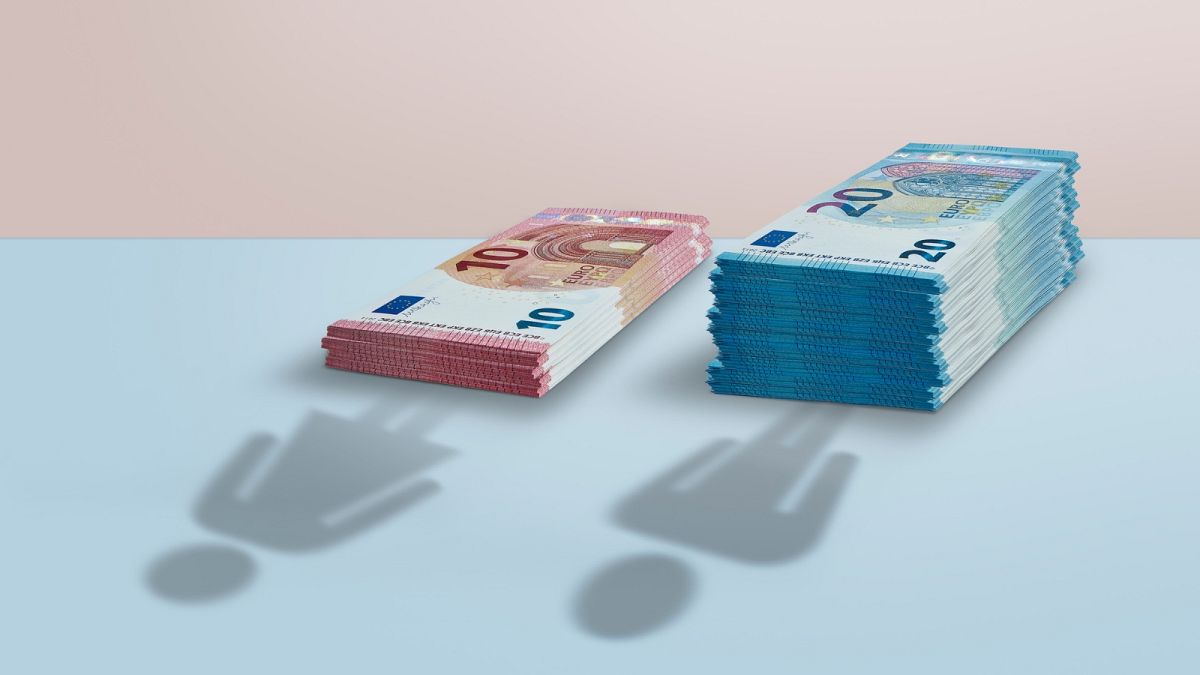
Despite decades of policy efforts, the gender pay gap remains a stubborn feature of European labour markets. In 2022, women across the European Union earned on average 12.7 percent less per hour than men, according to Eurostat. That means for every €100 a man earns, a woman takes home just €87.30 — and would need to work an extra 1.5 months to close the difference.
The unadjusted gender pay gap, which measures average gross hourly earnings without accounting for education, age, hours worked or job type, varies dramatically across the continent. Estonia recorded the widest gap at 21.3 percent, followed by Austria (18.4 percent), Switzerland and Czechia (both 17.9 percent). Among the EU’s largest economies, Germany (17.7 percent) and France (13.9 percent) both exceeded the bloc’s average.
Only one country — Luxembourg — posted a negative gap of -0.7 percent, meaning women there earn slightly more than men. Italy, Romania and Belgium also performed well, with gaps below five percent.
Slow progress and regional reversals
Between 2012 and 2022, the EU’s gender pay gap fell by 3.7 percentage points, from 16.4 to 12.7 percent. That pace, however, masks significant national variation. Spain recorded the steepest decline — a 10-point drop — followed by Estonia (8.6 points), Iceland (8.4 points) and Luxembourg (7.6 points). Germany and the United Kingdom also saw notable improvements of 5 and 4.7 points respectively.
Yet in six countries — Slovenia, Latvia, Poland, Malta, Switzerland and Lithuania — the gap actually widened, by between 0.1 and 3.7 percentage points. This suggests that without targeted structural reforms, progress can stall or even reverse.
Private sector penalties
The gender pay gap is consistently larger in the private sector than in the public sector across 21 of 24 European countries for which data are available. Eurostat attributes this to the fact that public-sector pay is often set by transparent wage grids that apply equally to men and women. In the private sector, Czechia had the highest gap at 20.5 percent, closely followed by Germany at 19.9 percent — meaning women in German private companies earn about €80 for every €100 earned by men.
Only in Portugal, Slovenia and Finland was the gap wider in the public sector. Cyprus recorded a negative gap in the public sector (-0.2 percent), indicating women were better paid than men there, but the difference between public and private sectors in Cyprus was the largest in Europe at 19.7 percentage points.
Why the gap persists
The European Commission identifies several structural causes beyond simple pay discrimination. Sectoral segregation accounts for about 24 percent of the gap: women are overrepresented in relatively low-paying fields such as care, health and education. In 2022, 28 percent of women in the EU worked part-time, compared with just 8 percent of men.
Unequal sharing of unpaid work — childcare, elder care, household tasks — also plays a major role. Women spend more hours on unpaid labour, which can limit their career progression and push them toward part-time roles. The Commission promotes equal parental leave as a remedy.
The glass ceiling remains intact. In 2021, women held only 35 percent of managerial positions across the EU. Latvia (46 percent), Poland and Sweden (both 43 percent) had the highest shares, while Cyprus (21 percent), Luxembourg (22 percent) and the Netherlands (26 percent) lagged. The profession with the largest hourly earnings gap was managers: women earned 23 percent less than men in those roles.
Interestingly, women are now more educated than men: 37.1 percent of women in the EU had tertiary education in 2022, compared with 31.4 percent of men. Yet this educational advantage does not translate into equal employment or pay. The disconnect underscores how deeply embedded gender inequalities remain in Europe’s labour markets.
As the European Commission continues to push for transparency measures — such as the Pay Transparency Directive — the data show that closing the gap will require not just equal-pay rules but broader changes in how work, care and career progression are structured across the continent.