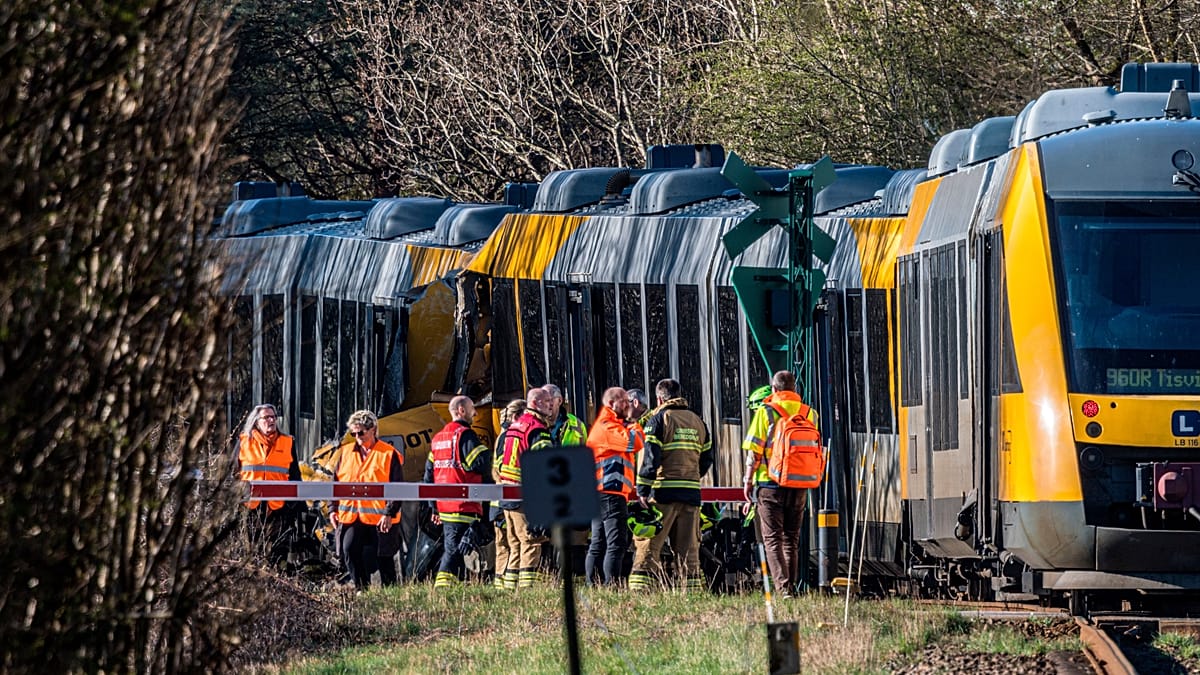
Two passenger trains collided head-on on a local rail line in Denmark on Thursday morning, leaving 17 people injured, five of them in critical condition, according to police and local media reports.
The accident occurred at around 6:30 am on the line between Hillerød and Kagerup, roughly 35 kilometres north of Copenhagen. Images from the scene show the front ends of both trains heavily damaged, though both remained upright on the tracks.
Emergency Response and Evacuation
Police described the incident as “a serious accident” and said that all passengers had been evacuated from the trains. A police spokesperson told AFP that emergency services were mobilised in large numbers. The area was sealed off as investigators began their work.
Gribskov mayor Trine Egetved wrote on Facebook that the line is used daily by many local residents, employees, and schoolchildren. The collision has raised immediate concerns about rail safety on regional lines, which are often less scrutinised than mainline routes.
The incident comes as European rail networks face increasing pressure to modernise and improve safety standards. While Denmark has a strong safety record, this crash highlights the vulnerabilities in local infrastructure. The European Union has been pushing for greater harmonisation of rail safety protocols across member states, but implementation varies widely.
In recent years, the bloc has invested heavily in cross-border rail projects, but accidents like this remind policymakers that safety must keep pace with expansion. The Danish accident will likely be examined by the European Union Agency for Railways, which coordinates investigations and recommends improvements.
For now, the focus remains on the injured and their families. Five people remain in critical condition, and hospitals in the Copenhagen area are treating the wounded. The cause of the collision is under investigation, with early reports suggesting a possible signal failure or human error.
Denmark’s rail network is generally considered reliable, but this event underscores the need for continuous investment. As Europe pushes for more sustainable transport, rail safety must remain a top priority.