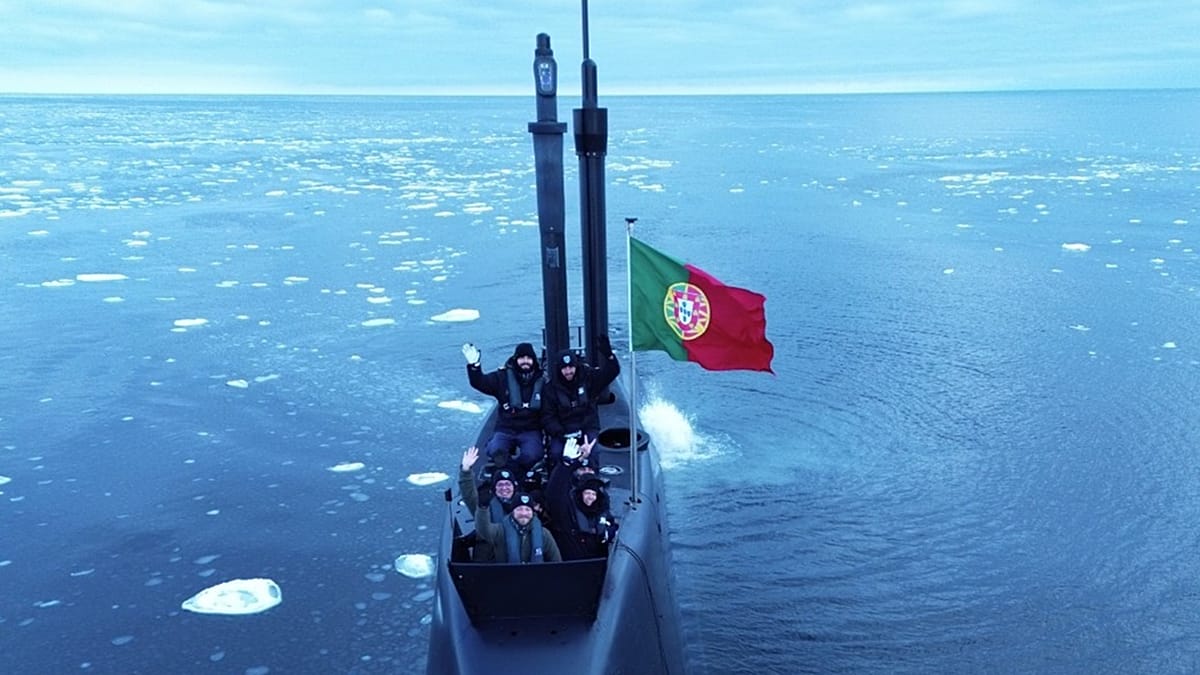
In the spring of 2024, the Portuguese Navy achieved something no other conventional submarine force had done in recent history: it operated beneath the Arctic ice cap. The NRP Arpão, a diesel-electric submarine equipped with air-independent propulsion (AIP), spent four days submerged under the ice sheet off Greenland, a feat that has since drawn the attention of Canada, which is now studying Portugal's adaptations for its own future submarine fleet.
The Arctic is warming nearly four times faster than the global average, according to recent climate data. As sea ice retreats, new shipping routes and resource extraction opportunities are opening up, but navigation in the region remains extremely hazardous. Ice floes can collide to form underwater ridges, or keels, that reach tens of metres deep, posing a serious threat to any submarine. For conventionally powered vessels, which have limited underwater endurance, the risk is even greater because surfacing through thick ice may be impossible.
Until the Arpão mission, under-ice operations in the Arctic had been the preserve of nuclear-powered submarines, which can stay submerged for months. Portugal's Navy, however, proved that with the right technology and procedures, a conventional submarine could operate safely in these extreme conditions. The vessel's AIP system, which uses fuel cells to generate electricity without needing to surface for air, allowed it to remain submerged for up to three weeks, depending on speed.
From Lisbon to the Polar Ice
The Arpão departed from the Lisbon Naval Base on 3 April 2024 as part of NATO's Brilliant Shield operation. The 78-day mission involved 1,800 hours at sea, 1,500 of them submerged. After an initial 22-day patrol to test new procedures and modifications, the submarine docked in Nuuk, Greenland, to refuel and take on provisions. It then crossed the Arctic Circle at parallel 66°33'N, with the then Chief of the Portuguese Navy, Henrique Gouveia e Melo, on board. Gouveia e Melo had conceived the expedition more than a decade earlier.
During the under-ice phase, the crew spent 39 hours and 30 minutes in deep submergence, mapping the ice sheet's thickness and identifying natural openings that could be used for an emergency surfacing. The mission demonstrated that conventional submarines could operate in the Arctic without the support of a nuclear reactor, a finding that has significant implications for smaller navies.
Canada, which is planning to acquire a new fleet of conventionally powered submarines, has been studying the Portuguese experience closely. The Royal Canadian Navy's current submarine fleet consists of four Victoria-class boats, which are also diesel-electric and have limited under-ice capability. The lessons from the Arpão mission, including modifications to the submarine's systems and crew training, are being incorporated into Canada's requirements for its future submarines, which are expected to be operational by the late 2030s.
The Arctic is becoming a theatre of growing strategic importance. The Arctic Council's latest report notes a 40% increase in the number of individual ships operating in the region over the past 12 years, while the distance sailed has jumped by 95%. This traffic includes vessels from the eight Arctic states—the United States, Canada, Iceland, Norway, Sweden, Finland, Denmark, and Russia—as well as ships from observer states. The melting ice is also making the region more accessible for naval exercises, as seen in recent NATO deployments.
Portugal's achievement has broader implications for European defence. As Sanna Marin has urged the EU to integrate battlefield lessons from Ukraine, the Arpão mission shows that smaller European navies can still contribute to high-end capabilities. The Portuguese Navy's willingness to push boundaries, even against initial scepticism from NATO allies, has opened a new chapter in Arctic underwater operations.
The mission also highlights the importance of AIP technology, which is becoming more common in European submarine programmes. Germany, Sweden, and France all produce AIP-equipped submarines, and the technology is seen as a cost-effective way for navies to extend their underwater endurance without the expense and complexity of nuclear propulsion. For Canada, which has a vast Arctic coastline, the ability to operate conventional submarines under ice is a strategic necessity.
As the Arctic continues to warm, the demand for capable underwater platforms will only grow. Portugal's pioneering mission has provided a template for how conventional submarines can operate in this challenging environment, and Canada is now set to benefit from that experience. The partnership between Lisbon and Ottawa on submarine technology is a reminder that European know-how can shape defence strategies far beyond the continent's borders.