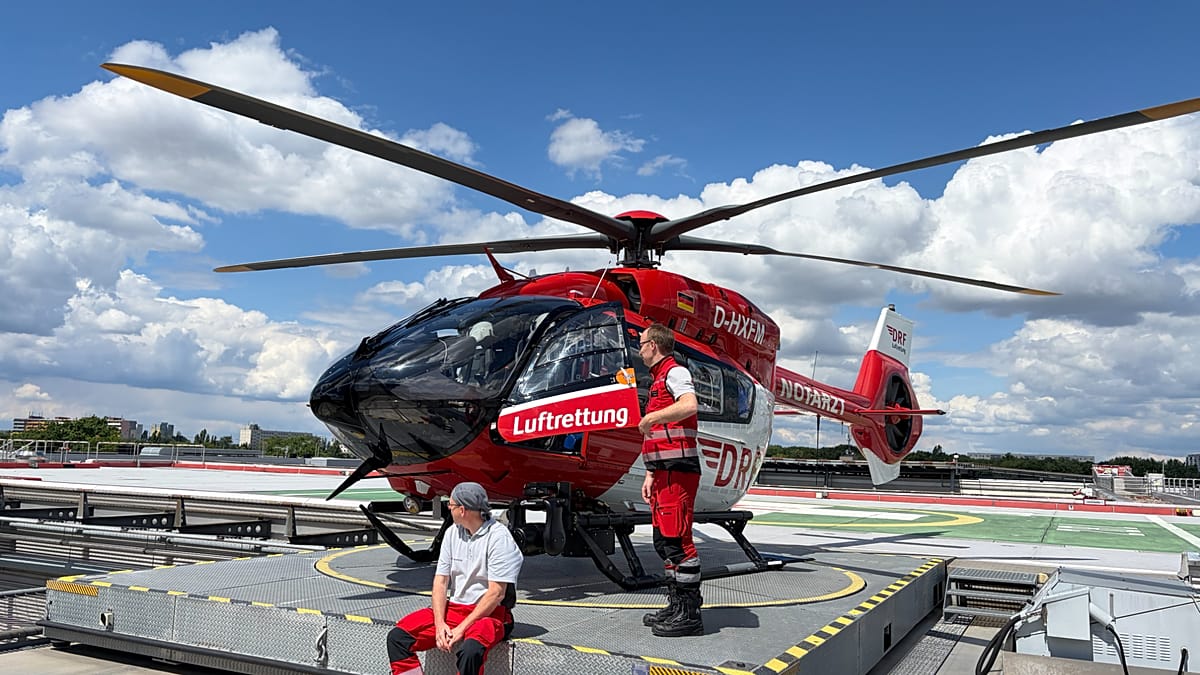
When an emergency call comes in, every second counts. At the Unfallkrankenhaus Berlin (ukb) in Marzahn, a helicopter crew is ready to take off within two minutes. On board are a pilot, an emergency doctor, and an emergency paramedic—a team trained for missions where routine, precision, and time can mean the difference between life and death.
Their destination is often a small town like Lübben in Brandenburg, where a patient with severe burns waits for transport to the ukb's specialist burns centre. For the crew, this is a familiar routine. "When an emergency call comes in, every moment counts," says emergency doctor Jan Martin. "With heart attack or stroke patients in particular, tissue is lost with every minute that passes without treatment."
Where Air Rescue Makes the Difference
Air rescue does not replace ground ambulances; it complements them. It becomes vital where distances are long, hospitals are far apart, or specialised treatments are only available at a few locations. The time saved by a helicopter can be decisive—both for initial care and for transfers between hospitals.
DRF Luftrettung operates 34 helicopter bases at 32 locations across Germany, three of them in Berlin. The Berlin base is on call around the clock. A helicopter can cover around 70 kilometres in about 17 minutes. Especially outside densely populated areas, that can make a substantial difference.
At the ukb, the "Christoph Berlin" intensive care transport helicopter handles two types of missions. Primary missions are classic emergency call-outs directly to the scene—after road accidents or in acute internal medical emergencies. Secondary missions are transfers between hospitals, taking patients to where specific treatments are available.
Ready for Emergencies 13 Hours a Day
The day shift starts at 6:30 a.m. Crew members check the technology, equipment, and readiness for deployment. That includes the medical kit, inspection of the helicopter, and the weather situation. They then hold a joint briefing over breakfast.
Pilot Sebastian Nothbaum describes how many factors have to be considered even before take-off: the weather, airspace restrictions, exercises, and prescribed flight routes. Air rescue means not only flying fast, but also precise planning under time pressure.
The crews work 13-hour shifts, requiring sustained concentration even when waiting for the next call-out. Night flights, changing weather conditions, and emotional strain add to the challenge. The crew sums it up soberly: "You have to really want to do this."
Highly Specialised Help on Board
Modern medical technology is carried on board. Since November 2024, blood and plasma supplies have been part of the equipment in Berlin-Marzahn. In cases of severe injuries or massive blood loss, life-saving measures can begin before the patient reaches hospital.
Emergency doctors need an additional qualification to work on the helicopter. Many also work in anaesthesia or intensive care medicine to maintain close links with clinical practice. The emergency doctors often come from partner hospitals, not directly from DRF Luftrettung.
Special requirements also apply to pilots and emergency paramedics (HEMS-TC). They must master both medical and flight procedures and function as a team under time pressure. This interplay is crucial, especially when landing away from hospital sites.
Once on scene, the crew carries out a high reconnaissance: from the air they check where they can land safely and how best to reach the patient. Direct access is not always possible, so the decision on how to continue the transport is often taken on site.
Limits and Cost Pressures
In low cloud, thunderstorms, storms, or ground fog, a flight may not be possible. Every take-off is preceded by a check to see whether the mission can be flown safely. The crews rely on information from the German Weather Service.
Not every location is suitable as a landing site, and sometimes the crew has to walk some distance to reach the patient. Public cooperation is also needed on the ground. If safety distances are not observed or instructions are not understood, this can make landing difficult.
But the biggest threat to air rescue may come from Berlin. A planned cap on health insurance costs could force DRF Luftrettung to reduce its fleet or cut back on services. For a system where every minute counts, such cuts could have deadly consequences. As Germany scrambles to adapt to extreme weather events, the need for rapid medical response is only growing.
For now, the crews at Marzahn continue their work, ready to take off at a moment's notice. They know that for the patients waiting below, time is the most precious resource of all.