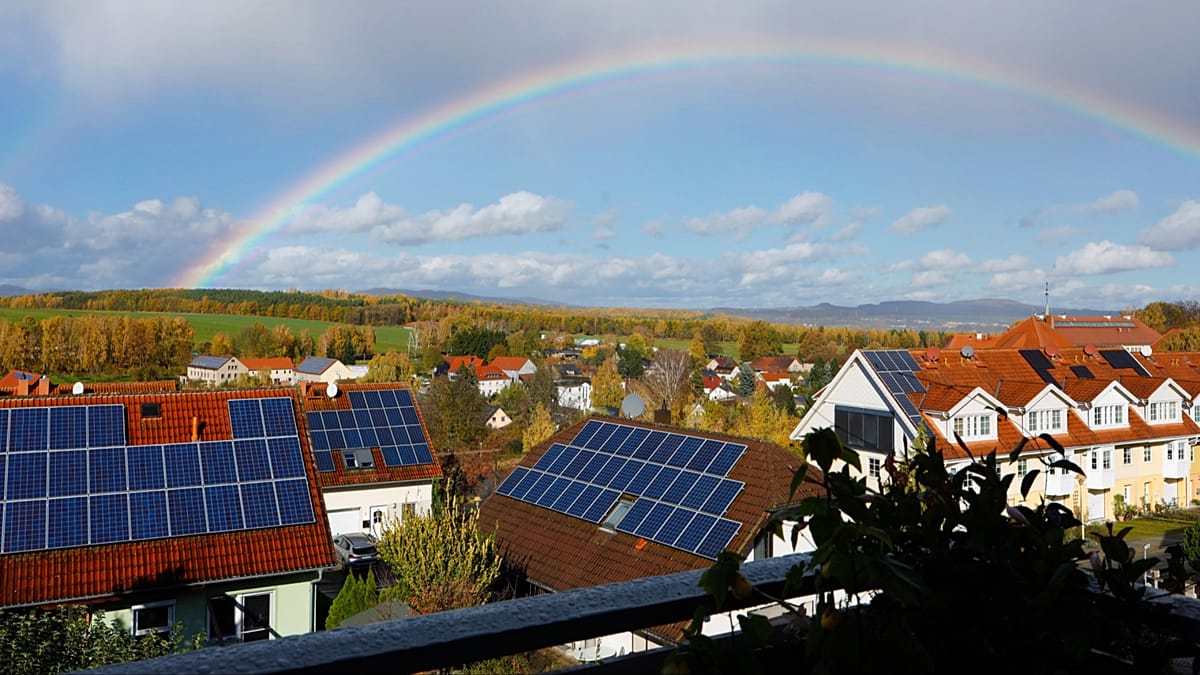
German homeowners could save more than €12,000 over 25 years by replacing their gas boilers with a combination of solar panels, battery storage, and a heat pump, according to a new analysis by the clean-tech company 1KOMMA5°. The finding challenges the common assumption that the high upfront cost of electrification makes it financially unattractive.
The study compares a new gas heating system costing €10,000 with a €60,000 package that includes solar photovoltaic panels, a home battery, a heat pump, and an intelligent energy management system. Factoring in a government subsidy of €16,500, a loan interest rate of 5.99 per cent, and projected energy savings, the electric setup totals €104,542 over 25 years. In contrast, the gas alternative—accounting for rising gas prices—costs €116,993 over the same period. That leaves a saving of €12,451 for households that make the switch.
Financing the transition
Jannik Schall, co-founder and head of product at 1KOMMA5°, argues that homeowners should look beyond the sticker price. “Homeowners should not be blinded by the pure acquisition costs,” he says. By spreading the cost through installment payments, households can benefit from predictable monthly outgoings and lower energy bills, while avoiding the volatility of fossil fuel prices.
“It’s already economical from the first month,” Schall adds. The company claims that pairing the technology with an intelligent energy management system can cut electricity bills by up to €42 per month. This system automatically directs solar power to where it is needed—either for immediate use, storage in the battery, or sale to the grid at times when prices are high. This is distinct from a smart meter, which simply encourages consumption during off-peak hours.
“The electrification of the home reduces energy costs so much that even long-term installment financing is worthwhile,” Schall explains. “If you can pay off the system faster, the advantage over gas heating increases.”
Germany’s heat pump boom and policy backtrack
Heat pumps have become the best-selling heating technology in Germany, accounting for 48 per cent of all new heating systems sold last year—a 21 per cent increase compared to 2024. The surge reflects growing consumer interest in electrified heating, driven by both environmental concerns and rising gas prices.
However, the German government has recently softened its green heating law, which would have required new heating systems to run on at least 65 per cent renewable energy. Plans to ban new oil and gas heating have also been dropped. Critics warn that this retreat could have serious consequences.
Jan Rosenow, professor of energy and climate policy at Oxford University, describes the watering down as potentially “catastrophic” for the climate. “The significant watering down of key provisions… postpones necessary decisions and will ultimately make the transition more expensive and more chaotic,” he says, noting that “the buildings sector has been missing its climate targets for years.”
Despite the policy uncertainty, the financial case for electrification appears to be strengthening. As gas prices continue to rise and renewable technology costs fall, the long-term savings from solar, battery, and heat pump systems are becoming harder to ignore. For German households, the decision may no longer be about environmental idealism alone, but about simple economics.