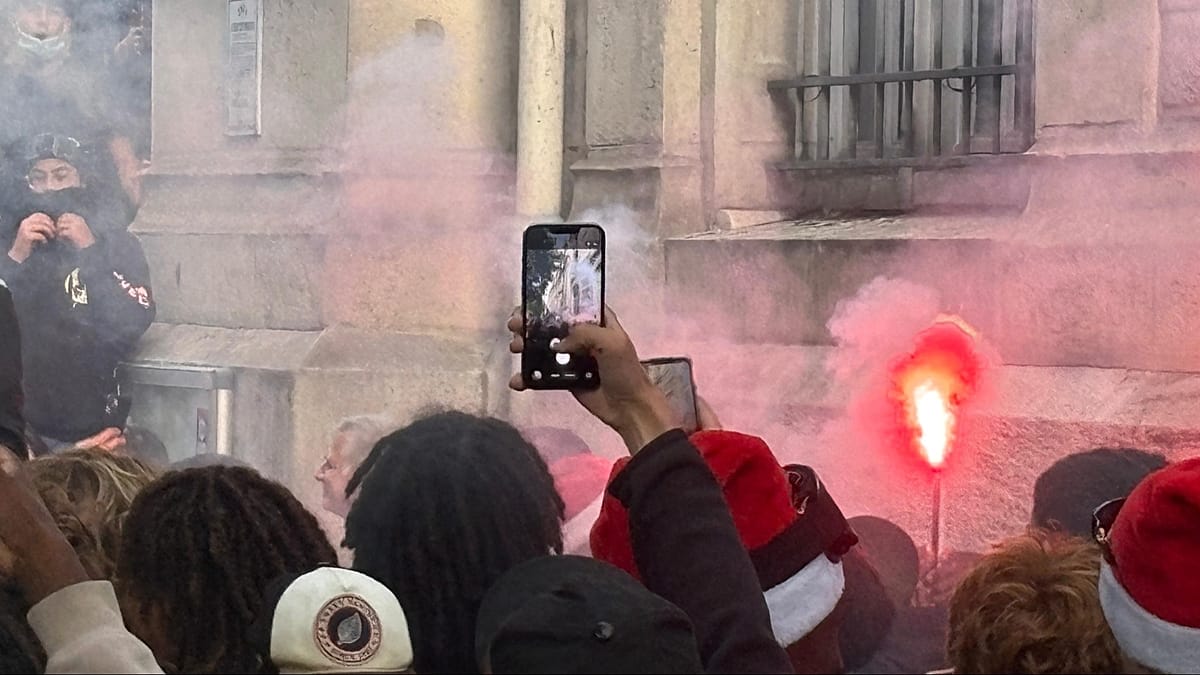
Paris, France — A day before a nationwide student protest, masked youths set fire to the entrance of a secondary school in the French capital, forcing its closure and escalating tensions over classroom conditions.
The incident occurred at the Vauquelin secondary school in the 13th arrondissement, where headteacher Carole Zerbib told BFMTV that "around ten hooded and masked young people came up to the entrance" and "brought bins and inflammable items" before setting them alight. The school remained closed for the day.
Jean-Didier Berger, France's junior interior minister, condemned the act: "These are criminal acts that fall under the law and must be punished in the harshest possible way."
Similar tensions were reported outside the Voltaire, Sophie-Germain, and Turgot high schools in Paris, as well as in Lyon and Lille. Higher Education Minister Philippe Baptiste told Sud Radio that "around forty higher-education sites" were also expected to be disrupted.
By late morning, the education ministry reported that 413 schools had been "subject to actions or disruptions since the start of the day" — a 27% drop compared with the same time on Friday, though 40% of those schools had not previously been affected.
Students demand better conditions
The protests, called by the Union syndicale lycéenne (USL), a high-school students' union, are driven by grievances over overcrowded classrooms, teacher shortages, and crumbling facilities. The movement has already seen hundreds of schools closed in recent days, and university students have joined blockades, widening the scope of the unrest.
In response to the violence, the government has promised a bill known as "casseurs-payeurs" ("vandals pay"), which will be examined in the Senate on 27 October. Government spokesperson Maud Bregeon told CNews that the bill "will allow us to dock family benefits… for damage caused by adults or minors" and "to introduce a form of collective responsibility."
The measure has drawn sharp criticism from opposition figures. Mathilde Panot, leader of the hard-left France Unbowed (LFI) group in the National Assembly, told franceinfo that "there is no political response" to the students' demands, only "a policing response."
The unrest comes at a time of heightened political and economic fragility in France. The country's debt woes have already rattled markets, with the euro sliding to a 17-month low amid concerns over French fiscal policy. The government's handling of the student crisis could further test its stability.
As the nationwide day of action approaches, the authorities are bracing for more disruptions. The education ministry has urged calm, while student unions insist that the underlying issues — inadequate funding, teacher shortages, and deteriorating school buildings — must be addressed.
For many observers, the events in Paris echo broader frustrations across Europe, where young people are increasingly vocal about public services and inequality. Whether the French government's punitive approach will quell the unrest or fuel it remains to be seen.