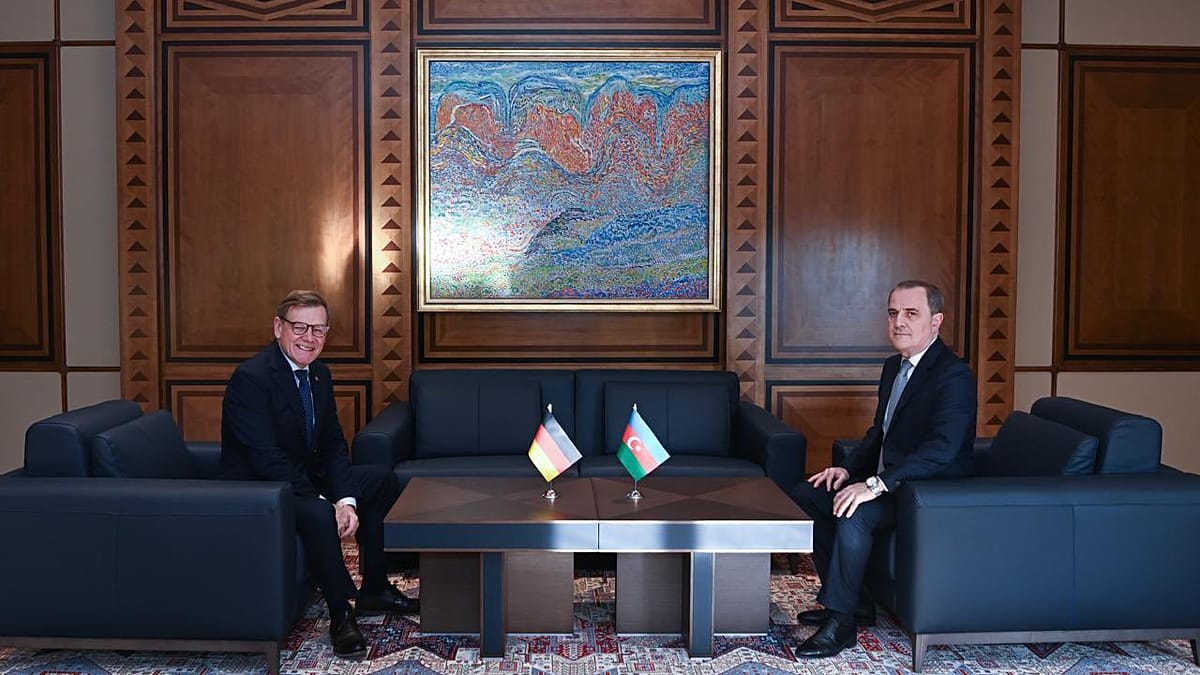
Germany is stepping up its diplomatic and economic engagement in the South Caucasus, a region long marked by conflict but now cautiously opening up. Foreign Minister Johann Wadephul travelled to Baku and Yerevan in mid-November, holding talks with Azerbaijani and Armenian officials, including President Ilham Aliyev and Foreign Minister Jeyhun Bayramov.
Speaking in Baku, Wadephul described the South Caucasus as “a region of opportunities” and stressed Berlin's interest in building “close relations” with Azerbaijan. He pointed to the potential for “connectivity, trade and education” as part of a joint strategic agenda.
The visit comes at a time when Europe is seeking to reduce dependencies and find reliable partners beyond traditional routes. “Amid Russia's aggression against Ukraine and the economic situation in Europe, we are seeking new opportunities to find reliable partners for diversification. Azerbaijan is one of these reliable partners,” Wadephul told reporters.
The Middle Corridor's strategic pull
At the heart of Germany's renewed interest is the Middle Corridor, a transport network linking China and Central Asia with Europe via the Caspian Sea and the South Caucasus. With ongoing disruptions in the Strait of Hormuz and the broader instability caused by Russia's war, the corridor has gained new relevance for global supply chains.
Wadephul called the project “of strategic importance to Europe both economically and politically,” particularly “during this period of destabilisation.” He said advancing the Middle Corridor had become a priority and that he would discuss it in Armenia.
The economic promise of the corridor, however, depends on political stability and cross-border cooperation. The route includes a 42-kilometre section through Armenian territory, and without Yerevan's participation, the project loses its logic. Azerbaijani Foreign Minister Jeyhun Bayramov acknowledged this during his meeting with Wadephul, noting that the “entry and exit points of this corridor are the Armenia–Azerbaijan border” and that without communication, the corridor “simply has no meaning, no logic.”
For Berlin, supporting a stable South Caucasus is both a diplomatic objective and part of a broader European strategic interest. Wadephul emphasised that “ensuring security and stability in the region is among Germany's main priorities” and expressed hope that “the peace agreement between Azerbaijan and Armenia will finally be signed and enter into force.”
The two countries have been negotiating a peace deal after decades of conflict over Nagorno-Karabakh, and the prospect of open borders could unlock significant economic benefits. The EU has been actively engaging with the region, seeing improved connections as a way to facilitate trade and strengthen alternative routes between European and Asian markets.
Germany's economic stake is already visible. Bilateral trade between Germany and Azerbaijan reached approximately $1.4 billion in 2025, with German exports including vehicles, machinery, and pharmaceuticals, while Azerbaijani exports are dominated by crude oil. The visit also signals a broader German interest in the region's energy security, particularly as Europe looks to diversify away from Russian gas.
Wadephul's trip underscores a shift in German foreign policy towards the South Caucasus, moving beyond crisis management to a more proactive engagement. As the region emerges from conflict, Berlin appears keen to support a future of peace and prosperity, with the Middle Corridor as a tangible symbol of that ambition.