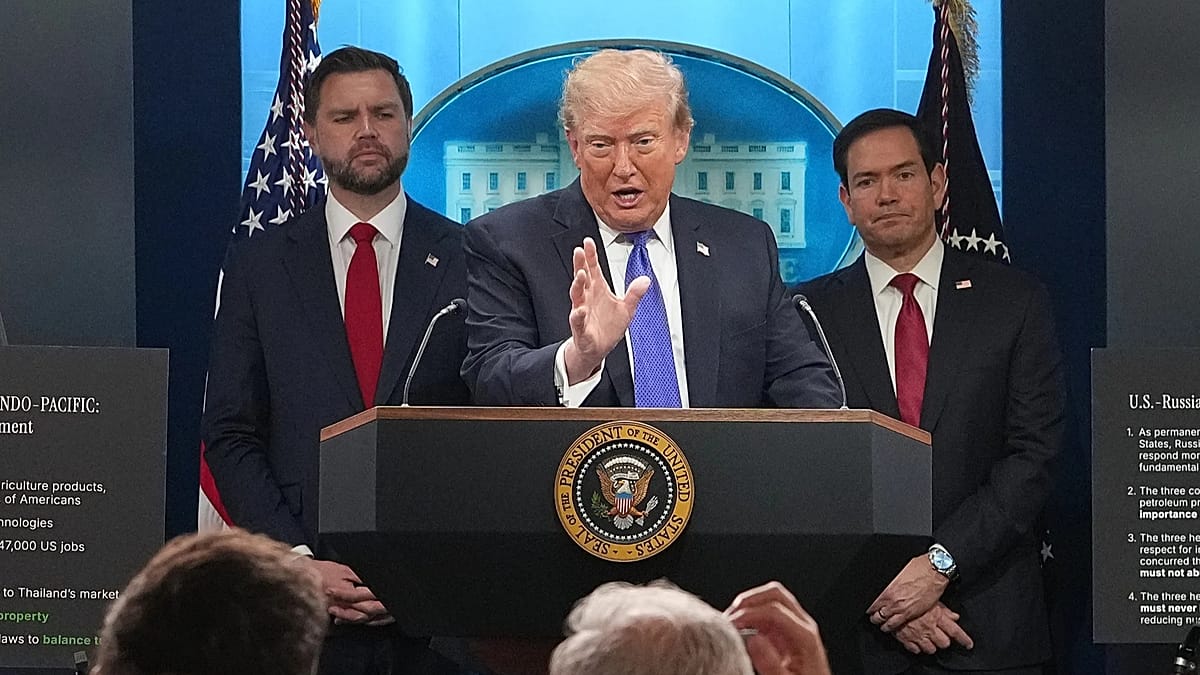
Speaking at the White House on Friday, US President Donald Trump defended his recent trilateral summit in Shenzhen with Chinese President Xi Jinping and Russian President Vladimir Putin, while launching a sharp attack on Iran's negotiating stance. The press conference offered a glimpse into the administration's foreign policy priorities, with Trump praising his personal rapport with both leaders and dismissing critics as "stupid."
A summit hailed as a success
Trump described the Shenzhen meeting as a success, highlighting the "great relationship" he has built with Xi and Putin. "We have a very great relationship. That's a positive, by the way," he told reporters, responding to backlash over his earlier description of Putin as his "friend." The summit, which marked the first trilateral gathering of the three leaders, has drawn mixed reactions across Europe, where allies remain wary of Moscow's intentions and Beijing's growing assertiveness. European diplomats have been closely monitoring the outcome, particularly its implications for transatlantic unity on issues ranging from trade to security.
The president's warm words for Putin contrast sharply with his tone on Iran. Accusing Tehran of "bull-----ing people for 51 years," Trump insisted that Washington seeks a "real deal, not a fake deal" with the Islamic Republic. He claimed that Iran wants an agreement but has yet to present terms that the US considers acceptable. The remarks come amid stalled negotiations over Tehran's nuclear program, a file that European powers—France, Germany, and the UK—have long been engaged in as part of the E3 format. The E3 countries have consistently pushed for a diplomatic solution, and any US-Iran breakthrough would have significant ramifications for European security and energy markets.
Ukraine: a complicated path to peace
On Ukraine, Trump said Putin had expressed a desire to end the war "by diplomatic means," but blamed the deep personal animosity between the Russian leader and Ukrainian President Volodymyr Zelenskyy for complicating peace efforts. "The problem is President Zelenskyy and President Putin have tremendous hatred, and that's never easy," he said. The comments come as European allies, including those who have been surprised by Trump's recent calls on Ukraine aid, remain skeptical of any deal that might favor Moscow. European Union leaders have repeatedly stressed that any peace plan must respect Ukraine's sovereignty and territorial integrity, a position that may clash with Trump's transactional approach.
The president's defense of his ties with Putin has raised eyebrows in European capitals, where many see the Russian leader as an unreliable partner. Analysts note that Trump's willingness to embrace Putin could undermine the EU's united front against Russian aggression, especially as some European politicians, such as Marine Le Pen, are seen as potential vehicles for Russian influence. The trilateral summit in Shenzhen has also unsettled Asian allies, with Trump leaving without a meeting with North Korean leader Kim Jong-un, a move that adds to the diplomatic uncertainty.
For Europe, the stakes are high. The US president's approach to Iran, Russia, and China will directly affect the continent's security architecture, energy supplies, and trade relations. While Trump touted his personal diplomacy, European leaders are likely to press for a more rules-based international order, one that does not hinge on the whims of a few powerful men. The coming weeks will show whether Trump's "real deal" rhetoric translates into concrete progress, or whether it remains just another talking point in a volatile geopolitical landscape.