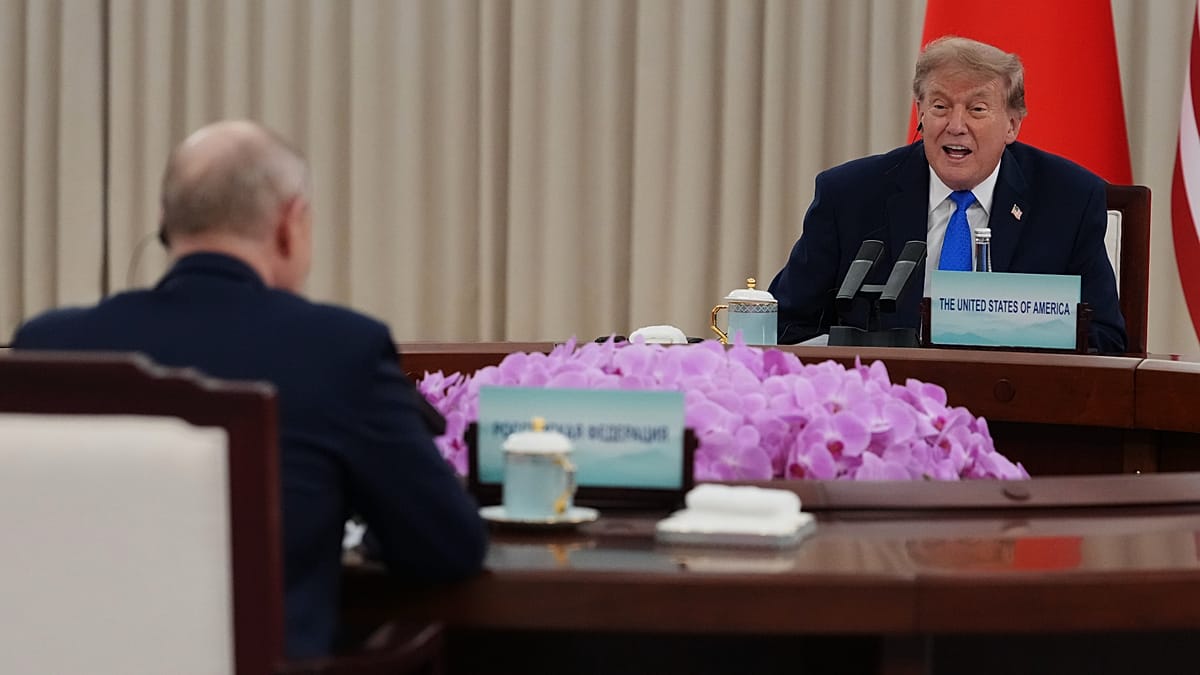
US President Donald Trump has sharply challenged European leaders over their continued financial backing for Ukraine, during an unexpected phone call into a meeting of Kyiv's European allies on Thursday. According to four European officials briefed on the discussion, Trump asked why the allies were still spending billions on military support for Ukraine, nearly five years into the conflict with Russia.
The call came just hours after Trump concluded a trilateral summit with Russian President Vladimir Putin and Chinese President Xi Jinping in Shenzhen, China. Speaking from Air Force One, Trump reportedly insisted that Putin was sincere about pursuing a peace deal to end the war, and that Moscow was ready to negotiate.
European skepticism over Trump's assurances
Three of the European officials, who spoke on condition of anonymity, said Trump expressed strong skepticism about the value of further aid from the so-called Coalition of the Willing—a group of 34 countries, plus Ukraine, that have pledged enhanced support for Kyiv. One official said Trump lamented the high human cost of the conflict and described the billions spent as "wasted" on a war that has dragged on for nearly five years.
The US president's intervention comes at a delicate moment for European unity on Ukraine. Many EU capitals, including Berlin and Paris, have been wary of any peace process that sidelines European interests. Poland has already insisted that no deal can be reached without Europe's say, and concerns about a "Yalta 2.0"—where great powers carve up spheres of influence—have resurfaced. The fear of being excluded from negotiations is palpable across the continent.
Trump's call also comes on the heels of the Shenzhen Declaration, which many European diplomats view as vague and insufficient. The declaration, issued after the trilateral summit, made no concrete commitments on Ukraine, and European leaders are now scrambling to ensure their voices are heard in any future talks.
Some European officials are concerned that Trump's overtures to Putin could undermine the coalition's resolve. The US president has repeatedly questioned the scale of American aid to Ukraine, and his latest remarks suggest he may pressure European allies to follow suit. However, several EU member states, particularly those in Central and Eastern Europe, remain committed to supporting Kyiv. The Baltic states and Poland have been vocal in their opposition to any premature concessions to Moscow.
Meanwhile, Ukraine continues to face relentless Russian attacks. In a separate development, Ukrainian forces struck the Crimean bridge again, halting rail traffic for the third time this week, a reminder that the conflict remains far from frozen. The bridge strikes underscore Kyiv's determination to keep pressure on Russian supply lines, even as diplomatic efforts intensify.
Trump's call has also reignited debates about the future of the Coalition of the Willing. Some European officials worry that if the US reduces its own contributions, other nations may follow, weakening the coalition's leverage. Others argue that Europe must step up its own defense spending to reduce reliance on Washington. The question of burden-sharing has long been a point of tension within NATO, and Trump's remarks are likely to sharpen that debate.
For now, European leaders are treading carefully. While they welcome any genuine move toward peace, they are wary of being presented with a fait accompli. The Polish government's insistence that Europe must have a seat at the table reflects a broader sentiment across the continent. As one EU diplomat put it, "We cannot allow the future of Ukraine to be decided over our heads."
The coming weeks will be crucial. If Trump follows through on his claim that Putin is ready to negotiate, European leaders will need to decide whether to engage with Moscow or hold the line. But if the past is any guide, they will approach any talks with deep skepticism, mindful of Russia's history of broken promises.