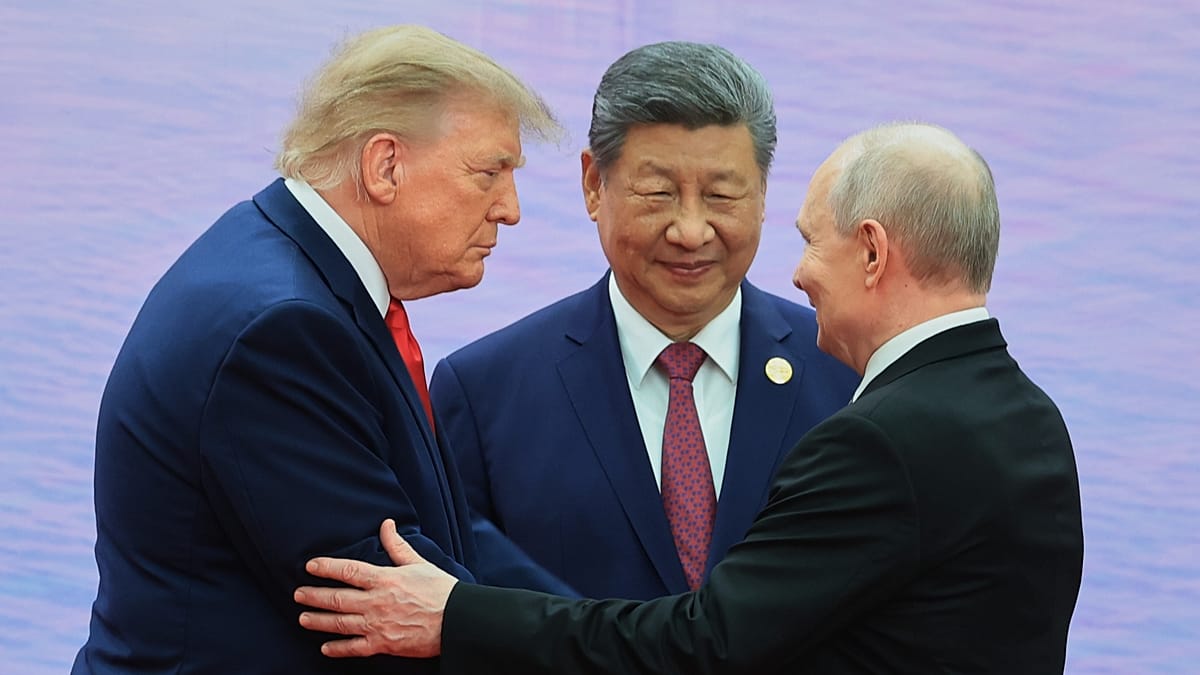
Good morning. Angela Skujins here with your Thursday briefing. Today, we look at a day of high-stakes diplomacy: while the Coalition of the Willing gathers in Berlin to reaffirm support for Ukraine, a potentially game-changing trilateral meeting is taking place on the sidelines of the APEC forum in Beijing.
The meeting between Xi Jinping, Vladimir Putin, and Donald Trump has drawn inevitable comparisons to the Yalta Conference of 1945, where Churchill, Roosevelt, and Stalin redrew the map of Europe. For the Baltic states—Latvia, Lithuania, and Estonia—that legacy is particularly painful, as their Soviet occupation was effectively sanctioned by the Western Allies. The question now is whether history might repeat itself in a different form.
Yalta 2.0?
Norwegian Foreign Minister Espen Barth Eide told me on Tuesday that he does not foresee a new division of spheres of influence. “The last thing anyone desires is an agreement between great leaders to divide the world between them,” he said. “I'm not suggesting that's going to happen, but this is something we don't want to see.”
Fredrik Wesslau, a senior policy fellow at the European Council on Foreign Relations, believes Putin will likely push for a discussion on Ukraine, aiming to end the full-scale invasion on his terms. “He wants Russia, the US, and China to decide everyone else's geopolitical fate,” Wesslau said. “But in the end, it's impossible to decide on the fundamentals of European security without Europeans.”
Ukrainian President Volodymyr Zelenskyy has been prescient in his warnings. In November, he told reporters, “We don't want to have Yalta 2.0. We don't want to be divided by Russia.” Yet Trump has already framed the trilateral as an opportunity to broker a deal, declaring earlier this week, “I think it's very close to getting it done.” Beijing has billed the meeting as an opportunity for “in-depth exchanges on safeguarding world peace and promoting strategic stability in major-power relations,” while Putin has said he expects the summit to be “highly useful.”
Berlin's Response
Back in Berlin, representatives from the E5 group—Germany, France, Italy, Poland, and the UK—are meeting on the sidelines of the Coalition of the Willing to discuss Europe's red lines for any future ceasefire talks. These are the countries, along with Council and Commission officials, tasked with engaging Russia following the informal European Council summit in Dublin on Friday.
Toomas Hendrik Ilves, former President of Estonia, spoke to Europe Tonight about the tone of the US approach under Trump. He noted that US Undersecretary of War Elbridge Colby had “started criticising the Ukrainians for their rocket attacks on Russian oil refineries and on data centres, which was kind of bizarre, given what the Russians are doing to Ukraine on a daily basis.” Ilves welcomed the swift response from German Defence Minister Boris Pistorius, who pushed back against Washington's criticism during a NATO meeting on Tuesday. “For the first time, you saw that Defence Minister Pistorius said, 'That's really stupid.' For once, we saw some backbone on the part of an EU minister standing up to this really Russophilic approach that the US has taken for a while.”
Energy Union Moves Forward
In other news, Energy Commissioner Dan Jørgensen hailed the latest EU agreement to accelerate permitting procedures as a step forward for clean power and infrastructure. He told Maria Tadeo that the move will revamp the bloc's obsolete power grid and boost electrification, even if financing remains a challenge. “This is about making sure that we have the infrastructure to actually electrify our societies, to get the renewable energy into our systems so that we can drive our cars on electricity, we can have heat pumps and so forth,” he said. “Instead of being 27 member states, we are trying to be one energy union.”
Montenegro's EU Path
Time is running out for Montenegro to meet its goal of closing all negotiation chapters for EU accession by the end of the year. According to my colleague Luca Bertuzzi, Podgorica still has ten chapters to close before the winter recess, but will only close two more at today's Intergovernmental Conference, on regional policy and taxation. The reasons are both technical and political. On the technical side, the Council is busy not only with Montenegro's accession treaty but also with discussing tighter safeguards for new member states and the annual political conclusions on enlargement.
Politically, the elephant in the room remains the bilateral disputes with Croatia. Despite pressure from Germany and other EU countries, Montenegro must resolve several issues before it can move forward. In practice, Podgorica might still join in 2028 if negotiations slip into early next year, but delays risk piling up.
In other Western Balkan news, the European People's Party (EPP) is likely to suspend the membership of Serbia's Serbian Progressive Party (SNS) at its next political assembly in December, Vincenzo Genovese writes. The EPP presidency, led by Germany's Manfred Weber, is set to propose the suspension following an internal scrutiny process launched more than a year ago, EPP sources told Euronews. The centre-right family is taking a firmer stance on rule-of-law concerns in candidate countries.
As the day unfolds, the central question remains: will Europe have a seat at the table, or will it be on the menu? The answer may determine the continent's security architecture for decades to come.