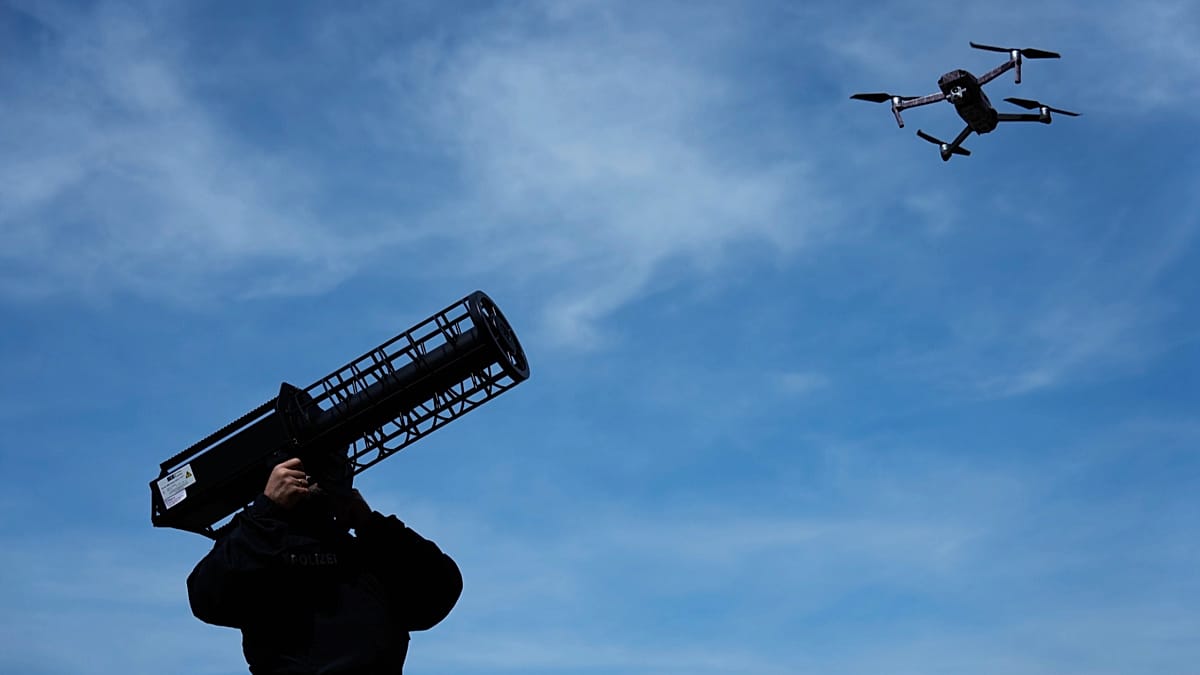
Berlin is significantly expanding its federal police anti-drone capabilities in the wake of a serious security breach at Leipzig-Halle airport, where an explosives-laden unmanned aerial vehicle was discovered near a Ukrainian cargo plane. Interior Minister Alexander Dobrindt announced on Monday that the dedicated anti-drone unit will double in size to 300 personnel, with operational bases increasing from four to eight across the country.
The incident, which occurred last week, has been described by Dobrindt as a “hybrid attack scenario” potentially involving a “foreign power.” The drone was found by an airport employee around midnight, hours after it reportedly bounced off the wing of an Antonov aircraft. The explosives failed to detonate, and the reason remains unclear, according to an unconfirmed report in Die Zeit that cited security camera footage.
Leipzig-Halle airport, located in eastern Germany, is a crucial hub for the transport of military equipment by the German armed forces and NATO allies. It also serves as a base for Antonov Airlines, Ukraine's state cargo carrier. The airport's strategic importance makes it a high-value target for potential sabotage.
Broader pattern of drone incursions
Germany and other European countries have repeatedly observed UAVs flying over sensitive sites such as airports, military bases, and industrial plants. German authorities, who are among Ukraine's largest military supporters, have said they suspect Russia of orchestrating many of these incidents as part of a broader campaign of sabotage, espionage, and disinformation. Russia has denied any involvement, with its embassy in Berlin dismissing the Leipzig incident as a “hastily contrived provocation” that serves only the interests of Kyiv and the militarist wing of the European political establishment.
The expansion of the anti-drone unit is part of a wider effort to counter such threats. Dobrindt is also set to formally open a new drone technology research centre next week, attached to the German Aerospace Centre (DLR). The centre will focus on developing countermeasures and detection systems to protect critical infrastructure.
Investigators have also made progress in identifying those responsible. According to Die Zeit and Bild, traces of DNA were found on the drone discovered at Leipzig. Die Zeit reported that the DNA had previously been registered in Lithuania, though no further details were provided.
The incident has heightened concerns across Europe, where similar drone sightings have been reported. In recent months, drones have been spotted over a Bundeswehr base in western Germany, and a drone exploded near a Bulgarian gas pipeline after crossing from Romania. These events underscore the growing challenge of securing European airspace against unmanned threats.
Germany's response reflects a broader European effort to bolster defences against hybrid warfare. The doubling of the anti-drone unit and the establishment of a research centre are concrete steps to address a threat that has become increasingly sophisticated. As Dobrindt emphasised, the security of critical infrastructure is paramount, and Germany is committed to ensuring that its airports, military bases, and industrial sites are protected.
The Leipzig incident also highlights the vulnerability of transport hubs that are vital to NATO's logistical network. With the war in Ukraine ongoing, such facilities are likely to remain targets. The expansion of the anti-drone unit is a clear signal that Germany is taking the threat seriously and is prepared to invest in the necessary resources to counter it.
While the investigation continues, the German government is moving quickly to implement measures that will enhance its ability to detect and neutralise drones. The new research centre will play a key role in developing advanced technologies, while the increased personnel and bases will improve operational response times across the country.
For now, the focus remains on identifying those behind the Leipzig incident and preventing future attacks. As European nations grapple with the rise of drone-based threats, Germany's proactive approach may serve as a model for others to follow.