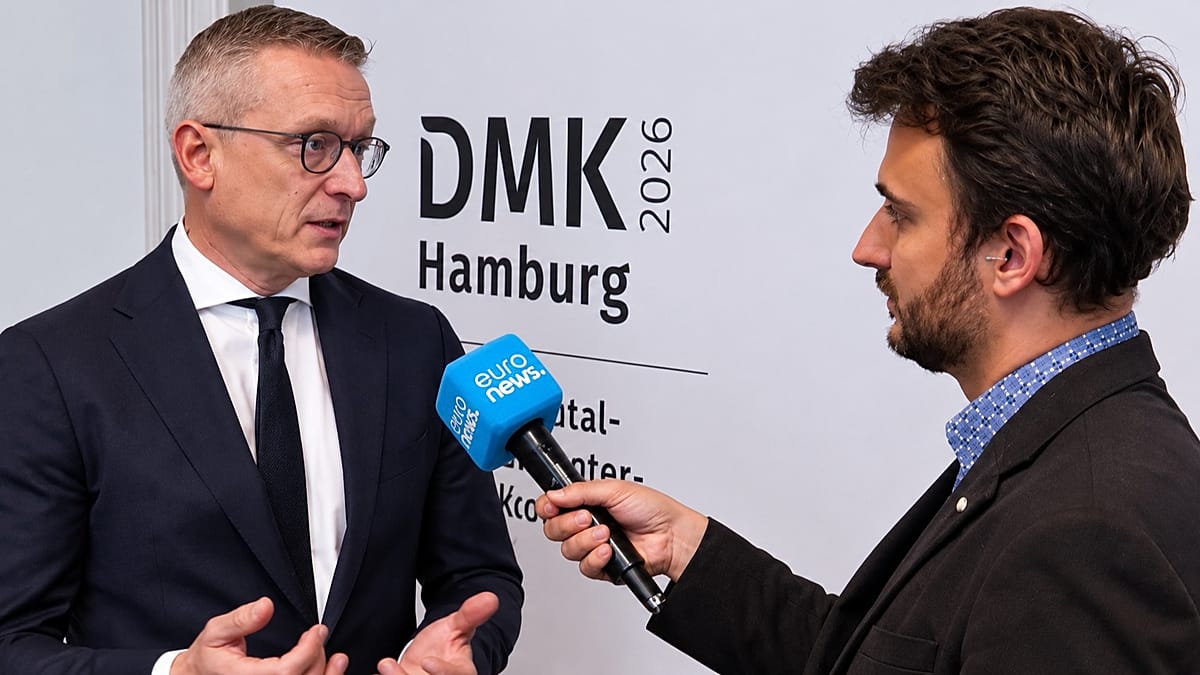
As the global artificial intelligence race intensifies, Europe finds itself caught between the scale and speed of American innovation and the state-backed ambition of Chinese tech giants. In an interview with Euronews correspondent Luca Bertuzzi, Germany's Digitalisation Minister, Karsten Wildberger, laid out his views on whether the continent can close the gap.
Wildberger acknowledged the challenge, noting that the United States and China currently lead in key areas such as large-scale model development and computing infrastructure. However, he stressed that Europe's strength lies in its industrial base, regulatory clarity, and commitment to democratic values. 'We don't need to copy Silicon Valley or Beijing,' he said. 'We need to build on our own strengths.'
Franco-German alignment
A central theme of the conversation was the relationship between Europe's two largest economies. Wildberger said that France and Germany are 'fully aligned' on the need to strengthen Europe's homegrown tech industry, even if their approaches differ. Berlin has focused on industrial applications and data sovereignty, while Paris has pushed for more ambitious state-backed investment and a stronger role for European champions.
This alignment is crucial, he argued, because fragmented national strategies would only benefit external competitors. 'If we want to be a global player, we have to act as one,' Wildberger said. He pointed to joint projects in areas like cloud infrastructure and semiconductor production as examples of what can be achieved when member states cooperate.
The minister's comments come at a time when European leaders are debating how to fund AI research and development. A recent warning from Europe's AI leaders about the EU budget's ability to close the gap with the US and China has added urgency to the discussion.
Regulation as a double-edged sword
Wildberger also addressed the EU's regulatory approach, particularly the AI Act. He defended the legislation as a necessary framework to build trust, but cautioned that over-regulation could stifle innovation. 'We need rules, but they must be smart and not overly burdensome,' he said. He highlighted the need for faster approval processes and more flexible testing environments for AI applications.
The minister's remarks echo concerns raised by entrepreneurs and researchers across the continent. Germany's own business startup red tape has been identified as the worst in a 27-country study, a fact that Wildberger acknowledged as a problem. 'We are working to reduce bureaucracy, especially for tech startups,' he said.
Investment and infrastructure
On investment, Wildberger called for a mix of public and private funding. He noted that the EU's NextGenerationEU recovery fund has provided a boost, but more is needed. He also stressed the importance of building European data centers and high-performance computing facilities to reduce reliance on non-European providers.
Germany has already taken steps to support the sector, including slashing the power tax and extending fuel price caps from 2027, which could lower energy costs for energy-intensive data centers. Wildberger said such measures are part of a broader strategy to make Europe more attractive for tech investment.
Looking ahead
When asked whether Europe can realistically catch up, Wildberger was cautiously optimistic. 'We have the talent, the research base, and the industrial know-how,' he said. 'What we need is the political will to act together and the courage to take risks.'
He also pointed to the potential of AI in addressing societal challenges, from healthcare to climate change. 'If we focus on these areas, we can create a unique European model of AI that is both innovative and trustworthy,' he concluded.
The interview underscores a broader debate in Brussels and national capitals about Europe's digital sovereignty. As the US and China continue to invest heavily in AI, the pressure on European leaders to deliver concrete results is mounting. Whether the continent can translate its ambitions into action remains to be seen, but Wildberger's message is clear: Europe must not be left behind.