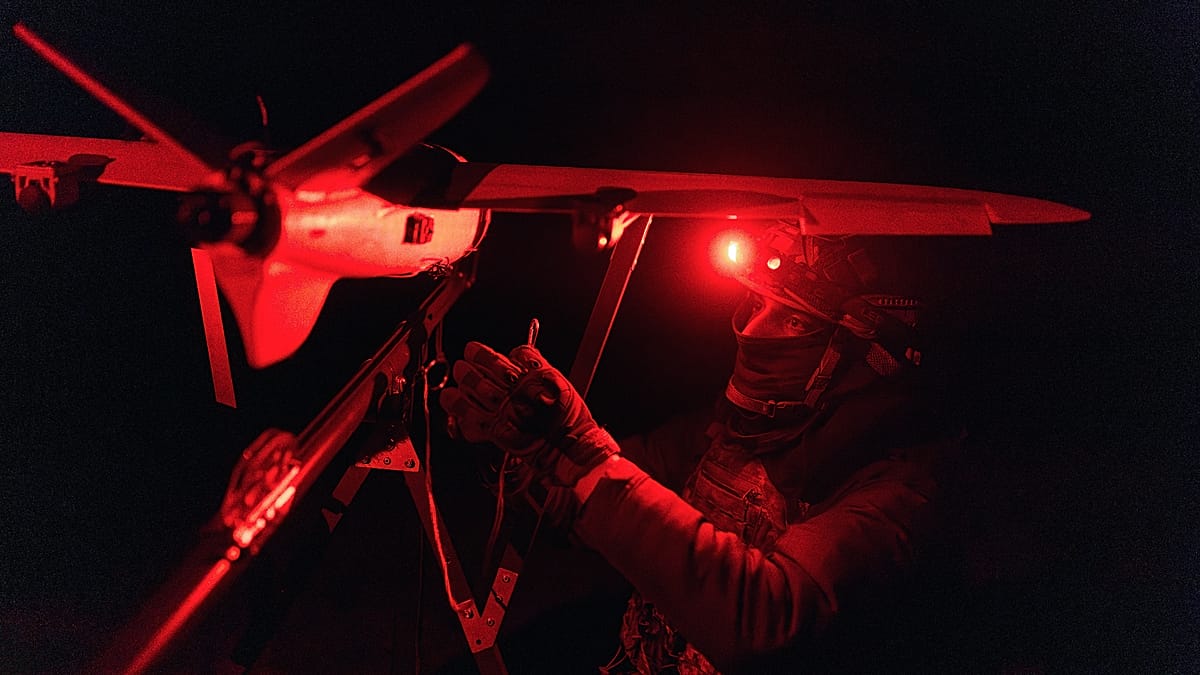
Ukraine's drone production has reached an extraordinary scale, with Ukrainian media reporting output of roughly 500,000 units per month—nearly double the figure from a year ago. But for the Ukrainian army, sheer quantity is not the decisive factor. The unmanned systems are being refined and adapted almost weekly, reflecting a war in which innovation cycles are measured in days, not years.
One company at the forefront is Buntar Aerospace, whose Buntar Copilot software now allows reconnaissance drones to be controlled entirely remotely. This means only a small team remains at the launch site; missions can be directed from hundreds or even thousands of kilometres away. "The main goal is to ensure the safety of experienced crews. Once the drone is airborne, the pilot can carry out the mission from a safe location while the launch team quickly leaves the area," Bohdan Sas, one of Buntar's founders, told Euronews. Unlike other firms, Buntar has built remote control directly into its own mission-planning platform rather than relying on external software. Sas explains: "Warfare has changed, and remote control has now become an indispensable standard."
Rapid adaptation on the front line
The pace of innovation is equally striking at Kaban Robotics, which converts existing vehicles such as the US HMMWV (Humvee) into remotely operated platforms. The advantage is that adapting proven hardware is faster than designing new unmanned vehicles from scratch. New functions are introduced in direct response to feedback from Ukrainian soldiers. In one case, troops suggested that exterior lights should switch off automatically if communication was lost—the modification was implemented in about 15 minutes. Similarly, cameras were adjusted after frontline experience showed that oncoming headlights could dazzle the main camera at night; a button now lets the driver switch to thermal imaging instantly. As David from Kaban told Euronews: "Sometimes the time between a suggestion from military personnel and the implementation of a new feature is not measured in months or weeks, but literally in minutes."
This agility stands in stark contrast to the German armed forces. The Bundeswehr is attempting to ramp up industrial production, and the Bundestag's budget committee recently approved, with conditions, the delivery of thousands of "kamikaze" drones—relatively inexpensive systems designed to engage individual targets over long distances. Bavaria has emerged as a hub for drone manufacturers, including Quantum Systems, Helsing, ARX, and Airlogix, which have reportedly begun mass production of more than 5,000 long-range combat drones for Ukraine. Another production facility is planned in eastern Germany, according to the newspaper Welt.
Yet the parliamentary commissioner for the armed forces, Henning Otte, warned in his latest report that "the armed forces are, however, lagging far too far behind in the acquisition of modern unmanned systems." During a troop visit, soldiers criticised that the KZO and LUNA drones were already outdated when introduced. Otte argues that the priority must be to get new systems "into series production quickly" and deliver them in large numbers.
The problem, however, is not just production. Otte also criticises the Bundeswehr's procurement processes as overly bureaucratic. He writes that the "blanket invocation of underfunding of the Bundeswehr" is no longer an excuse. Instead, procurement needs to be accelerated and the forces relieved of "non-military bureaucracy."
Security expert Dr Frank Sauer sees technology as the lesser problem. "Catching up and closing the gap is quite possible here and in fact already under way, albeit at much higher prices per drone, which is why German products are not particularly popular in Ukraine," he told Euronews. "The real issue is how we handle these new systems, internalise the changed geometry of the battlefield, and develop new tactics and procedures along with the organisational 'muscles' that go with them. I fear we are still too wedded to the old ways and not learning fast enough."
Lieutenant General Dr Christian Freuding, speaking to the RND news platform, said that basic training already includes an introductory course in operating drones. "Everyone must learn it, everyone must be able to do it," he emphasised, adding that every soldier has to be a drone reconnaissance operator or a counter-drone specialist. This reflects a recognition that the Bundeswehr must not only acquire new hardware but also embed drone warfare into its doctrine and training.
The contrast with Ukraine's approach is instructive. Ukrainian forces treat drones as an integral part of every unit, with constant feedback loops between soldiers and manufacturers. Germany, by contrast, still struggles with a culture that separates technology from tactics. As diplomatic efforts continue to end the war, the lessons from Ukraine's drone revolution are clear: procurement reform and organisational change are as vital as the drones themselves.
Germany's challenge is not unique in Europe. Many NATO allies face similar gaps between technological potential and military adaptation. But given its economic weight and strategic role, the Bundeswehr's slow progress is particularly consequential. The war in Ukraine has shown that drones are not a niche tool but a central element of modern warfare. Germany's military must learn to adapt at the speed of conflict, not the speed of bureaucracy.