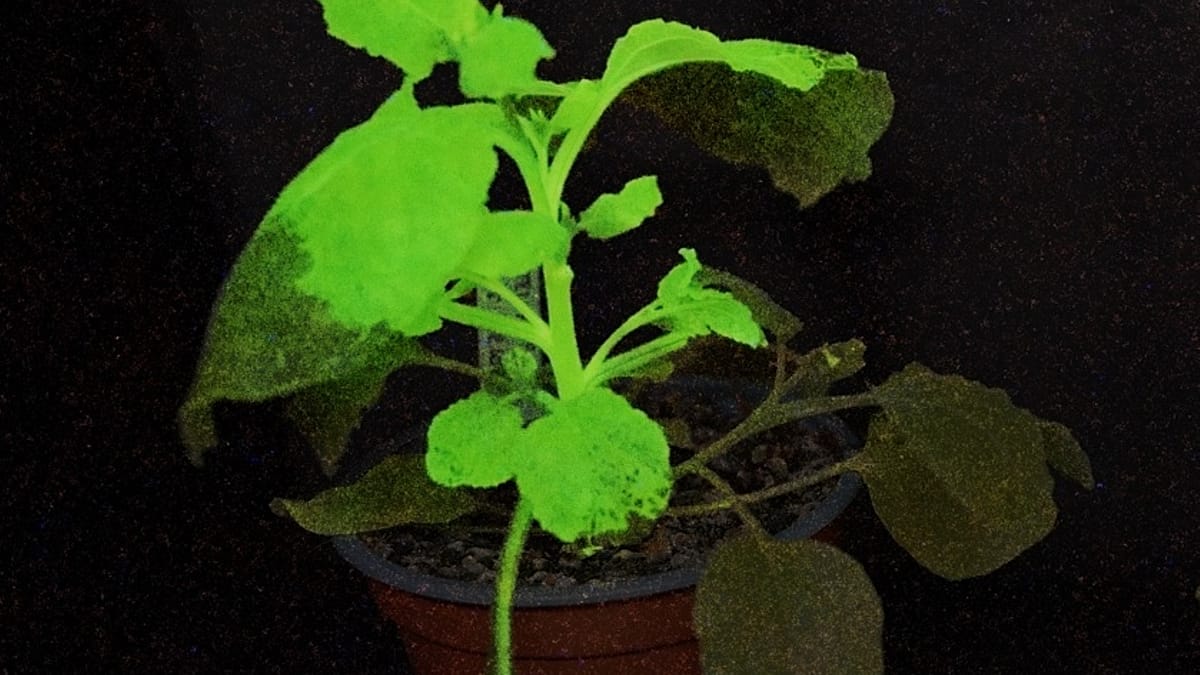
A team at the Instituto de Biología Molecular y Celular de Plantas (IBMCP), a joint centre of Spain’s CSIC and the Universitat Politècnica de València (UPV), has developed a novel method for early detection of crop diseases. By engineering plants to glow in the dark and shift colour when infected, the researchers have created a biological sensor that can be monitored with ordinary cameras.
The study, published in Nature Communications, draws inspiration from the bioluminescence of fungi. The team introduced four enzymes that modify caffeic acid, a natural plant compound, to produce a molecule that emits a steady green light as it oxidises. This constant glow turns the plant into a living sensor of its own health.
How the System Works
To test the concept, the researchers worked with transgenic plants of Nicotiana benthamiana, a tobacco relative commonly used in laboratory studies. They inserted fungal bioluminescence genes using modified viruses, allowing them to visually track infection spread and pinpoint affected areas.
In a key advance, the team created a sentinel system that detects potyvirus infection through a colour shift. Healthy plants maintain a consistent yellow signal; when infected, a pathogen enzyme triggers a colour change visible with low-cost devices. This enables early detection long before visible symptoms emerge.
Traditional diagnostic methods like PCR or ELISA are highly accurate but require specialised equipment, trained staff, and time. The new approach offers a simpler, faster alternative for continuous monitoring.
Applications and Future Potential
The system is initially suited for greenhouses and controlled environments, where sentinel plants could serve as early warning systems for viral outbreaks. The researchers believe the technology could eventually be adapted to detect bacteria and fungi, becoming a critical tool as climate change introduces new agricultural threats.
This innovation adds to a growing body of Spanish scientific work, including drilling into meteorite craters for Mars clues. It also comes amid broader European efforts to bolster food security, as seen in EU accession talks with Ukraine and the bloc’s push for resilient agriculture.
While the technology is not yet ready for field deployment, the team is optimistic about scaling it up. The ability to detect infections early could reduce pesticide use, limit crop losses, and help farmers respond faster to emerging threats.