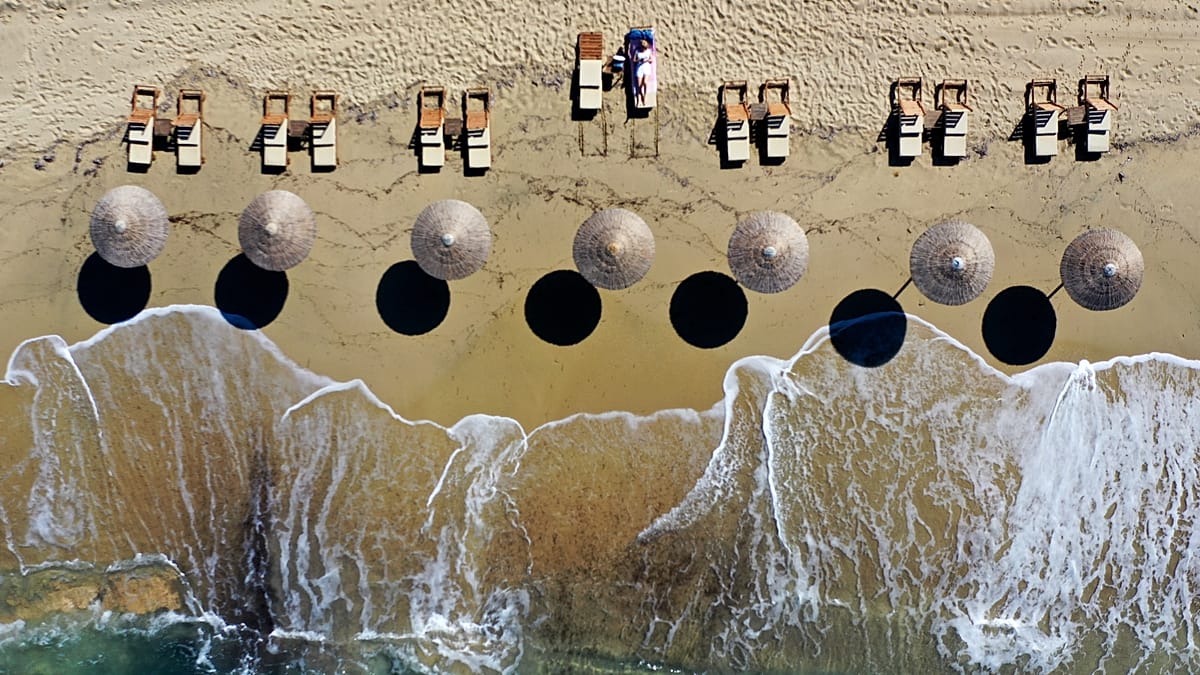
Greece's tourism sector continued its upward trajectory in August 2026, with arrivals and overnight stays in hotels, campsites, and rented rooms increasing compared with the same month in 2025. However, the overall positive picture masks notable differences between Greek and foreign visitors, as well as between accommodation types.
According to provisional data from the Hellenic Statistical Authority (ELSTAT), total arrivals reached 7,429,931, up 2.6% year-on-year, while overnight stays amounted to 34,685,695, a 2.1% increase. The growth in arrivals outpaced that of overnight stays by 0.5 percentage points, suggesting a slight shift toward shorter trips.
Foreign visitors drive the increase
International tourists played a decisive role, accounting for 76.7% of all arrivals and 84% of overnight stays. Greek residents, by contrast, represented 23.3% of arrivals and just 16% of overnight stays. The gap is particularly stark in overnight stays, where the foreign share was 68 percentage points higher than that of Greeks, underscoring the stronger contribution of international demand to the sector's overall activity.
In terms of annual change, arrivals by foreign visitors increased by 2.9%, compared with 1.7% for Greek residents—a difference of 1.2 percentage points. Similarly, overnight stays by foreigners rose by 2.3%, against 1.2% for Greeks, widening the gap to 1.1 percentage points.
Rented rooms grow more rapidly
The sharpest growth was recorded in collective short-stay accommodation, such as rented rooms. Arrivals there rose by 5.2%, outpacing the 1.5% increase seen in hotels and campsites by 3.7 percentage points. The difference was even more pronounced in overnight stays: rented rooms climbed by 4.6%, compared with just 1.1% for hotels and campsites—a gap of 3.5 percentage points.
This pattern highlights that, in percentage terms, short-stay accommodation is expanding significantly faster than traditional hotels and campsites. The trend aligns with broader shifts in European travel preferences, as seen in other destinations like Azerbaijan's tourism push and Uzbekistan's new routes, though Greece's established market remains a key benchmark.
Foreign and Greek visitors across accommodation types
In hotels and campsites, arrivals by foreign visitors increased by 1.9%, while those of Greek residents rose by just 0.5%—a difference of 1.4 percentage points. For overnight stays, the corresponding rises were 1.2% for foreigners and 0.8% for Greeks, narrowing the gap to only 0.4 points.
In rented rooms, the increases were clearly higher. Arrivals by foreign visitors went up by 5.5%, against 4.2% for Greek residents, while overnight stays grew by 5.1% and 2.2%, respectively. As a result, the gap between foreign and Greek visitors reached 1.3 percentage points in arrivals and 2.9 points in overnight stays.
Foreign visitors stay longer
The average length of stay in August remained at 4.7 days, unchanged from August 2025. Yet the difference between the two visitor categories is noteworthy: foreign tourists stayed on average 5.1 days, while Greek residents stayed 3.2 days—a gap of 1.9 days, meaning foreigners' stays were roughly 59% longer.
The same pattern holds across accommodation types. In hotels and campsites, the average stay for foreigners was 5.1 days versus 3.2 days for Greeks; in rented rooms, it stood at 5.2 and 3.3 days, respectively.
ELSTAT's figures for August 2026 confirm an increase in tourist traffic, with clearly faster growth in rented rooms and a stronger contribution from foreign visitors. At the same time, the rise in arrivals outpaced that in overnight stays, while the average length of stay remained flat. This mixed picture suggests that while Greece remains a top European destination, the sector's growth is increasingly reliant on international demand and short-stay rentals—a trend that carries implications for local economies and housing markets, as noted in leisure affordability concerns across the EU.