Uzbekistan is doubling down on tourism as a pillar of its economy, reporting a record 11.7 million international visitors in 2025. According to the National Statistics Committee, the momentum has carried into 2026: UN Tourism data shows a 37% jump in arrivals during the first quarter compared with the same period last year, placing the Central Asian nation among the world's five fastest-growing destinations.
The economic impact is already visible. In the first seven months of 2026, more than 7.7 million foreign visitors arrived, up 22.6% year on year. Tourism services exports—earnings from what international visitors spend on services—reached nearly €3.5 billion, according to the Tourism Committee.
Behind these figures lies a coordinated strategy to make tourism a more durable source of revenue. The government is offering financial incentives to airlines and tour operators, expanding air and rail connections, easing visa requirements, and investing in visitor infrastructure. The goal is not just to attract more tourists but to spread the benefits across the country.
Subsidies and incentives to lure airlines and operators
For the 2026 Open Tourism Season, Uzbekistan has introduced subsidies designed to encourage airlines to open new routes. Qualifying carriers receive €89 for each foreign tourist they bring in, plus a 20% discount on airport services. Tour operators can earn up to €4,460 for every 1,000 international visitors they attract from eligible overseas markets. Additional support covers charter flights and selected tourism start-ups.
The accommodation sector is also expanding. New facilities added more than 22,000 beds in the first seven months of 2026. These measures aim to stimulate private-sector activity and open up new markets, though their long-term success will depend on whether the extra demand proves commercially sustainable.
Air and rail: connecting more of the country
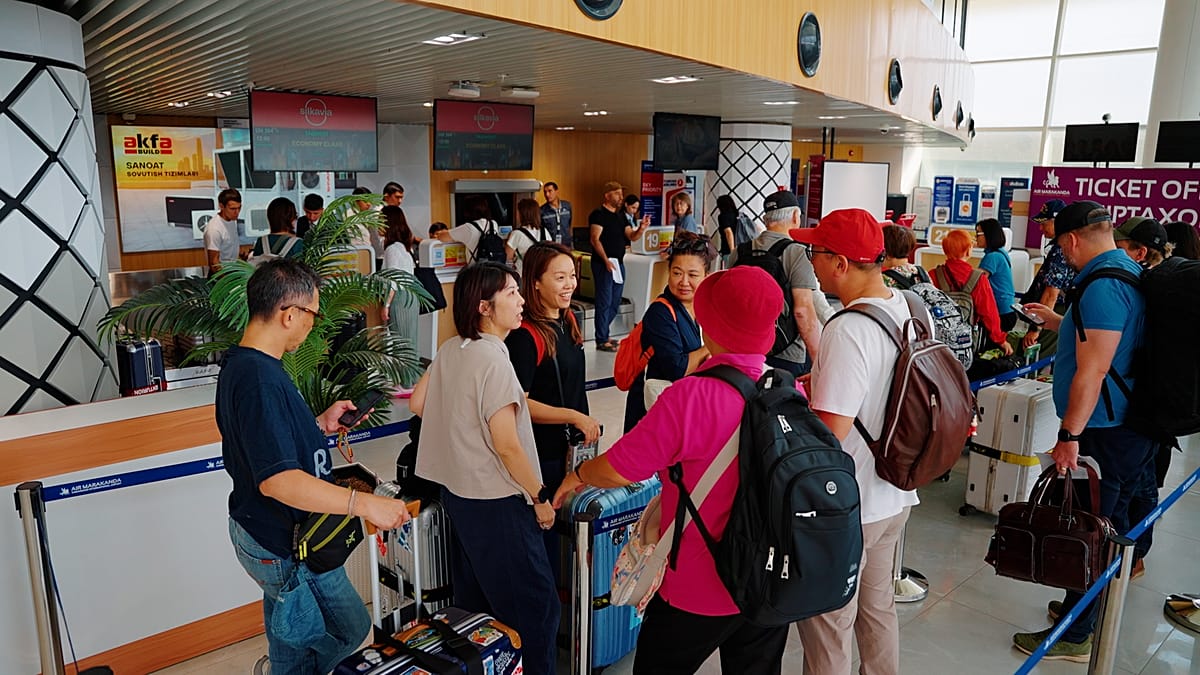
Samarkand International Airport illustrates how infrastructure investment is paying off. Passenger traffic has tripled since 2022, driven by a new terminal, an open-skies policy, and aggressive courting of international airlines. In 2025, the airport handled a record 1.5 million passengers, up about 10% from the previous year, with 24 airlines flying to 30 destinations.
“We are now actively developing flights to China. We are also working on opening routes to Southeast Asia,” said Dmitry Martynenko, the airport's Commercial Director. The airport has also introduced automated baggage handling, digital passenger services, and a capsule hotel to improve the traveller experience.
Rail is another focus. The new Jaloliddin Manguberdi train has cut the Tashkent–Khiva journey from 14 hours to seven and a half, making one of the country's key historical sites far more accessible. “Today, we are providing high-speed rail services to more than ten cities in Uzbekistan, and we plan to expand this network year by year,” said Hikmatulla Rahmetov, First Deputy Chairman of Uzbekistan Railways. A dedicated high-speed line between Tashkent and Samarkand, designed for trains up to 300 km/h, is also planned.
Better transport links could encourage tourists to venture beyond the main hubs, supporting hotels, restaurants, and local businesses in smaller towns.
Visa liberalisation and new source markets
Uzbekistan has been easing entry rules and promoting itself more aggressively abroad. Citizens of more than 90 countries can enter without a visa for varying periods, and electronic visas are available for others. The Tourism Committee is showcasing the country at international exhibitions, roadshows, and on digital platforms like Expedia and Trip.com.
A reciprocal 30-day visa-free regime with China has paid off handsomely. “By the end of 2025, the number of tourists from China had increased more than sixfold compared with 2023,” said Oybek Hakimov, Adviser to the Chairman of the Tourism Committee. The authorities are also diversifying beyond the classic Silk Road cities, developing more than 50 tourism villages and neighbourhoods, plus new mountain resorts and regional attractions.
These efforts could help distribute tourism spending more evenly, creating opportunities for local guides, craftspeople, and small businesses.
Service quality: the next frontier
As visitor numbers climb, service standards are becoming a competitive issue. Romanian tourist Cezar Marksteiner-Ungureanu, visiting for the first time, was struck by the sense of safety. “I felt all the time very secure. I think security is my last problem in Uzbekistan,” he said. But he also noted gaps in the information available at some museums, pointing to areas where visitor services could improve.
South Korean visitor Gown Yong Won was impressed by Khiva's preserved architecture and hospitality. “I've visited many historical sites in Europe and elsewhere, but I think this is the first time I've seen an entire city preserved as a historical site like this,” he said.
Uzbekistan's tourism development strategy for 2026–2030 sets an ambitious target of 20 million international visitors annually. Whether the country can convert its current boom into lasting economic value will depend on how well it manages infrastructure, service quality, and the balance between growth and sustainability. For European travellers, the expanding rail and air links—and the easing of visa rules—make Uzbekistan an increasingly accessible destination, one that offers a deep historical tapestry without the crowds of more established routes.