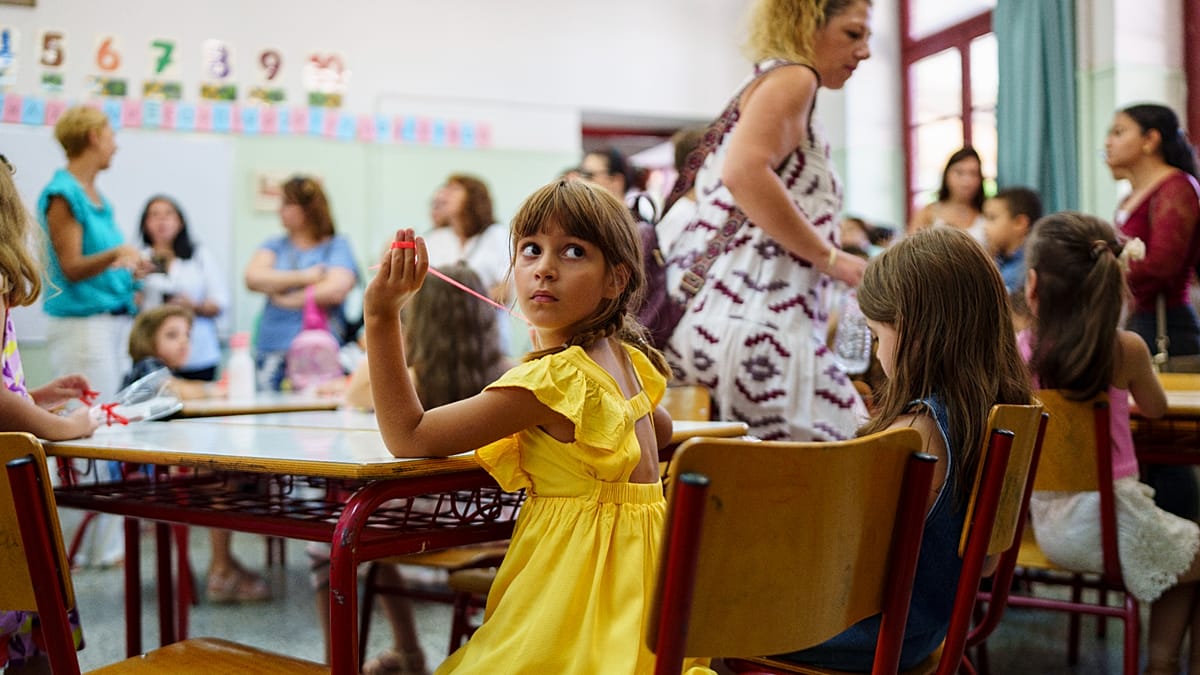
As the summer holidays wind down across Greece, families are once again facing the annual ritual of outfitting their children for the new school year. From Athens to Thessaloniki, bookshops and stationery stores are seeing a steady uptick in footfall as parents hunt for exercise books, pens, art supplies, and the rest of the kit that pupils will need from September.
The cost of this essential shopping trip, however, is far from uniform. According to a market survey by Ertnews Radio 105.8, the basic school supplies for a child in the early years of primary school will set families back roughly €100 to €120 this year. That figure excludes the school bag, lunch box, and water bottle, which can add significantly to the total.
A wide price spectrum
The gap between budget and premium options remains striking. A simple school bag can be found for as little as €15, while branded or more elaborate models can reach €100. Similarly, a classic blue 50-page exercise book starts at around €0.49, while a maths notebook ranges from €1.59 to €2.50. Writing notebooks are priced between €0.80 and €2, and two-subject spiral notebooks can cost anywhere from €1 to €8.
Art supplies show a similar spread. A pad of watercolour paper starts at about €2.25 and can climb to €15, with the average price hovering around €3.50. A set of 12 felt-tip pens or a set of brushes begins at roughly €2.50, but premium options can reach €10.
For many families, the final bill depends on the school's list, the quality of the products, and whether they opt for branded items or more economical alternatives. The choice can make a difference of several hundred euros over the course of a year.
Comparing with 2025 prices
To put this year's prices in context, the Greek Workers' Consumers Association (EEKE) published a price survey in September 2025, based on a sample of supermarket chains. At that time, a 17x24cm two-subject spiral notebook cost €1.64, while an A4 version was €2.55. A set of 12 fine washable felt-tip pens was €1.99, and another set of 12 felt-tip pens cost €1.89. A pack of five pencils was €1.49, four pens €1.29, and a compass with pencil €1.49. A sharpener and eraser set cost €0.99, a 20-centimetre ruler €0.36, and a pack of 12 coloured pencils €2.85.
These figures are not directly comparable with every product on shelves this year, as brands, packaging, dimensions, and points of sale vary. Still, they offer a useful benchmark for the level at which basic supplies were priced just a year ago.
In late August 2025, the Ministry of Development announced that, following a meeting with the Hellenic Supermarkets Association, retailers had pledged to keep school supply prices at their 2024 levels. The ministry's statement, however, did not include detailed price lists for individual products.
A year on, the picture suggests that in many categories the lowest prices remain relatively affordable. Yet the wide gap between budget and premium options means that the final cost can escalate quickly, especially for families with more than one child or those who prefer well-known brands.
This annual spending spree is not just a Greek phenomenon. Across Europe, the back-to-school season is a significant financial event for households, and the pressure is felt particularly in countries where incomes are under strain. Europe's education spending varies widely, and the burden on parents is often a reflection of broader economic conditions.
For now, Greek parents are doing what they have always done: comparing prices, hunting for discounts, and hoping that the school list does not grow longer than expected. As one Athens mother put it, "You want your child to have what they need, but you also have to watch the budget. It's a balancing act every September."