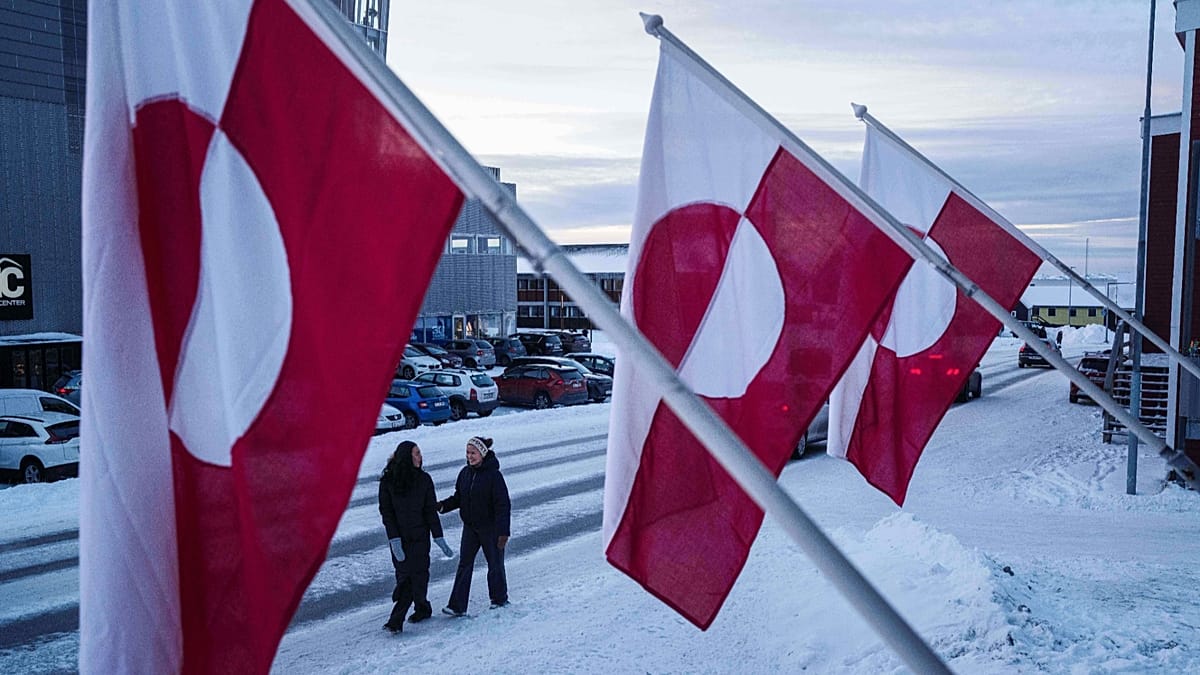
Greenland's government has announced the creation of a truth and reconciliation commission to investigate Denmark's historical forced contraception of Inuit women, a practice that has left deep scars across the Arctic territory. The decision follows the release of expert reports that failed to reach a unanimous conclusion on whether the campaign constituted genocide.
From the 1960s until 1990, more than 4,000 Greenlandic women were fitted with intrauterine devices (IUDs), in most cases without their knowledge or consent. Girls as young as 12 were affected, and some later discovered they could never have children. The scale of the programme was such that by the late 1970s, roughly one in two Greenlandic women of childbearing age had been fitted with an IUD, according to an investigation presented in September 2025.
Speaking to reporters in Nuuk, Greenland's Justice Minister Marianne Paviasen said the government could not definitively state whether the actions amounted to genocide. "We cannot say, on behalf of the government, whether there was genocide. This is something we can continue to debate," she said. Prime Minister Jens-Frederik Nielsen stressed that the immediate priority was to "begin the healing process," and confirmed that a reconciliation commission would be established, with hopes of cooperating with Copenhagen.
In Denmark, Prime Minister Mette Frederiksen adopted a conciliatory tone, saying: "We will handle the political process together with the government of Greenland. The most important thing for me is that we find the right path together." Frederiksen had already presented an official apology last year and pushed through a compensation scheme for affected women, which the Danish parliament approved on Thursday.
The four-member expert commission, tasked in August 2024 with shedding light on the scheme, could not agree on a single conclusion. Instead, it produced two separate reports: one stating that no genocide occurred, and another suggesting that it might have. Both reports, however, agreed that the programme likely violated multiple human rights and the rights of indigenous peoples.
Victims demand recognition
For Henriette Berthelsen, a 68-year-old psychologist and one of the most vocal survivors, the process has been deeply personal. "For me, this is not just about history or politics. It's my body, my life and my right to self-determination," she told AFP before the reports were presented. She also criticised the composition of the expert panel, noting that no Greenlandic Inuit had been appointed. "And once again, I see that it is others who will investigate and define what was done to me and to other Inuit women," she said.
Another survivor, Kirstine Najarak Berthelsen, described the long-buried trauma that resurfaced as media coverage intensified. "I realised everything it had cost me, all those hospitalisations, those surgeries, the schooling I missed and, above all, those pains I had never associated with that damn IUD," she said. "It was buried so deeply in my subconscious... Everything that happened to people is beyond imagination if you haven't experienced it yourself."
The scandal first came to light when a victim spoke publicly about her experience, and a 2022 podcast series revealed the full extent of the campaign. Since then, survivors and their advocates have pushed for official acknowledgment and accountability. Henriette Berthelsen has long called for a truth and reconciliation commission, arguing that it would allow the nation to "acknowledge what happened." She added: "I believe that only then will we be able to begin to heal and move forward - not as adversaries, but as human beings and as peoples equal in dignity."
The announcement comes as Greenland, a self-governing territory within the Kingdom of Denmark, continues to navigate its complex relationship with its former colonial master. The forced contraception scheme is widely seen as one of the darkest chapters in that history, and the new commission is expected to provide a platform for survivors to share their stories and for the broader society to confront the past. As the process unfolds, both Nuuk and Copenhagen will be watching closely to see whether it can deliver the healing that so many have sought for decades.