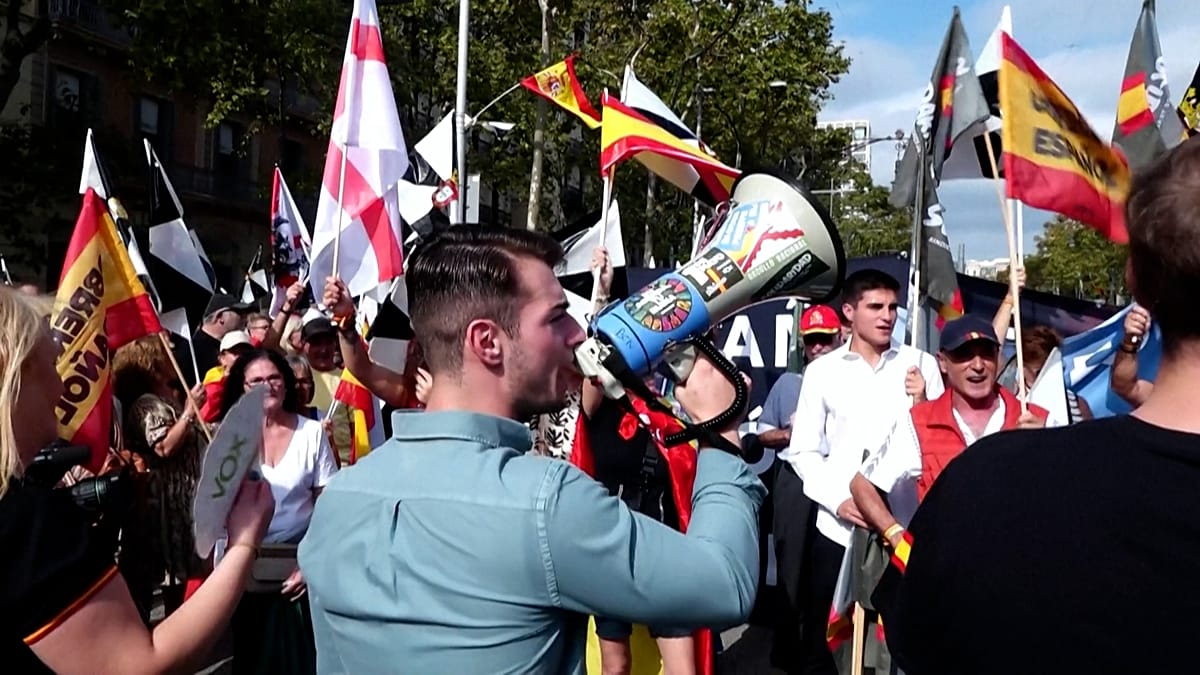
Spain marked its National Day on 12 October with a familiar mix of celebration and political friction. In Barcelona, thousands took to the streets to voice support for Spanish unity, while in Ceuta, the Spanish enclave on Morocco's Mediterranean coast, the leader of the far-right Vox party, Santiago Abascal, made a symbolic appearance.
The date, which commemorates Christopher Columbus's arrival in the Americas in 1492, has long been a flashpoint for Spain's territorial debates. This year was no exception, as the country's political class remains divided over the status of Catalonia and the North African enclaves.
Barcelona's pro-unity demonstration
In Catalonia's capital, organisers of the pro-unity rally sought to project a message of cohesion. Participants waved Spanish flags and carried banners reading "Somos España" (We are Spain), a counterpoint to the region's strong independence movement. The demonstration drew a diverse crowd, from families to retirees, many of whom expressed frustration with the separatist push that has dominated Catalan politics for over a decade.
"We are here to say that Catalonia is and will remain part of Spain," said Marta Rovira, a 54-year-old teacher from Barcelona. "The separatists do not speak for all of us."
The rally took place against a backdrop of ongoing political uncertainty. Catalonia's pro-independence parties have been locked in a standoff with Madrid over amnesty negotiations and the region's fiscal autonomy. The emergence of new political platforms challenging Spain's traditional two-party system adds another layer of complexity to the national conversation.
Ceuta and the far-right presence
Meanwhile, in Ceuta, Santiago Abascal's visit was seen as a deliberate provocation. The enclave, which shares a land border with Morocco, has been a recurring source of diplomatic tension between Madrid and Rabat. Abascal, known for his hardline stance on immigration and national sovereignty, used the occasion to criticise the government's handling of border security.
"Ceuta is Spain, and we will not allow anyone to question that," Abascal told supporters gathered near the border fence. His remarks came weeks after police cleared a makeshift camp on a Ceuta beach ahead of a royal visit, a move that drew criticism from human rights groups.
The enclave's strategic importance was underscored earlier this year when Spain's National Day parade showcased new military vehicles, including the Dragón armoured personnel carrier, amid an election buildup. The display was widely interpreted as a show of force aimed at both domestic and external audiences.
Territorial unity as a national theme
Spain's National Day has increasingly become a barometer of the country's territorial tensions. While the official celebrations in Madrid feature a military parade and royal attendance, the day often sparks counter-demonstrations in regions with strong nationalist sentiments, such as Catalonia and the Basque Country.
For many Spaniards, the day is a reminder of the delicate balance between central authority and regional autonomy. The Spanish Constitution of 1978, which established the current system of autonomous communities, was a compromise designed to accommodate the country's diverse identities. Yet four decades later, the debate over how much power should reside in Madrid remains unresolved.
In Ceuta and Melilla, the other Spanish enclave on the African coast, the issue is particularly acute. These territories are geographically part of Africa but politically and culturally European, a duality that makes them a focal point for discussions about Spain's borders and its relationship with the European Union.
The EU's role in these matters is not insignificant. Border management and migration policy are shared competencies, and Brussels has often weighed in on Spain's handling of its southern frontier. The recent drug shortage in Spain, which exposed broader EU supply chain vulnerabilities, is a reminder that even domestic issues can have European dimensions.
As the day's events unfolded, political leaders across the spectrum offered their interpretations. Prime Minister Pedro Sánchez, in a statement from Madrid, emphasised the importance of "unity within diversity," a phrase that has become a staple of his government's messaging. Opposition leaders, meanwhile, accused the executive of being too lenient with separatist movements.
The scenes in Barcelona and Ceuta reflect a country that is both proud of its pluralism and wary of its fractures. For now, the National Day serves as an annual reminder that Spain's territorial unity is not a settled matter but an ongoing project, one that will continue to shape its politics for years to come.