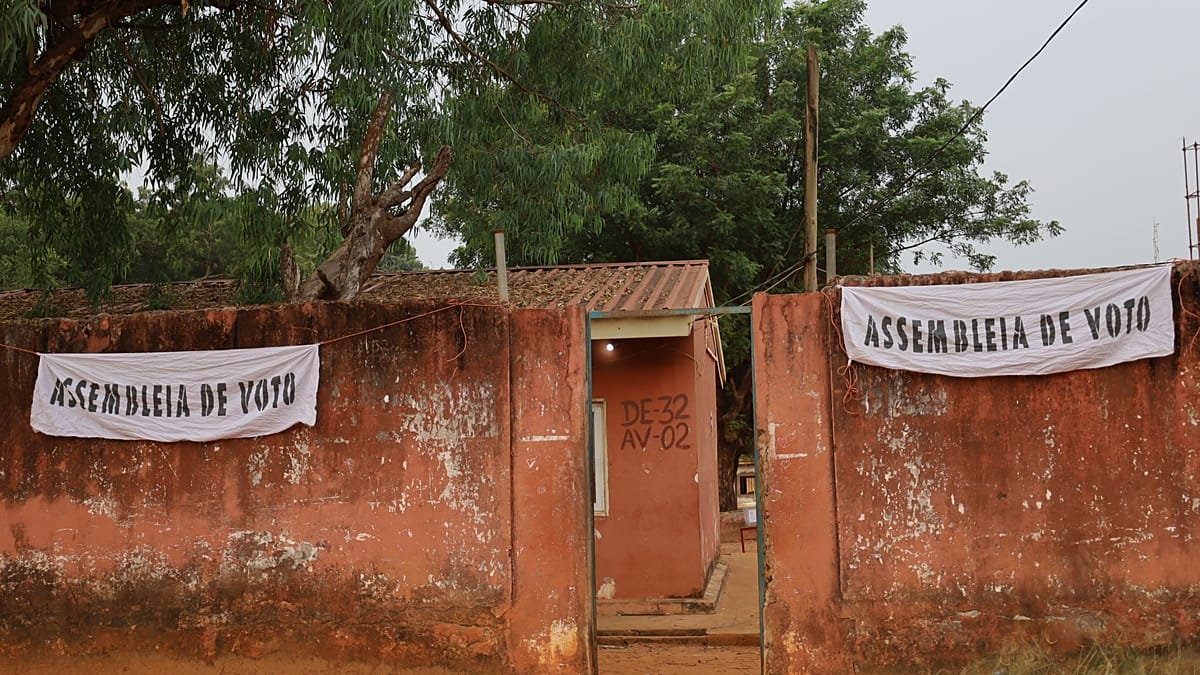
On Sunday, Guinea-Bissau's military-led transitional government will hold a referendum on a new constitution that would significantly strengthen the president's powers, a move critics say is designed to entrench the junta's grip on power ahead of elections later this year. The vote comes just nine months after the November coup that ousted the civilian government, and the opposition is urging citizens to stay home.
The proposed charter, drafted by unelected transitional bodies that emerged from the coup, would allow the president to chair the Council of Ministers and would alter the rules for appointing the prime minister. The current constitution, in force since 1996, has often been blamed for the country's chronic instability, but the way this revision is being pushed through has drawn sharp criticism from human rights groups and political analysts.
Bubacar Turé, head of the Guinean League for Human Rights, told Euronews that only the "yes" campaign is officially active, and it is being run "in all regions" by the military and its allies. "There is a campaign under way led by the military, their political supporters and also some senior figures from the previous regime," he said. "The climate is not favourable, it is not a climate of freedom."
Turé noted that advocates of a "no" vote are not allowed to campaign, and that several fundamental freedoms remain suspended. He added that the opposition, including civil-society groups, has issued a strong call for a boycott.
A 'staging' to legitimise the coup
The main opposition party, the African Party for the Independence of Guinea and Cape Verde (PAIGC), has also called for a boycott, describing the referendum as "a staging meant to give the appearance of legitimacy to the new constitution." In a statement, the party said the institutions born of the coup are "devoid of any democratic legitimacy" and that the authorities are preventing the "no" side from campaigning.
PAIGC leader Domingos Simões Pereira went further, telling Portuguese broadcaster RTP that the referendum is an "absolute farce." He said, "What will happen on 30 August is the continuation of the coup d'état carried out on 26 November."
The transitional authorities, however, defend the document. Nelson Moreira, second vice-president of the Transitional Council that replaced parliament, told RFI that the current constitution has often been cited as "the cause of instability in Guinea" and that "through the High Military Command it was possible to turn that dream into reality."
Constitution already in force?
Turé also pointed out that the constitutional text has already been published in the Official Gazette, raising the question of what legal effect the referendum can have. "What legal effect can this referendum have if the constitution is already in force, since it has already been approved, promulgated and is in force in Guinea-Bissau?" he asked.
The new charter, Turé said, entails "an excessive concentration of powers in the hands of the president of the republic." While the post of prime minister remains, the appointment criteria have changed. "In the previous constitution, the requirement for appointing the prime minister was based on the election results," he explained. "This new constitution, however, adds the existence or not of a parliamentary majority that guarantees stability. This opens up the possibility that legislative elections will have no meaning at all."
He also noted that the chapter on constitutional review has been removed entirely, calling that "absurd, strange and extremely dangerous for the rule of law and for democracy."
The process itself has been conducted in secrecy, Turé said. "No one was consulted – not political parties, not civil-society organisations, let alone traditional leaders, religious leaders, and so on. Everything was done in secret."
'Nobody knows where this will end'
Tamilton Teixeira, a university professor and commentator on Guinean media and RTP África, echoed these concerns. "Nothing guarantees that this process is not just a mere formality," he told Euronews, also highlighting the publication of the constitution. He acknowledged that constitutional revision in Guinea-Bissau has long been needed, but questioned the manner in which it is being carried out.
"It could have been done through a constitutional reform that was legal and democratic, which is not the case now," Teixeira said. "Nobody knows where this will end, what it will lead to."
Teixeira stressed that the country is being governed by an armed group that seized power and then "began to raise issues that we could never have imagined would be among its concerns." He argued that the proposed text reflects the way former president Umaro Sissoco Embaló behaved during his six years in office. "What is being put to a vote is the way Umaro has run the country over the past six years," he concluded.
The referendum is being watched closely in Brussels, where the EU has repeatedly called for a return to constitutional order in Guinea-Bissau. The bloc has suspended some cooperation programmes since the coup, but critics say stronger action is needed. As the EU grapples with security challenges closer to home, the situation in West Africa risks being overlooked. The outcome of Sunday's vote, and the legitimacy of the transition, will have lasting implications for the region's democratic trajectory.