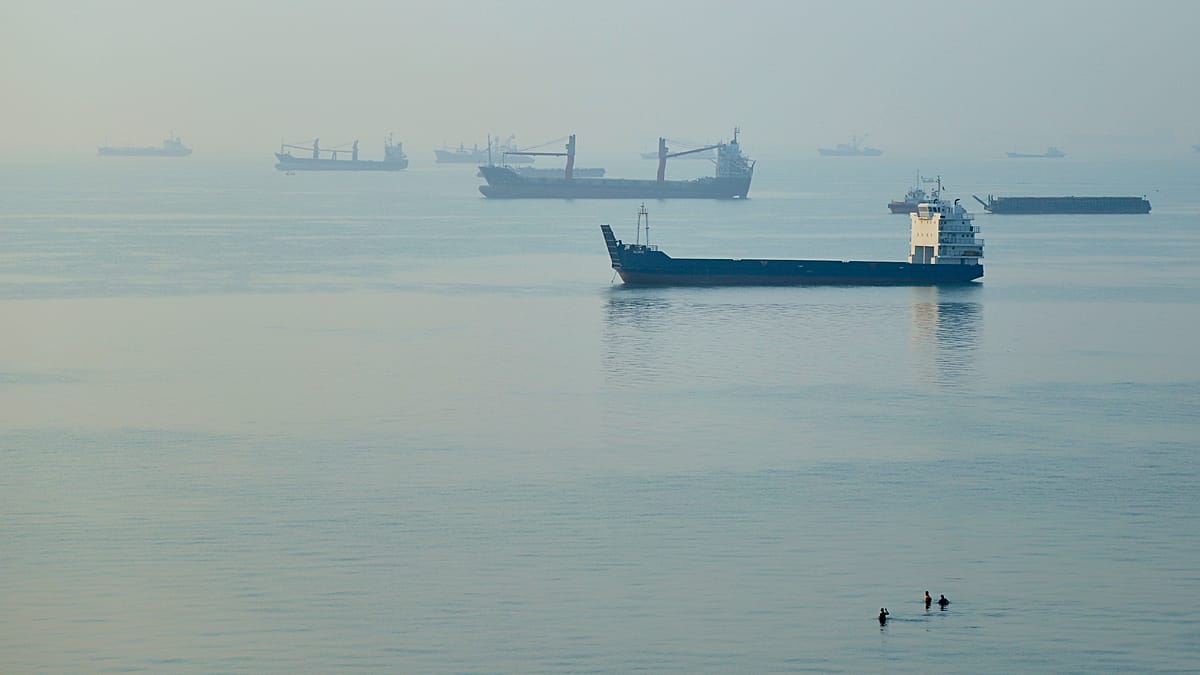
Seven months into the conflict with Iran, Gulf producers are gradually restoring oil flows, but the route through the Strait of Hormuz remains fraught with danger and European buyers are still feeling the pinch.
Preliminary data from Kpler show Middle East crude exports reached 16.3 million barrels a day in September — the strongest monthly figure since the war erupted in late February. That is still roughly 3.2 million barrels below the 19.5 million recorded in February, underscoring how far the region is from normal operations.
Saudi Arabia drove much of the rebound, more than doubling its shipments from 2.45 million barrels a day in August to about 5.4 million in September. Riyadh redirected additional crude from its Gulf terminals after attacks damaged the East-West pipeline that normally carries oil to the Red Sea. Flows through Hormuz were projected at around 9.7 million barrels a day, with the remainder leaving via ports outside the strait.
LNG traffic resumes, but contracts remain suspended
Several LNG carriers linked to Qatar also transited Hormuz this month, after no visible crossings were recorded in August. Ship-tracking data from Kpler and LSEG show the GasLog Skagen off Sri Lanka on Sunday, carrying a cargo from Ras Laffan, while the Al Ghashamiya delivered to India and the Shandong Redwood headed to Pakistan. The Al Daayen emerged with a shipment for China, and an empty tanker, Al Mafyar, entered the strait on 22 September.
Yet normal trade is far from restored. QatarEnergy has extended force majeure for several European and Asian customers, and Italian utility Edison said it received a new notice pushing the suspension to early December. Six more LNG cargoes due at the Adriatic LNG terminal will not arrive, bringing the total number of missed deliveries since April to 35. Edison has replaced 23 of them, mainly with gas from the United States.
Edison’s 25-year contract with QatarEnergy supplies 6.4 billion cubic metres of gas a year — roughly 10% of Italy’s total consumption. Pakistan and Bangladesh have also been told that suspensions will continue through November.
Force majeure allows a company to pause contractual obligations when events beyond its control prevent fulfilment. The disruption began after joint US-Israeli strikes on Iran on 28 February, which sharply reduced traffic through Hormuz while both Washington and Tehran targeted commercial vessels in and around the strait.
Qatar’s Energy Minister Saad Sherida Al-Kaabi said last week that building a pipeline around the strait would make no economic sense, as it would require a new liquefaction plant outside Qatar. Every Qatari LNG tanker must pass through Hormuz, leaving the country with no alternative export route.
Qatar exported only 18 LNG cargoes in the first six months of the war, compared with 509 in the same period a year earlier, according to data provider ICIS. The exact number of recent crossings is unclear because some ships switch off their tracking systems while transiting the strait.
On the diplomatic front, US President Donald Trump on Saturday rejected an Iranian proposal to reopen Hormuz and end the fighting within seven days. The offer had been passed to Washington through Qatari mediators, who continue to push for talks. Iranian Parliament Speaker Mohammad Bagher Ghalibaf warned that no infrastructure in the region would be safe unless Iran’s security is guaranteed. “In a region where Iran cannot sell oil, no one else will sell oil either,” he told state broadcaster IRIB.
For European governments and utilities, the prolonged disruption is a stark reminder of their continued reliance on Gulf energy. While the US has stepped in as a stopgap supplier, the fragility of global LNG markets remains a central concern for EU efforts to secure stable energy supplies. The bloc’s foreign policy chief has called for toll-free passage through Hormuz, but with no political breakthrough in sight, European buyers may have to brace for more months of uncertainty.