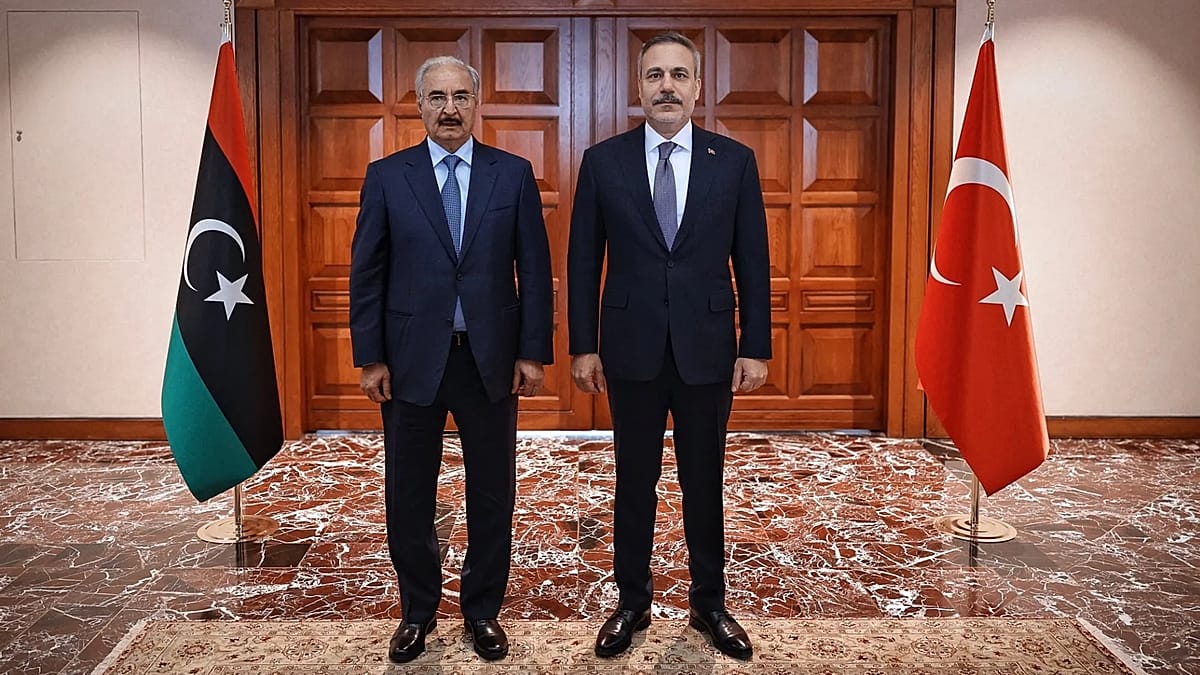
Khalifa Haftar, the commander of the Libyan National Army (LNA) that controls eastern Libya, arrived in Ankara on Tuesday for a series of high-level meetings with Turkish officials. The visit comes just days after Ukrainian naval drones sank a Russian warship at Benghazi's naval base, an operation that has added new layers of complexity to Libya's already fragmented political landscape.
Haftar, accompanied by his son Saddam Haftar, met Defence Minister Yaşar Güler and Foreign Minister Hakan Fidan on Tuesday. On Wednesday, he held further talks with Fidan, Energy Minister Alparslan Bayraktar, and İbrahim Kalın, head of Turkey's National Intelligence Organisation (MIT). The LNA's own footage showed Chief of General Staff Selçuk Bayraktaroğlu receiving Haftar upon arrival. As of Wednesday, no official statement had been issued on the substance of the discussions, and no meeting with President Recep Tayyip Erdoğan appeared on the presidency's public schedule.
A delicate balancing act
Turkey has long maintained active relations with both of Libya's rival administrations. Between 2019 and 2020, Ankara provided military support to the Tripoli-based Government of National Unity (GNU), led by Prime Minister Abdulhamid Dbeibah, which was instrumental in repelling an LNA offensive on the capital. Since then, ties with the Haftar camp have improved steadily, with Turkish officials making regular visits to Benghazi and Turkish companies investing in the region, primarily in construction.
The timing of Haftar's visit is significant. It comes ahead of Erdoğan's planned trip to Tripoli on 8-9 December for the Turkey-Africa Partnership Summit, which would be his first visit to Libya in 15 years. Erdoğan last visited Libya on 16 September 2011, shortly after Muammar Gaddafi's overthrow, when he met leaders of the National Transitional Council and signed cooperation agreements.
Diplomatic contacts have intensified in recent weeks. Fidan and Kalın met Prime Minister Dbeibah in Istanbul on 21 November. Turkey also hosted Khalid Haftar, the LNA's chief of staff, earlier in November, and in October military representatives from both eastern and western Libya held talks in Ankara aimed at unifying the country's armed forces.
Russia's shadow over Benghazi
The Ukrainian drone strike on the Russian warship Merkury at Benghazi's naval base on Saturday has heightened tensions. Ukrainian President Volodymyr Zelenskyy confirmed the operation, praising it as exemplary, while a cargo vessel was also damaged. The internationally recognised Tripoli government has requested an explanation from Ukraine, while eastern Libyan authorities have called for an international investigation into what they describe as a Ukrainian military presence in the country.
Russia has backed Haftar since at least 2019, when Wagner Group mercenaries supported the LNA's offensive on Tripoli. Wagner has since been reconstituted as Africa Corps, which maintains logistics bases in southern and eastern Libya and has announced plans for a naval facility in Tobruk. Moscow views eastern Libya as a bridgehead for its operations across the Sahel and a potential foothold in the southern Mediterranean, particularly after the fall of its ally Bashar al-Assad in Syria.
The Ukrainian strike, however, has exposed the vulnerability of Russian assets in Libya. It also raises questions about the extent of Ukrainian operations in the region, and how they might affect the delicate balance of power. As the UN has called for a probe into the drone strikes, the incident has unsettled European capitals, particularly Italy, which has historical ties to Libya and fears a renewed civil war.
Maritime disputes and European concerns
Turkey's engagement with Libya is not limited to security. In October, the eastern-based House of Representatives endorsed the 2019 memorandum on maritime jurisdiction areas signed between Ankara and the former Tripoli-based Government of National Accord. That agreement, which delineates maritime boundaries in the eastern Mediterranean, drew sharp reactions from Greece, Cyprus, and the European Union, as it challenges their own claims and energy exploration rights.
Erdoğan's upcoming visit to Tripoli is likely to reinforce Turkey's position on maritime issues, as well as its broader economic and political influence in Libya. For the EU, which has struggled to forge a coherent policy on Libya, the prospect of a more assertive Turkish role is a source of concern. The bloc has also been wary of Russian expansion in the region, and the recent drone strike has only added to the volatility.
As the EU prepares its 22nd sanctions package against Russia, the situation in Libya remains a reminder of the interconnectedness of conflicts in Europe's neighbourhood. The Mediterranean, already a hotspot for migration and energy disputes, is becoming a stage for great-power rivalry.
Haftar's visit to Ankara, and Erdoğan's forthcoming trip, underscore Turkey's ambition to play a central role in Libya's future. But the path to stability remains fraught, with competing interests, foreign interventions, and a fragile political process. For now, Ankara is walking a tightrope, courting both sides while trying to protect its own strategic interests.