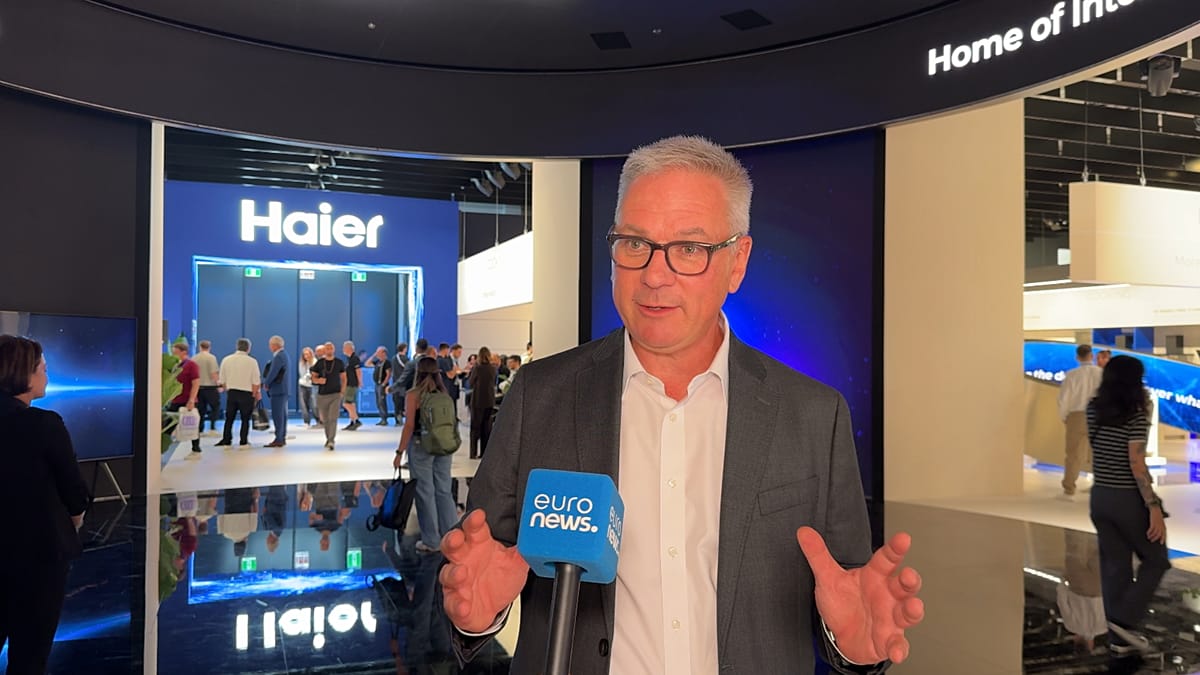
At this year's IFA in Berlin, Haier is presenting a vision that goes beyond the smart home. Under the banner "Home of Intelligent Possibilities," the Chinese appliance and consumer electronics group is demonstrating how AI and connected devices could soon anticipate household needs rather than simply respond to commands.
Euronews spoke with Neil Tunstall, CEO of Haier Europe, about the company's roadmap for the "intelligent home" and how quickly these concepts might reach European consumers.
From smart to intelligent
The shift, Tunstall explains, is about placing people at the centre of the system. Instead of a collection of individual gadgets, Haier envisions a network of appliances that work together around daily routines. This means ovens that can identify what is inside and adjust cooking times automatically, or washing machines that learn loading habits and optimise cycles.
"In the area of cooking, the possibility for the product to see what's inside, to make sure it's done the right way, to take out the variation of people not being so confident in putting something in the oven and hoping it's cooked," Tunstall said. "The product now will do that for you. And that hopefully means then that we can actually enjoy eating much more at home."
Sustainability as a driver
Beyond convenience, sustainability is a major motivation. Tunstall points out that the biggest environmental impact of appliances occurs during their use, as they consume significant electricity and water. Smart technology can help manage this consumption more efficiently, reducing the overall footprint.
"If you think about the whole cycle, from manufacturing, from logistics, the lorries moving around, the biggest one for our industry is actually use, because we are electrical products, so we use a lot of electricity and water," he said.
Haier's approach, which it calls "end-to-end innovation," applies AI and data across design, production, and delivery. By analysing how consumers actually use their appliances, the company aims to create new use cases and improve efficiency throughout the value chain.
"We have mass of big data where we can understand how do people use products, which programmes do they use? How do they load the washing machine? What do they do? All this data comes together to allow us then to create new use cases and new things," Tunstall explained.
€13bn investment in AI and robotics
To accelerate this transformation, Haier plans to invest €13 billion over the next five years in AI, robotics, R&D, and advanced engineering. Tunstall says this investment will speed up the introduction of new technologies across all product categories, benefiting both consumers and trade partners.
"We want to innovate to bring better value to consumers and to our trade partners. And that 13 billion will be accelerating how fast we can bring innovation to market," he said.
Humanoid robots: not replacing humans
Looking further ahead, Tunstall sees humanoid robots becoming part of the home environment, but he is careful to stress that the goal is not to replace people. Instead, robots could handle basic tasks like vacuuming or mowing the lawn, freeing up time for more meaningful activities.
"We're not trying to replace the human," Tunstall said. "But there are basic tasks that robotics can do. Already robot vacuum cleaners, robots cutting the grass. And some of the basic things that we need to do ourselves, the robots will be able to do it for us together with AI."
He believes these innovations will arrive sooner than many expect. "I think you will see our industry creating this innovation very rapidly. Things move faster than we think," he said, adding that while the technology is not fully here yet, it will be commercialised soon.
Adapting to Europe's diverse consumers
Bringing these products to market also means adapting them to local habits. Tunstall notes that there is no single European consumer. The French, British, and Italian markets each have distinct cooking and laundry practices, requiring tailored solutions.
"The Chinese consumer cooks something completely different to the British consumer, as you can imagine," he said. "The French consumer is different to the European, the English consumer very different Italians, so even within Europe we don't have one consumer, we have many different cases and we need to make sure then that we are truly listening to the individual consumer and giving them the product they want."
Haier's global scale allows it to develop core technologies centrally while adapting the final products to regional preferences. This strategy is evident at IFA, where the company is showcasing a range of appliances designed for European kitchens and homes.
As the boundaries between digital and physical living continue to blur, Haier's vision offers a glimpse of a future where technology works quietly in the background, making daily life more convenient and sustainable. For European consumers, that future may be closer than it seems.