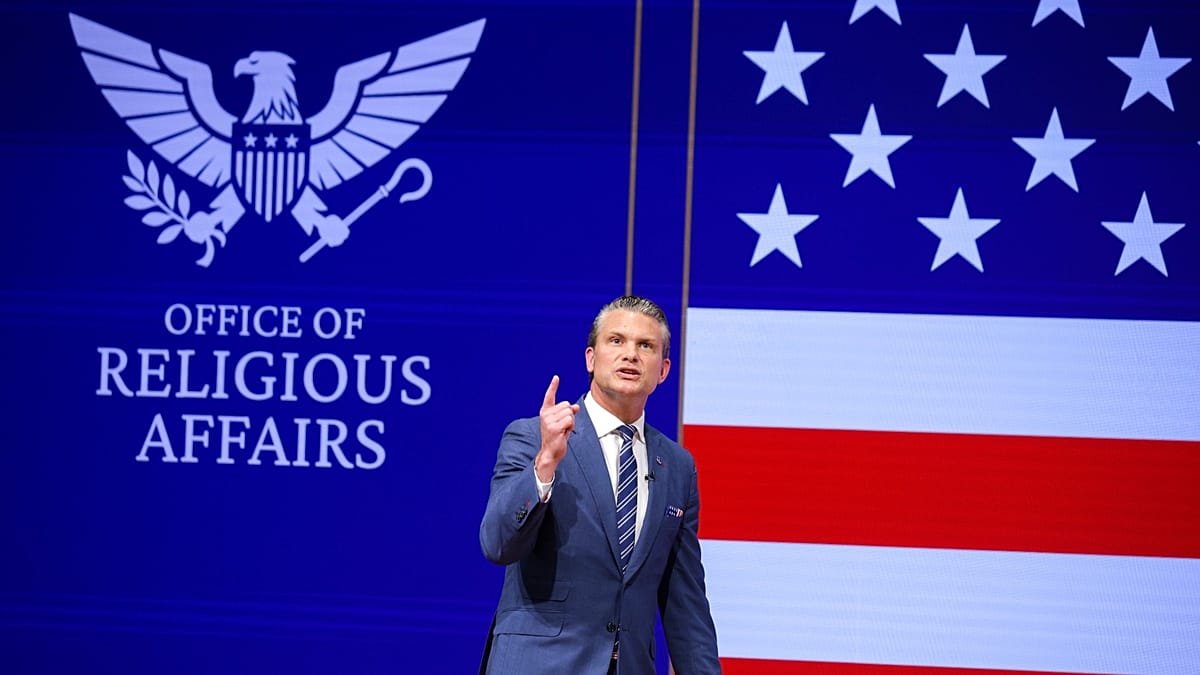
US Defense Secretary Pete Hegseth has announced the creation of a new Office of Religious Affairs (ORA) at the Pentagon, a move that deepens his efforts to weave faith into the fabric of the American military. The office, which will report directly to Hegseth, is tasked with advocating for chaplains and religious support at the highest levels of the Department of Defense.
In a speech delivered on Wednesday at Marine Corps Base Quantico in Virginia, Hegseth framed the initiative in explicitly spiritual terms. "Our department is, you might say, putting on the full armour of God, because while we wage physical war, we all know the real battle is spiritual," he said. The secretary, who has frequently described the United States as a Christian nation, has already hosted worship services for Pentagon employees and pushed for a more faith-centric approach to military life.
The Pentagon's statement insists the ORA will not "compel religious participation, favour one faith, or diminish the rights of personnel of any faith or lack thereof." Yet the announcement has drawn swift criticism from advocates of church-state separation. Rachel Laser, president of Americans United for Separation of Church and State, which has sued the Pentagon over its worship services, argued that the new office "violates that promise by elevating Christianity to an even higher role in shaping US military policy."
The creation of a religious affairs office is not unprecedented in the US federal government. Similar offices have existed since the George W. Bush administration, with variations under Barack Obama and Joe Biden. Donald Trump established a White House Faith Office during his first term and has revived the concept in his current presidency. However, the Pentagon's version is distinct in its direct reporting line to the secretary and its explicit focus on spiritual warfare.
Shaun Casey, who led the State Department's Office of Religion and Global Affairs under Obama, offered a contrasting model. "It was there to understand what were the political implications of lived religion in the various hot spots around the world," he said, noting that his office did not promote religion or spiritual well-being. The new Pentagon office appears to take a different approach, with a memo outlining duties that include coordinating "faith-based homeschool support for military families" and "faith-based initiatives supporting Department-wide suicide reduction."
The leader of the ORA has not yet been named. Hegseth has also pushed the military school system to incorporate more coursework influenced by conservative and Christian perspectives, and he has ordered chaplains to remove their rank insignia in favor of religious symbols. The Defense Department has slashed the number of officially recognized religious affiliations from over 200 to just 31, a list that no longer includes atheists, Unitarian Universalists, pagans, or Wiccans.
Hegseth's address to chaplains at Quantico was laden with Christian imagery. "Live your calling. Stand firm. Preach truth. Minister to the flock," he told them. He has expressed a desire for chaplains to focus more on God and less on therapeutic "self-help and self-care," even as the military increasingly relies on chaplains to address rising rates of mental health distress among troops.
The move has implications beyond the United States, particularly for European allies who watch Washington's defense posture closely. The intertwining of evangelical Christianity with military leadership raises questions about the cultural and ethical dimensions of NATO cooperation, especially in missions where religious sensitivities are paramount. As European defense officials assess the direction of US policy, the role of faith in the Pentagon's decision-making will be a point of observation.
For now, the ORA stands as a testament to Hegseth's vision of a military that is as spiritually fortified as it is physically prepared. Whether that vision strengthens or strains the fabric of the armed forces remains to be seen, but its creation marks a significant shift in how the Pentagon approaches the intersection of faith and service.