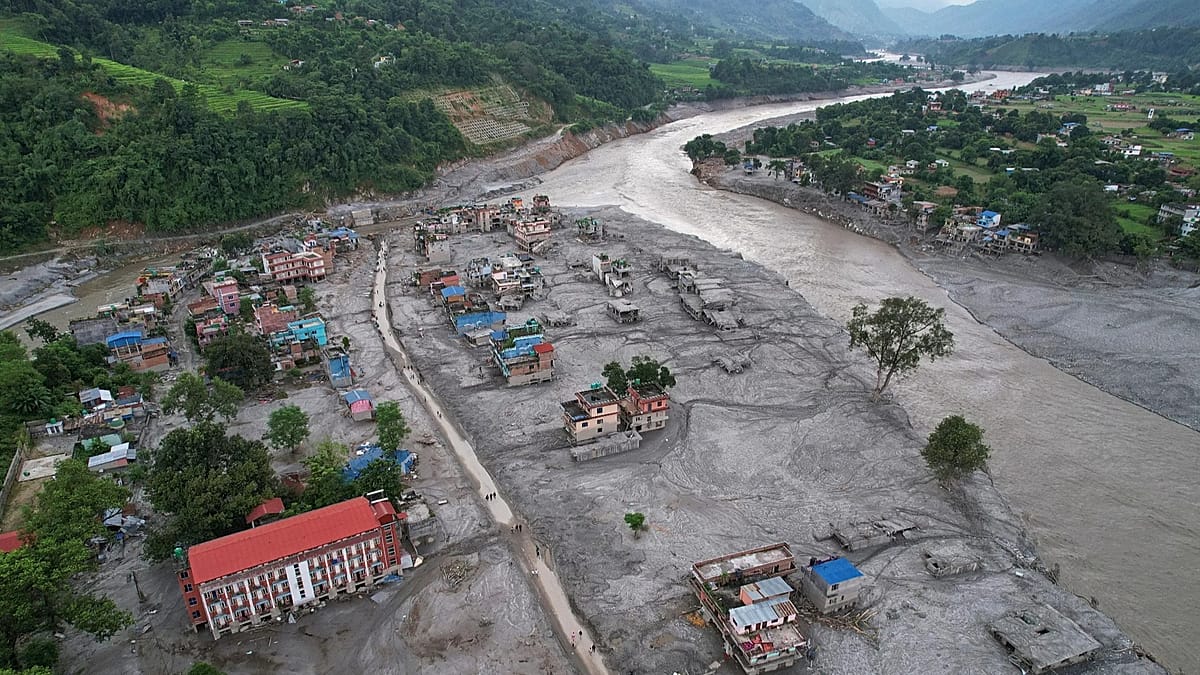
Climate change played a decisive role in last month's catastrophic flood in the Himalayas, according to a rapid analysis by the World Weather Attribution group. The disaster, which struck near Nepal's border with China on 26 August, was not a typical extreme weather event, but the long-term effects of rising temperatures had so weakened the mountain that a collapse became far more likely.
The collapse unleashed a torrent of water, ice, boulders and sediment that swept through villages along the Trishuli River corridor, killing more than 1,300 people and leaving over 5,000 missing. The report, released on Thursday, describes a “compound crisis” in which glacier retreat, permafrost thaw and geological instability combined to trigger the tragedy.
“This disaster was not an extreme weather event, but the fingerprints of climate change are still clear to see in long-term changes,” said Ben Clarke, a climate researcher at Imperial College London and one of the report's authors.
Warming pushes the freezing line higher
The analysis found that one of the clearest climate-related changes is the rising elevation of the freezing threshold. Across the Himalayas, the altitude at which the ground remains frozen year-round has climbed by roughly 100 metres per decade. This exposes rock at ever-higher elevations to periods above freezing, causing permafrost to thaw and cracks to form within the ice, ultimately weakening the rock face.
Jakob Steiner, a geoscientist at the University of Graz who has worked in the region since 2006 but was not involved in the report, said monitoring instruments at around 5,000 metres now show that some rock and ground no longer stay frozen throughout the year. “This means that the ground that was sitting below ice for hundreds and thousands of years is now becoming exposed,” he said.
The report also highlights glacial retreat as a destabilising force. Glaciers in the region have been losing mass at a rate equivalent to more than half a metre of thinning per year. The Langtang Lirung glacier, near the disaster site, has retreated about half a kilometre since the 1990s, exposing rock that was once covered by ice. As glaciers shrink, they remove pressure that helped support adjoining rock walls, while also producing additional meltwater that can saturate and weaken slopes.
The Himalayan region holds the largest volume of snow and ice outside the polar regions. More than 63,000 glaciers feed at least ten major Asian river systems, supporting the food, water, energy and livelihood security of billions of people. Yet studies show that around 78% of the glacier area, located between 4,500 and 6,000 metres above sea level, is highly exposed to warming. UN reports indicate that between 2000 and 2019, glaciers lost 267 billion tonnes of ice per year — roughly the mass of 46,500 Great Pyramids of Giza.
The weeks before the collapse were also unusually warm, with July and August 2026 recorded as the warmest such months locally. This warmth likely accelerated meltwater production and further weakened the slope.
“Other than the potential geological factors like earthquakes that are weakening the bedrock, all these other factors are made worse by human-induced climate change,” said Friederike Otto, climate scientist at Imperial College London and another author of the report.
The findings echo broader concerns about mountain stability across the Alps and other European ranges, where similar processes are underway. As positive tipping points could help reverse some damage, the report underscores the urgency of cutting greenhouse gas emissions to limit further warming and reduce the risk of such compound disasters.