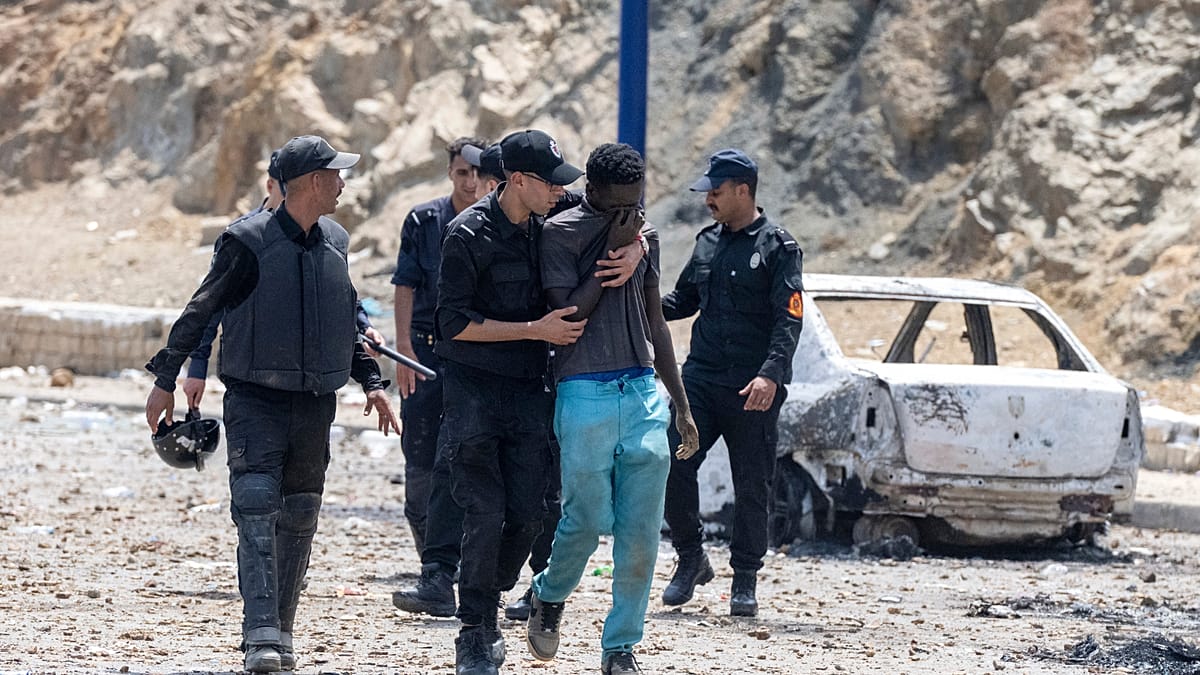
What began as a handful of Instagram posts suggesting that Spain's border with Morocco was about to open quickly spiralled into one of the most serious migration crises between the two countries in years. Within days, an estimated 60,000 people had reached the Spanish enclave of Ceuta, overwhelming local authorities and leaving more than 80 dead on both sides of the frontier.
The trigger was not a policy change or a diplomatic breakthrough, but a wave of viral content. Accounts such as Haraga Ceuta — a name that references the Moroccan dialect term for young migrants who destroy their documents and attempt illegal crossings — claimed the border would be open. Facebook groups like Fnideq Bab Sebta shared live updates on coastguard patrols, while TikTok videos mapped out the exact swimming routes around the breakwater that marks the border.
In the Moroccan city of Larache, about 150 kilometres from Ceuta, three friends saw one such video and decided to take the risk. Anas Amrani, Yahya Harak and Ismail Atik were among the thousands who believed that Europe was suddenly within reach. Buses from Fnideq, the Moroccan town nearest to Ceuta, were packed; commuter trains and taxis were filled to capacity.
Chaos on the breakwater
When the migrants reached Ceuta's shores, the narrow concrete breakwater became a scene of chaos. According to several migrants interviewed by the Associated Press, people surged onto the slippery rocks simultaneously, pushing and climbing over one another. Some described seeing people fall into the water and become trapped beneath the crowd, unable to surface as others struggled to make it onto land.
“I stepped on the face of a dead man as I was getting out. May God forgive me and all those whose bodies were found,” said Lahcen Kalouch, a Moroccan migrant who reached Ceuta before returning home devastated. At least 72 people died on the Spanish side of the border, and another 11 on the Moroccan side, according to authorities.
Most of the survivors have since returned to Morocco, either expelled by Spanish authorities or leaving voluntarily because of the lack of shelter, food and water in Ceuta. But the consequences of last week's events will endure.
Misreading Spain's migration policy
Some migrants misinterpreted recent legislative changes in Spain, including Prime Minister Pedro Sánchez's measures to regularise migrants' status and a court ruling that limits the authorities' ability to immediately return migrants who swim to Ceuta. Sánchez's regularisation effort was intended only for people already living in Spain before 1 January, most of whom come from Latin America and entered legally but overstayed their visas. Yet the policy was widely misunderstood in Morocco, with some believing they would be allowed to stay. That belief spread rapidly online.
“Pedro Sánchez is a liar. He told us that if we came, we would get jobs and papers, but they sent us back,” said Adam Assil, a migrant from Casablanca, even though Sánchez never made such a promise.
Migrant advocates noted that this episode was different from previous attempts to reach Ceuta because of the way rumours spread online, encouraging thousands to head for the enclave at the same time rather than in smaller, more scattered groups.
Security failures on both sides
Moroccan authorities said the migration wave was not spontaneous. The Interior Ministry blamed “the exploitation of digital space” and “the spread of disinformation”, though officials provided no evidence and said an investigation had been opened. The Spanish government made similar statements.
Officials in Ceuta said they had warned Madrid about a rise in arrivals before the mass surge. Spain's Interior Ministry said on Monday it had received “no report or warning about the mass arrival of people in Ceuta”, and praised cooperation with Moroccan authorities in returning most of the migrants.
“No one has explained how these people managed to get across the border,” said Mustapha Azaitraoui, a Moroccan geographer specialising in migration dynamics. “If a large group of people can cross the border in these circumstances, it suggests a broader security problem that has yet to be acknowledged publicly.”
Migrants reject smuggling claims
Both Morocco and Spain blamed the crisis on human traffickers and smuggling networks, saying organised criminal groups had encouraged the mass crossings. However, Moroccan migrants who returned and were interviewed by the AP mostly rejected that explanation.
“No one smuggled me. I chose to go of my own free will, but that country is not worth such sacrifice,” Kalouch said. “There are no mafias. The border was open and I crossed. But now I regret it,” said Omar Danbor, 17, from Fnideq, his clothes still wet from the journey back.
The episode has raised urgent questions about the reliability of social media as a source of information in migration contexts, and about the ability of European border authorities to respond to sudden, digitally fuelled surges. As the EU debates migration policy, the Ceuta crisis serves as a stark reminder of how quickly disinformation can translate into human tragedy. For more on the broader implications, see how Spain's border with Morocco collapsed and Spain's call for EU solidarity.