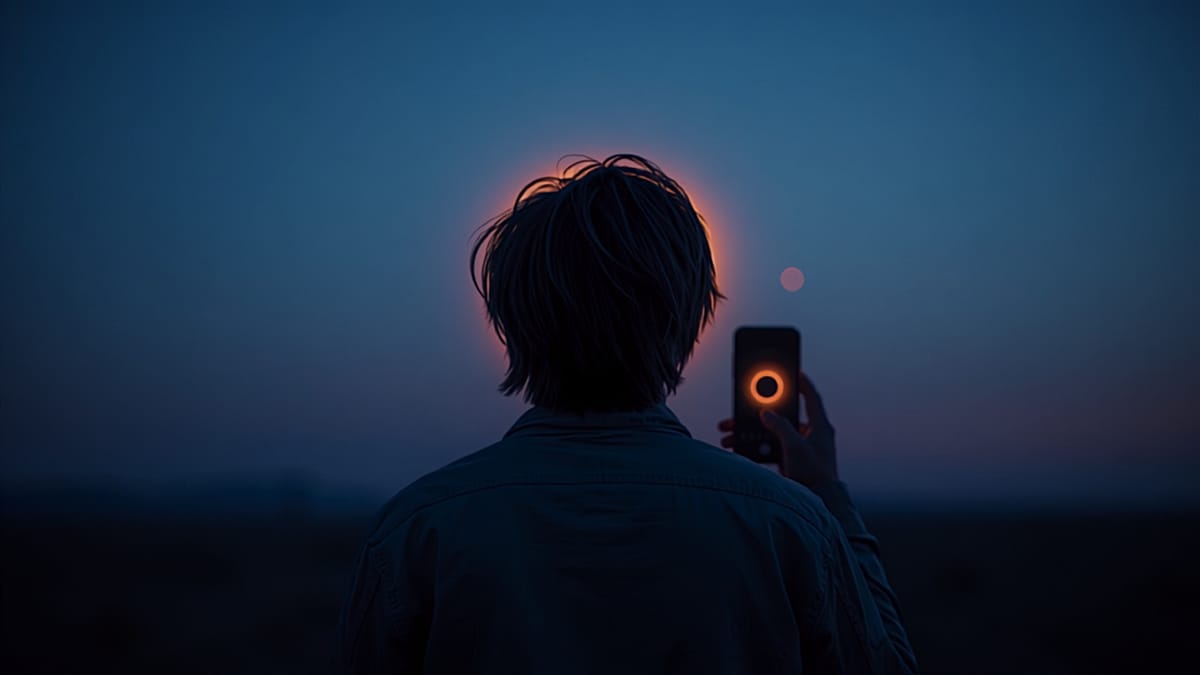
On 12 August 2026, a total solar eclipse will sweep across northern and eastern Spain, the first visible from the Iberian Peninsula in over a century. The Moon's shadow will enter over Galicia and travel west to east, reaching Palma de Mallorca as the Sun sets. For those on the mainland, the partial phase begins around 19:30 local time, with maximum darkness between 20:27 and 20:35, depending on location. Totality will last just under two minutes, and the event ends shortly before 21:30 with the Sun low on the horizon.
That same night, the Perseid meteor shower peaks, offering a rare double celestial show. But capturing the eclipse with a smartphone carries real risks—not just to your eyes, but to your device.
Why your phone's camera is at risk
A smartphone lens acts like a magnifying glass, concentrating sunlight onto a tiny sensor. Pointing it at the Sun for several minutes without protection can overheat the camera module and permanently burn the photodiodes that make up the sensor, leaving black spots or banding in your photos that cannot be repaired. It can also trigger the phone's thermal protection, causing an abrupt shutdown.
While there are no official statistics on how many phones have been damaged during past eclipses, anecdotal reports confirm that users have suffered permanent sensor damage. The risk increases with prolonged exposure, especially when using zoom or attaching an external telephoto lens. A quick, isolated shot is less likely to cause harm, but the longer the lens stares at the Sun, the greater the chance of burning out photodiodes.
How to protect your phone
The golden rule is simple: as long as any part of the Sun is visible, your camera needs a solar filter. The only standard endorsed by NASA and astronomy societies is ISO 12312-2:2015, the same one used for eclipse glasses. You don't need an expensive accessory—a low-cost option is to cut out the lens from a certified pair of eclipse glasses and tape it over your phone's camera, ensuring no gaps for light to leak through. For a more robust solution, consider high-density neutral solar filters (ND100000) designed for smartphones, available for under €40.
Tips for filming and photographing
- Lock exposure and focus: Tap and hold on the Sun until the lock icon appears to prevent the camera from adjusting mid-shot.
- Use manual mode: Set ISO between 100 and 200 and shutter speed below 1/1000 to avoid overexposure, even with a filter.
- Stabilise your phone: Use a tripod and self-timer to avoid blurry images.
- Consider a time-lapse: During the partial phase, a time-lapse with 1–2 second intervals captures the Moon's slow movement better than real-time video.
- During totality only: If you're in the path of totality, remove the filter and record real-time video to capture the solar corona—but only for those brief seconds.
- Prefer optical zoom: Digital zoom only enlarges pixels, reducing quality.
- Watch the temperature: August heat combined with direct sunlight can overheat your phone. Keep it in the shade between shots and carry a power bank.
What never to do
- Do not leave your phone recording for minutes on end pointing at the Sun, even with a filter.
- Do not remove the filter except during the exact seconds of totality, and only if you're in the total eclipse band.
- Do not attach binoculars, telescopes, or telephoto lenses without a certified solar filter.
- Do not look at the Sun through any viewfinder or lens, even with eclipse glasses—the concentrated rays can burn through the filter and damage your eyes.
- Do not leave your phone exposed to the Sun for long periods between shots.
Watching the eclipse on your phone screen is safe for your eyes—the danger is to the sensor, not the display. As you prepare for this historic event, remember that free certified glasses are available across Spain, and NASA has chosen a revived Burgos hamlet as a broadcast location. For a deeper look at how eclipses have inspired artists, explore our cultural feature. And if you're planning to travel, check the latest on border checks that could affect your journey.