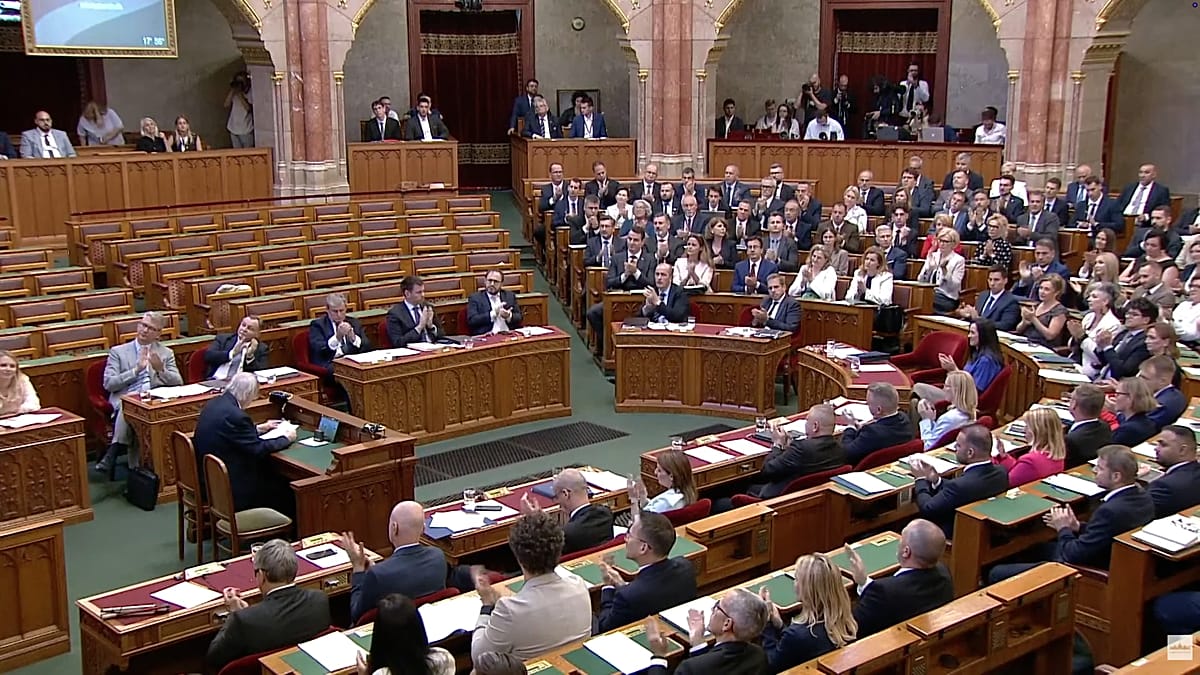
Hungary's parliament voted on 13 July to remove President Tamás Sulyok from office, following the adoption of the 17th amendment to the constitution. The amendment passed with 139 votes in favour and 6 against, while 54 MPs abstained. The move, championed by Prime Minister Péter Magyar, is part of a broader effort to dismantle what he calls the 'Fidesz-built Cosa Nostra' and replace officials he views as loyalists of former Prime Minister Viktor Orbán.
The constitutional change is tailored to end Sulyok's mandate the day after it enters into force. Parliament will then elect a new head of state to serve until a new constitution is enacted, but for no more than five years. The amendment also introduces a 12-year term limit for MPs, a 70-year age cap for constitutional judges, and a mechanism for judges to initiate the recall of the presidents of the Curia and the National Judicial Office.
Magyar's Justification and Accusations
In a speech before the vote, Magyar argued that failing to amend the Fidesz-drafted constitution would be a betrayal of the Hungarian nation. He described the document as 'the founding document of the Hungarian Cosa Nostra built by Fidesz–KDNP.' Magyar claimed that under Orbán's governments, everything had been subordinated to one man's will and political survival.
Magyar listed several instances where Sulyok, as president, remained silent on constitutional breaches. These included cases where police and secret services allegedly targeted IT experts from the Tisza Party on fabricated charges. 'He should have defended constitutionalism when one of its most important foundations was at risk: the principle that the secret services protect the Hungarian state and can never become the ruling party's henchmen,' Magyar said.
He also recalled that under Chief Prosecutor Péter Polt, no investigation was launched into the disappearance of hundreds of billions of forints from the Hungarian National Bank. Polt now serves as president of the Constitutional Court. Magyar's comments echo broader concerns about Hungary's recent decision to join the European Prosecutor's Office, which could open the door to probes into Orbán-era corruption.
Fidesz Boycott and Gulyás Resignation
The Fidesz and KDNP parliamentary groups boycotted the vote, with Fidesz MP Miklós Panyi announcing they would not 'take part in dismantling democracy.' On the day of the vote, Fidesz MPs stayed away from the chamber, and Sulyok himself did not appear in parliament.
Gergely Gulyás, leader of the Fidesz parliamentary group, announced his resignation before the vote, stating that 'from now on there is a political contest in Hungary in which at least half of MPs are excluded from competing.' He added that the removal of the head of state was 'unprecedented' and that he could not lead a group whose leader, in public-law terms, could not effectively function.
Fidesz organised a demonstration outside the Sándor Palace, the official presidential residence, under the slogan 'Stop arbitrary rule!' The party has framed the constitutional amendment as a power grab by Magyar's government.
Sulyok's Options and Next Steps
President Sulyok has five days to sign the constitutional amendment. If he refuses, parliament can initiate removal proceedings, after which he would lose his powers and the Speaker of Parliament could sign the law. Sulyok has previously raised constitutional concerns and sought advice from the Constitutional Court and the Venice Commission.
Justice Minister Márta Görög, who drafted the amendment, said it aims to ensure the essential institutional conditions for lawful state functioning until the new constitution is enacted. The amendment also includes provisions to restore constitutional democracy, such as the term limits for MPs and judges.
In a Facebook post before the vote, Magyar warned that 'the replacement of Orbán's political puppets can begin.' He argued that Sulyok cannot examine the content of a constitutional amendment and could only refer it to the Constitutional Court if there were a public-law ground for invalidity. 'But it is obvious that no such situation exists,' Magyar wrote, accusing Fidesz of pressuring Sulyok not to sign the amendment.
The political crisis in Budapest comes as Hungary navigates its relationship with the European Union. The country's recent approval of a €10 billion recovery plan by EU finance ministers signals a tentative thaw, but the removal of a president through a targeted constitutional amendment is likely to raise concerns in Brussels about the rule of law.