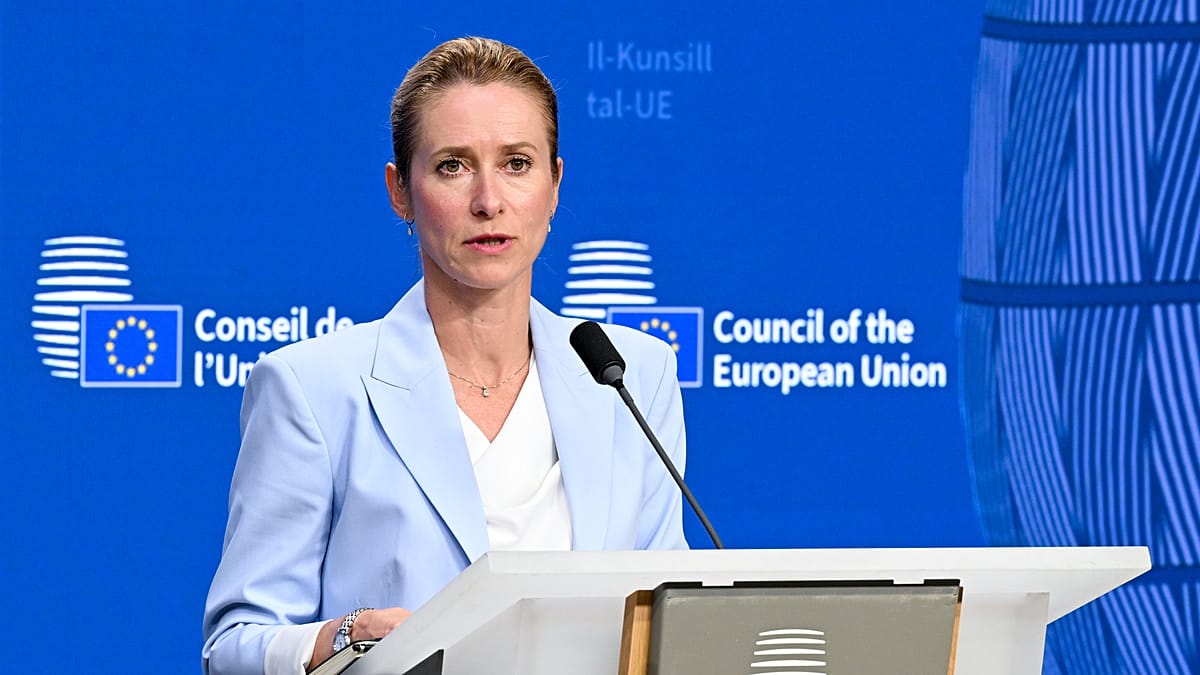
EU foreign policy chief Kaja Kallas confirmed on Monday evening that a full ban on EU imports of goods produced in Israeli settlements garnered the most support among member states during closed-door discussions. The European Commission had presented a range of options last week, with the most far-reaching being a complete prohibition on settlement trade.
“The option that got the most support was banning the trade with the illegal settlements,” Kallas told reporters in Brussels. Israeli settlements in the occupied Palestinian territories are considered illegal under international law, a position the EU has long upheld.
EU ambassadors will now refine the Commission’s initial two-page “options paper,” first reported by Euronews, into a concrete proposal. Kallas also indicated that an extraordinary meeting of foreign ministers could be convened to accelerate progress, as the next formal gathering is not scheduled until October—weeks before Israel’s legislative elections. Several diplomats fear the sensitive timing could further delay any decision.
Trade vs. Foreign Policy: A Key Procedural Divide
A crucial development during Monday’s meeting was that a majority of member states backed framing the measures as trade policy rather than foreign policy. This distinction matters because trade measures can be adopted by qualified majority vote—requiring 15 member states representing 65% of the EU population—while foreign policy decisions require unanimity.
Proponents of the ban—including Belgium, France, Ireland, Luxembourg, the Netherlands, Spain, and Sweden—had pushed back against the European Commission’s initial argument that any restrictions should be treated as foreign policy. Dutch Foreign Minister Tom Berendsen stated, “These are trade measures, so that means that, as far as we are concerned, that should be possible with a qualified majority.”
Italy’s Foreign Minister Antonio Tajani, whose backing is considered pivotal for reaching the necessary threshold, suggested earlier on Monday that no measures should be taken before the Israeli elections.
Frustration with Commission’s Pace
Several ministers expressed frustration with the EU executive led by Ursula von der Leyen over the lack of detail in the proposal and the delay in its presentation. Belgian Foreign Minister Maxime Prévot told reporters, “It gives me the sense that it’s more a bone to chew on, than a desire to really move forward.”
Spain’s Foreign Minister José Manuel Albares added, “I am concerned that we are engaging in delay tactics, debating endlessly without taking action, when such debate is not actually necessary. A decision not to trade would simply be an application of international law.”
The EU already pursues a policy of “differentiation” for settlement-manufactured goods, exempting them from preferential tariffs under the EU-Israel Association Agreement. However, political momentum for a full ban has grown amid the deteriorating situation in the occupied West Bank and a 2024 advisory opinion from the International Court of Justice (ICJ), which obliges states to abstain from economic dealings that entrench the unlawful situation.
Critics have accused von der Leyen of obstructing a decision by insisting on unanimity. Kallas, however, cited an oral opinion from the Council of the EU’s legal services, which found that member states could restrict or ban settlement trade with qualified majority support.
For more context on the divisions among EU capitals, see EU capitals clash over trade ban on Israeli settlements as unanimity rule stalls decision. Meanwhile, the broader geopolitical backdrop includes tensions in the Gulf, as reported in Iran Strikes Gulf Targets as EU Ministers Debate Israeli Settlement Trade Ban. Some member states have accused the Commission of foot-dragging, detailed in EU capitals accuse Commission of foot-dragging on Israeli settlement trade ban.