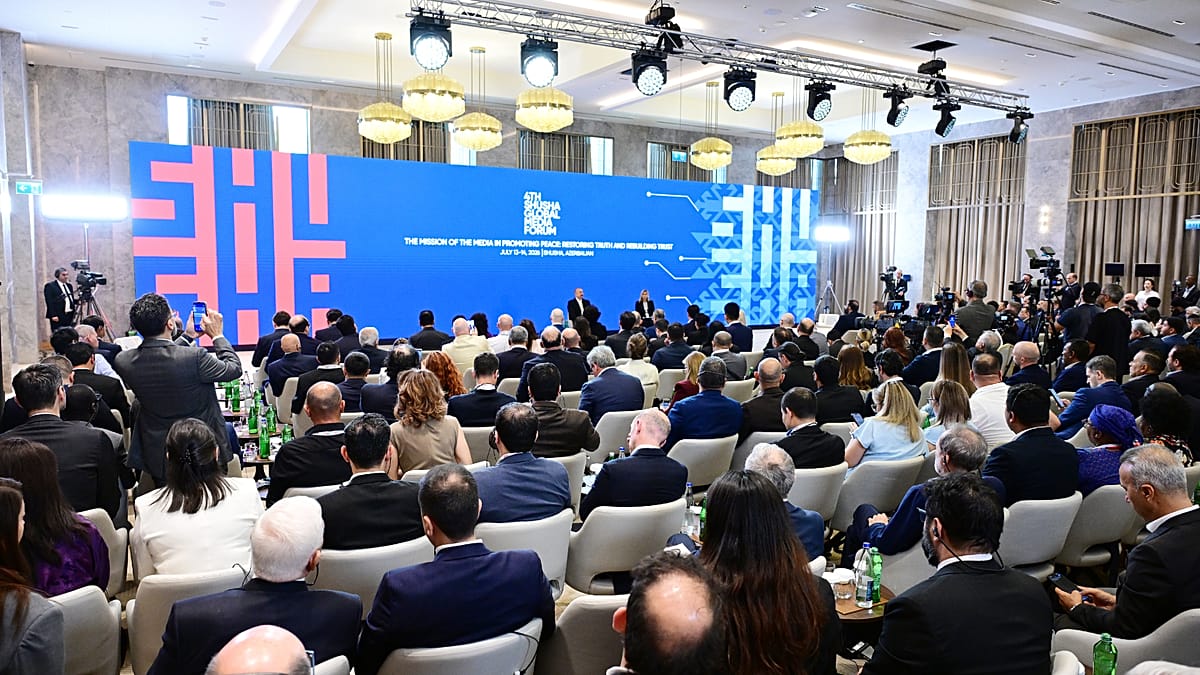
Speaking at the Shusha Global Media Forum in the Azerbaijani city of Shusha on Monday, President Ilham Aliyev struck a cautiously optimistic tone on regional stability, even as his country borders two active conflict zones. “We believe peace is possible,” Aliyev told an audience of international media professionals, policymakers, and experts gathered under the forum’s theme of restoring truth and rebuilding trust.
Aliyev framed Azerbaijan’s growing importance as a transit hub and energy supplier against a backdrop of global instability. He noted that turmoil in the Middle East has made the transport corridors passing through his country more attractive, accelerating their development. “The situation in the Middle East now makes this corridor more attractive,” he said, without specifying which routes he meant.
Energy Expansion and European Dependence
On energy, Aliyev confirmed that Azerbaijan has begun supplying natural gas to Germany and Austria this year, part of a broader push to deepen its footprint in the European market. Baku now delivers pipeline gas to 16 countries, 14 of them in Europe, and is in talks with additional EU member states. “We are number one in the world with this geography of supplying gas by pipeline,” he asserted.
But the president warned that future production growth hinges on long-term commitments from European buyers. “We need long-term contracts. Because in order to increase production dramatically, we need to invest largely,” Aliyev explained. “And if at a certain point we will be told that, ‘Thank you, goodbye, we don’t need you guys any longer,’ then what are we going to do?” His remarks come as the EU seeks to diversify energy sources following the war in Ukraine, but also faces pressure to accelerate its green transition—a tension that European Central Bank President Christine Lagarde has urged the bloc to confront head-on, as noted in Lagarde’s recent call for EU action.
Conflict and the Council of Europe
Turning to the war in the Middle East, Aliyev expressed hope that the latest escalation would be short-lived. Drawing on Azerbaijan’s own experience with the Nagorno-Karabakh conflict, he argued that lasting peace must be grounded in international law. “Peace must be just and fair and based on international law and not based on someone’s ambitions and agenda,” he said. He appealed to regional neighbours to “be responsible and to stop as soon as possible, and to try to normalise relations.”
In a more contentious part of his address, Aliyev revealed that Baku is considering a complete withdrawal from the Council of Europe, not merely a suspension of its membership. The move follows the Parliamentary Assembly’s decision in 2024 to strip the Azerbaijani delegation of its voting rights. “We are unequivocally considering leaving that structure,” Aliyev stated, adding that the organisation’s secretary general had personally asked him to reconsider. He insisted Azerbaijan would only return once its voting rights are restored: “We have not taken any wrong steps. They have made an unjust decision. Therefore, they must step back and acknowledge their mistakes.”
Media as a Bridge for Peace
The forum also addressed the role of journalism in conflict resolution. Secretary General of the D-8 Organisation for Economic Cooperation Sohail Mahmood stressed that credibility remains paramount as audiences navigate an information-saturated environment. Dr Zaid AlNawaiseh, Secretary General of Jordan’s Ministry of Government Communication, described media as “soft power” and a bridge for peace. “The real mission of the real media is not to lose the truth. Rather its mission is to shed light on the truth,” he said.
Disinformation emerged as a central concern. Leon Cook, founder of the London-based strategic communications consultancy Atticus Partners, called it the key challenge of the 21st century. “Media is both a problem and a solution,” Cook told Euronews. “Disinformation, unfortunately, is here to stay.” The forum’s discussions on media ethics and AI’s impact on truth-telling echo broader European debates, such as those around age-based social media restrictions backed by Ursula von der Leyen.
The Shusha Global Media Forum, held under the banner “The Mission of the Media in Promoting Peace: Restoring Truth and Rebuilding Trust,” brought together broadcasters, editors, government officials, and communications specialists. It highlighted the delicate balance between energy security, geopolitical stability, and the media’s responsibility in an era of deepfake and algorithmic manipulation—a challenge that the AI for Good Summit in Geneva also grappled with this year.