United States President Donald Trump has reimposed a naval blockade on Iranian ports and declared that Washington will collect a 20% fee on all cargo passing through the Strait of Hormuz, dramatically escalating the confrontation with Tehran. The move, announced on Monday, reverses the script on Iran's own toll demands and has triggered the largest exchange of military strikes since the April ceasefire.
In a post on his Truth Social platform, Trump declared the US would be known as "The Guardian of the Hormuz Strait" and would be "reimbursed, at the rate of 20% on all cargo shipped, for any and all costs necessary to do the job of providing safety and security to this very volatile section of the world." While Iranian ports would again be blockaded, he said, "all other countries will have fair and open use of the strait."
Iran's military command swiftly rejected the US claim. The spokesman for the Khatam Al-Anbiya central command insisted that Tehran "under no circumstances will allow... the United States to interfere in the management" of the strategic waterway. Mohammed Mokhber, an adviser to Iran's Ayatollah Mojtaba Khamenei, said Tehran will "defend" the strait, adding: "Retreating from this vital matter has no place in the mind of any friend of Iran."
Military Clashes Intensify
The confrontation on the ground and at sea has intensified. The US Central Command (CENTCOM) announced that for the first time, American forces used maritime drones to strike an Iranian submarine and a maintenance facility at the Bandar Abbas naval base. CENTCOM released video of the operation, describing it as "the first time American forces have employed sea drones in combat operations."
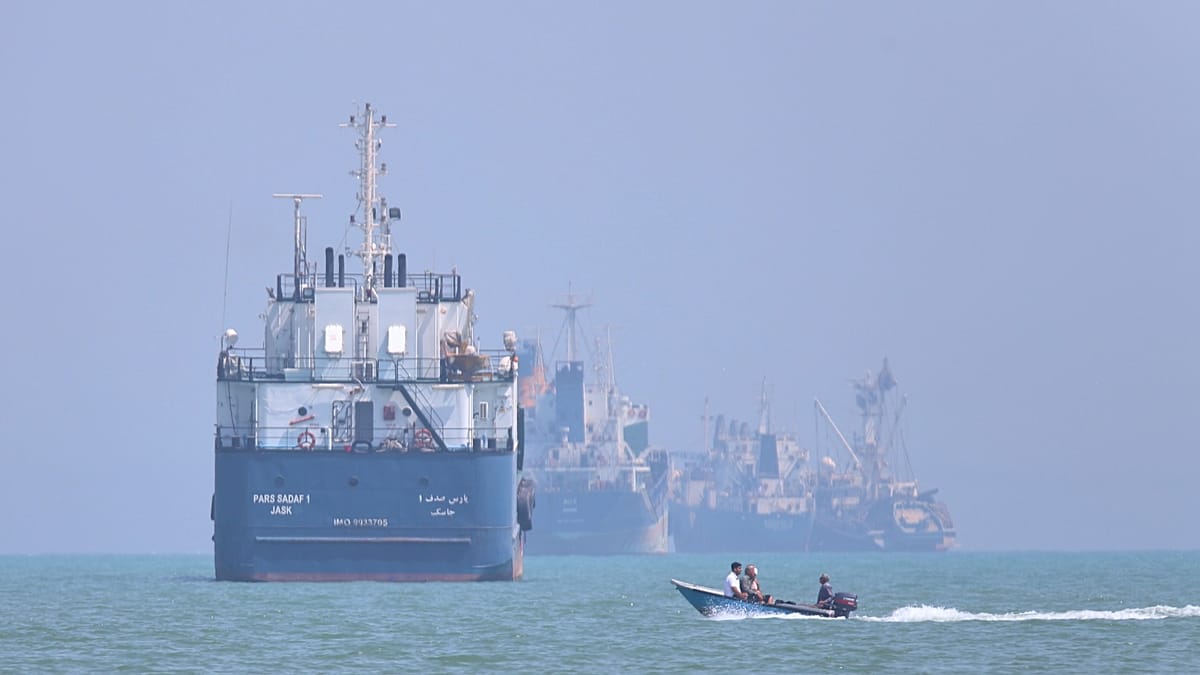
Iranian state television reported that two ships attempting to cross the strait "illegally" were targeted with warning shots by the Revolutionary Guards' navy. Meanwhile, Iran's IRGC launched new strikes on Bahrain, Jordan, Kuwait, and Oman, drawing sharp condemnation from European capitals.
The foreign ministers of Germany, France, and Britain issued a joint statement condemning "Iran's heinous attacks on merchant shipping in the Strait of Hormuz and on countries in the region including Qatar, Kuwait, Oman and Jordan." The United Kingdom separately announced it would designate Iran's IRGC as a national security threat, potentially leading to prison sentences for its supporters.
The escalation has sent shockwaves through global energy markets, with oil prices surging as traders price in the risk of prolonged disruption. The Strait of Hormuz is a critical chokepoint for oil and liquefied natural gas shipments, and any sustained blockade would have severe consequences for European economies, which rely heavily on energy imports from the Gulf.
Diplomatic Framework in Jeopardy
The renewed hostilities come just weeks after the June framework deal that ended the previous US blockade and lifted sanctions on Iranian oil exports. Trump has declared that ceasefire "over," accusing Iranian negotiators of breaking the agreement. "It was a done deal and then they broke it. They always break it. We've had 10 deals with these people – and so we're just going to hit them very hard," he said.
Iran's foreign ministry spokesman, Esmaeil Baghaei, acknowledged that the framework deal is "in crisis" and said Tehran would ignore its obligations if Washington does the same. However, he added that Iran continues talks with mediators from Qatar, Pakistan, and Oman to prevent further escalation.
Pakistan expressed "deep concern at escalation in regional tensions," while Chatham House associate fellow Bader Al-Saif argued that the attacks merely delay an inevitable negotiated settlement. "Both sides want to end the impasse on their own terms, and they are increasingly finding it difficult to do so. Hence the return to and increase in the scale of attacks," he said. "That only prolongs what will eventually happen: a negotiated settlement."
For Europe, the crisis poses a direct challenge to its energy security and diplomatic credibility. The International Energy Agency has warned that a blockade of the Strait of Hormuz would devastate European economies, which are already grappling with high energy prices and inflation. The EU's ability to mediate a resolution is also being tested, as the bloc seeks to maintain unity in the face of US unilateralism and Iranian brinkmanship.
As the fighting continues, the human toll is mounting. Iranian state media reported at least 25 deaths in the latest US strikes, which targeted areas across southern and western Iran. The situation remains fluid, with both sides showing little appetite for de-escalation.