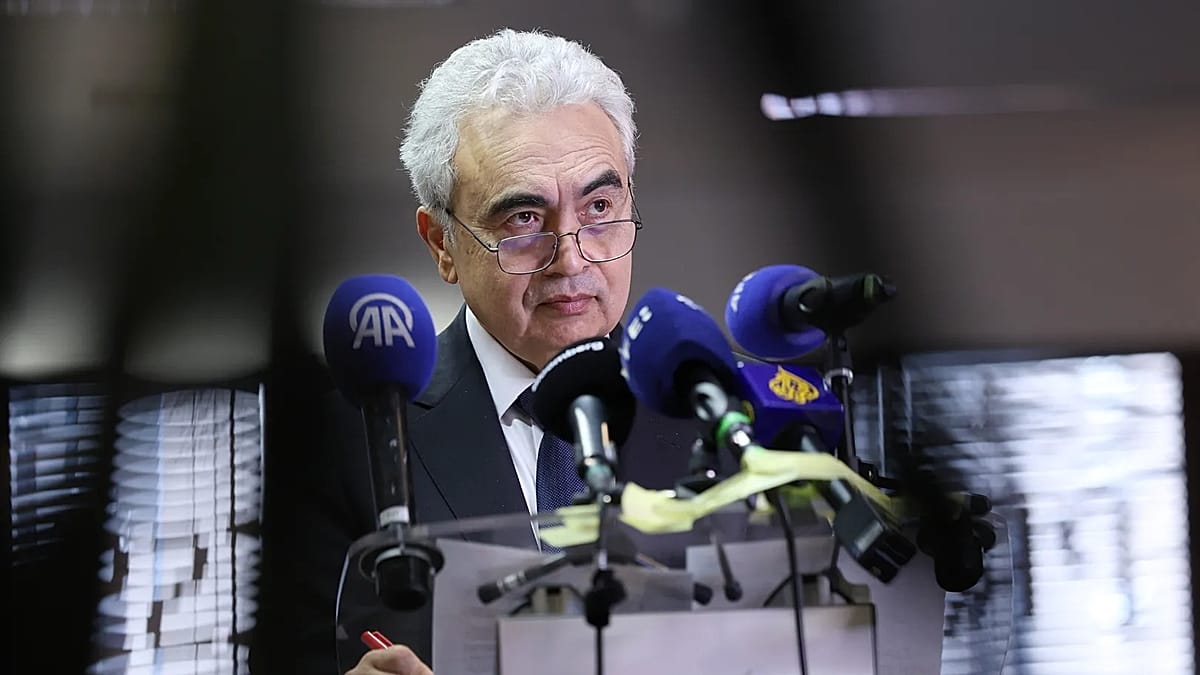
The head of the International Energy Agency (IEA), Fatih Birol, has issued a stark warning to European leaders: complacency over energy security is a dangerous illusion. In an exclusive interview with Euronews, Birol stressed that while global fuel supplies remain stable for now, the recent attacks on tankers near the Strait of Hormuz underscore Europe's persistent vulnerability to imported fossil fuels.
"The entire world should be prepared for the worst case, which we hope will not materialise, but we really need to be prepared for the worst case scenario," Birol said, referring to a complete blockade of the strait through which 20 percent of the world's oil and gas transits. He dismissed accusations of fearmongering, instead framing the situation as a "wake-up call" for European refineries and policymakers to act swiftly.
Birol acknowledged that, thanks to coordinated efforts by European commissioners, refiners, and support from the United States and Nigeria, refined product markets are currently balanced. However, he cautioned that if the Strait of Hormuz remains partially or fully closed, the challenges will multiply. Beyond energy, the Middle East conflict has already disrupted global supply chains for fertilisers, chemicals, and pharmaceuticals.
No Return to Russian Gas
Birol firmly rejected any notion of returning to Russian gas, which the European Union has officially committed to phasing out by 2027. He argued that the bloc's over-reliance on Moscow was the root cause of today's high electricity prices and a catalyst for Europe's push to end foreign dependencies. "We suffered a lot in Europe from the over-reliance on Russia, after the cutting of the Russian gas. And our economies, businesses and households suffered from high energy prices," he said.
While some energy ministers, notably in Romania and Cyprus, have floated the idea of new domestic oil and gas drilling to bolster energy security, Birol dismissed such hopes. "Europe tomorrow cannot suddenly discover oil or gas," he warned, adding that if significant fossil fuel reserves existed on the continent, they would have been found decades ago. Instead, he urged investment in electrifying the bloc's economy.
The EU has already shifted its energy dependencies, with the United States now the top supplier of liquefied natural gas (LNG). Yet Washington is pressuring Brussels to scrap its methane monitoring rules, arguing they increase costs for US producers. Energy Commissioner Dan Jørgensen told Euronews that while "there will be tweaks," the Commission will not retreat from its climate targets.
Electrification as the Path to Sovereignty
For Birol, the only sustainable route to energy sovereignty is electrification. "We have to electrify our energy, our economy as much as possible, which means more electric cars, more heat pumps, and more electrified industry," he said. However, he noted that Europe's electrification rate has stagnated at 23 percent over the past decade, lagging far behind Japan, South Korea, and China—countries that also lack abundant domestic oil and gas.
Birol highlighted a critical bottleneck: Europe's outdated electricity grids. "Last year, 85 gigawatts of renewables were added to the European grid. This is a big number. But 600 gigawatts, almost seven times that, of renewable projects finished because there was no grid to bring it to the homes and to the industry," he said, calling the grid deficiency "an economic crime." He fully supported the European Commission's efforts to modernise grid infrastructure.
Despite billions spent on clean energy, electricity remains two to three times more expensive than gas in many EU countries. Birol stressed that affordability is key: "We should make the electricity prices affordable for the people, so that the consumers, households and industry can go for a cheaper option. They will not go for electricity because it is clean. They would go for electric because it's cheap."
After the summer break, the European Parliament and Council will begin negotiations to revamp Europe's power lines, following a common position adopted by member states in June under the rotating EU Cyprus Presidency. The outcome will determine whether Europe can turn its renewable potential into a reliable, affordable, and sovereign energy system.