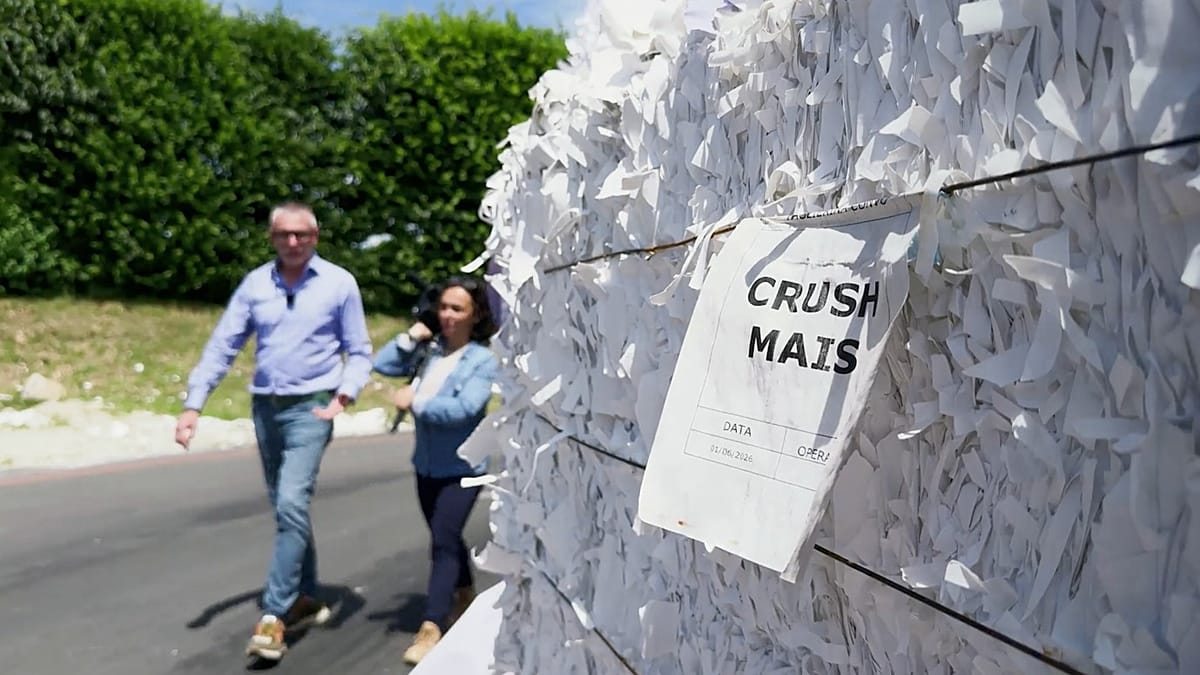
In the Veneto region of northern Italy, a historic paper mill is redefining what it means to make paper. Favini, a family-owned company based in Rossano Veneto and celebrating its 120th anniversary this year, has turned agricultural and textile waste into a raw material for luxury paper. By replacing a portion of the tree-derived cellulose with by-products such as coffee silverskin, tomato skins, and corn cob flour, the mill is helping to reduce pressure on forests while giving a second life to materials that would otherwise be discarded.
Favini was among the first in the world to industrialise eco-friendly paper production using alternative fibres. The company’s journey began in the late 1980s, when the need to restore the Venice lagoon and combat algae overgrowth led to the creation of Alga Carta, patented in 1992. That innovation set the stage for a broader commitment to sustainability that now encompasses 14 different types of waste materials.
From Algae to Coffee: A History of Innovation
“We made this choice thanks to the vision of my grandfather,” explains Export Sales & Marketing Director Andrea Favini. “He positioned this small company in a niche market. At the time, environmental concerns in the paper industry appealed to only a very limited number of customers. We had to convince clients to embrace this project because it carried real value for ecology and the environment.”
Today, eco-friendly papers still represent a niche segment in Europe, but they are Favini’s fastest-growing product line, accounting for 10% of annual turnover. Prices are comparable to those of traditional high-quality papers, which has helped attract clients in the luxury packaging and stationery sectors. The company’s Crush range, which incorporates 14 different waste materials, is sold worldwide and used for tote bags, premium shopping bags, and high-end packaging.
“Right now, we are working on two types of residues: tomato skins and corn,” says Giacomo Berton, Head of Research & Development at Favini. “Over the years, we have experimented with more than 500 different types of biomass, but only about 5%, ultimately, could be scaled up for industrial production.” Recovered materials account for between 10 and 40% of the final product, depending on the application.
Supply Chain Collaboration
The challenge lies in ensuring a steady supply of waste materials. Favini works with around a dozen Italian and international companies that provide by-products from their own industrial processes. One such partner is Dersut, a coffee roaster also based in the Veneto region. Dersut’s CEO, Lara Caballini di Sassoferrato, showed us the so-called “silverskin” — the thin skin that covers coffee beans and separates during roasting. This by-product, previously used as soil fertiliser, now supplies Favini to produce 60,000 premium shopping bags for Dersut’s brand.
“We have always collected it,” says Caballini di Sassoferrato. “As it can be used as a soil fertiliser, for example, in organic farming. But in 2022, we began a collaboration with the University of Padua, which found that it could also be used in paper production.” The project earned Dersut the Sustainable Company 2025 award and has prompted the partners to explore further applications.
Marketing Manager Michele Posocco emphasises the creative potential: “Using these 14 materials, we have created a range called Crush, which we sell worldwide. It is a clear example of how discarded materials from one industrial supply chain can be creatively upcycled and turned into new raw materials.”
The final step in the value chain involves premium packaging manufacturers like DueGi, which has worked with Favini for 30 years. Here, sustainability meets the aesthetic quality and attention to detail typical of goods Made in Italy. The result is a product that appeals to environmentally conscious consumers without compromising on performance in printing and converting.
This approach aligns with broader European efforts to reduce deforestation and promote circular economies. While the paper industry remains a significant consumer of wood pulp, innovations like Favini’s demonstrate that luxury and sustainability can coexist. As the company continues to experiment with new biomass sources, it offers a model for how traditional industries can adapt to modern environmental challenges.