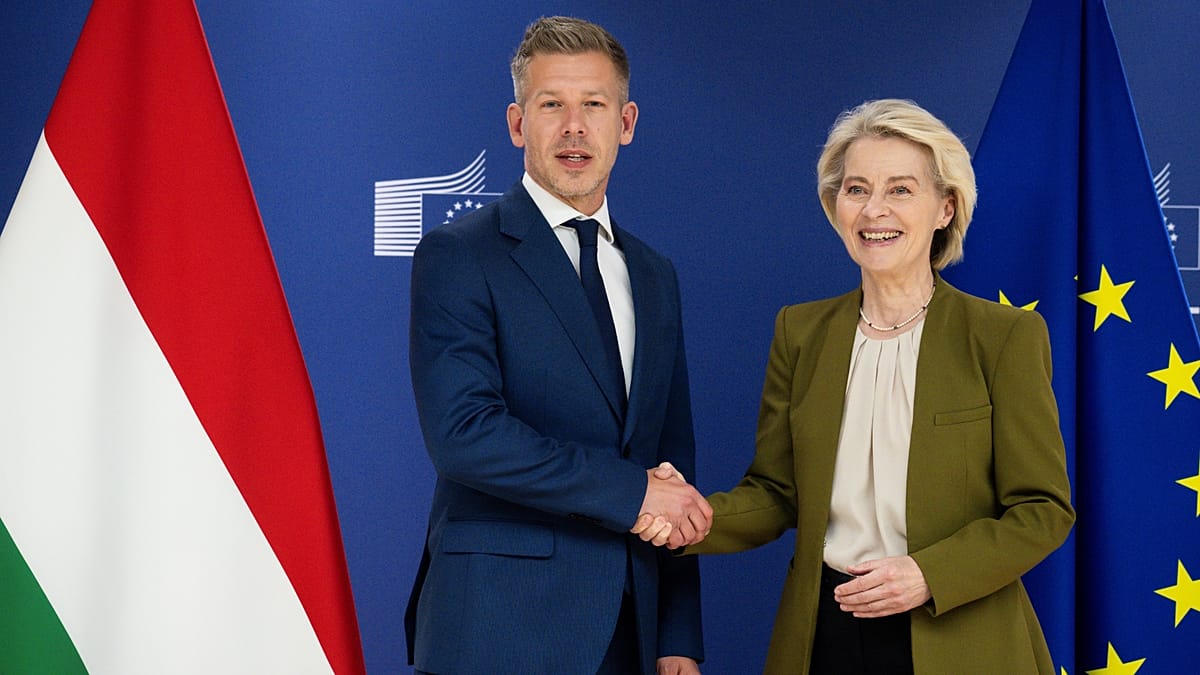
Hungarian Prime Minister Péter Magyar will travel to Brussels this week for a series of high-level meetings, including a pivotal encounter with European Commission President Ursula von der Leyen on Friday. The visit is intended to secure a political agreement that would reset Hungary’s strained relationship with the European Union and unlock billions of euros in frozen funds.
Magyar, whose Tisza Party won a decisive victory in April’s parliamentary elections, ousting Viktor Orbán’s nationalist government, has pledged to normalise ties with Brussels. His government faces a tight deadline: Hungary must meet all conditions by the end of August to access €10.4 billion from the EU’s post-Covid Recovery and Resilience Facility (RRF). The package consists of €6.5 billion in grants and €3.9 billion in loans.
“Tomorrow I will be meeting with the NATO Secretary General and the Belgian Prime Minister, and on Friday with the President of the Commission in Brussels. Everyone is working on bringing back the EU's billions,” Magyar said on Facebook. He is also scheduled to meet Belgian Prime Minister Bart de Wever and NATO Secretary General Mark Rutte on Thursday.
Race Against Time for Recovery Funds
Magyar’s most pressing priority is securing a timeline to access the RRF funds. Hungary risks losing the entire amount if it fails to meet the conditions set out in the regulation by the end of August. The European Commission has previously urged Budapest to focus on the grants, given the country’s weak budgetary position.
Budapest is currently revising its national recovery plan. In a recent interview with Hungary’s RTL Klub television, Magyar said the updated plan would prioritise railway projects, energy infrastructure, and a rental housing programme. He acknowledged for the first time that Hungary may not be able to access the full amount. “Our goal is to bring the €10.4 billion that is stuck for Hungary. I am not saying that we can bring all 100 per cent, but every euro cent that we can bring here is needed to jump-start the Hungarian economy,” Magyar said.
Sources familiar with the technical negotiations between Hungary and the EU told Euronews that both sides are engaging constructively, but time is short and Hungary’s fiscal position remains precarious. Hungary must also submit a revised national recovery plan; a submission was initially expected this week, but it is unclear whether it will be delivered on Friday or delayed until early June.
The broader context includes billions of euros in cohesion funds that remain frozen. Unlocking the recovery funds would automatically release most of the cohesion financing, though one tranche is conditional on Hungary amending its previous anti-LGBTQ+ legislation and asylum law. Magyar has also suggested that Hungary’s original €16 billion programme may be excessive in scale.
Rule of Law, Defence, and Ukraine
Beyond the recovery funds, Magyar and von der Leyen are expected to discuss several other issues. Hungary’s request to join the EU’s joint defence borrowing scheme, the Security Action for Europe (SAFE), is being reassessed in Budapest over corruption concerns connected to Orbán’s inner circle. Magyar may also seek agreement on resolving the Erasmus+ dispute, which has seen thousands of Hungarian students barred from foreign exchange programmes following the transfer of universities to private foundations.
Restoring the rule of law remains a cross-cutting requirement. Hungary must guarantee the independence of the National Judicial Council and reduce political influence over judicial appointments, among other reforms. “It is encouraging to see the commitment and dedication of the new Hungarian government to swiftly proceed with rule-of-law reforms,” said Michael McGrath, the EU Commissioner for democracy, justice and the rule of law, at a press conference on Tuesday.
Ukraine’s EU membership is also on the agenda. The opening of an accession negotiating chapter is contingent on Hungary lifting its veto. Orbán’s government had opposed Kyiv’s EU membership bid, framing it as a threat to European security and the economy. Magyar’s government has indicated that it is prepared to open the first chapter, provided Ukraine addresses the language and educational rights of the Hungarian minority in the Transcarpathia region. Technical talks between Budapest and Kyiv on the minority issue are ongoing.
Magyar’s visit comes as other EU member states face their own fiscal challenges. For instance, Italy’s Prime Minister Giorgia Meloni has been pressing Brussels for fiscal relief amid rising energy costs, highlighting the broader tension between national priorities and EU fiscal rules. Meanwhile, Magyar has resisted EU demands on pension and tax reforms as part of the conditions for unlocking the full €17 billion in frozen funds.
The outcome of this week’s meetings will be closely watched across Europe, as it could signal whether Hungary’s new government can deliver on its promise of a fresh start with Brussels—or whether the legacy of the Orbán era will continue to cast a long shadow.