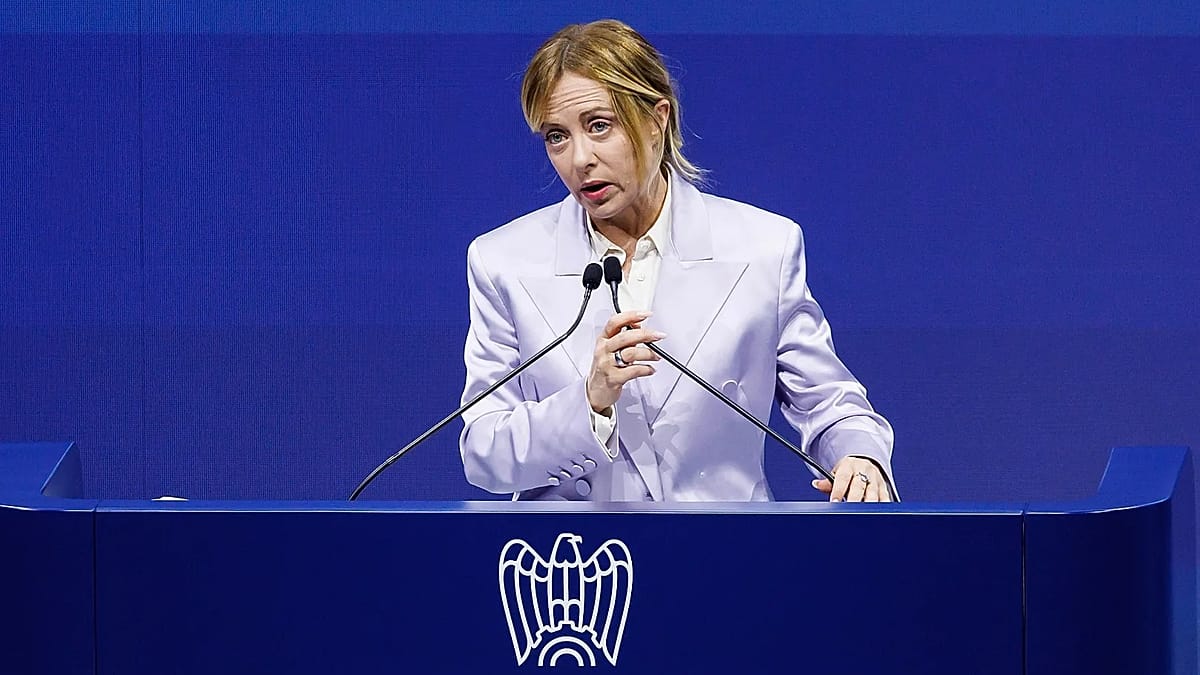
Italian Prime Minister Giorgia Meloni has escalated her criticism of the European Union in recent days, demanding greater fiscal flexibility to tackle rising energy costs that threaten Italy's economy and her government's popularity. Speaking at the Confindustria general assembly on Tuesday, she described the EU as a 'bureaucratic behemoth' that has sacrificed competitiveness and growth for ideological and technocratic approaches, contributing to Europe's economic and geopolitical decline.
Meloni's remarks come as Italy faces local elections, with the first round held on 24-25 May and a potential second round on 7-8 June. Her centre-right coalition has scored victories in major cities like Venice and Reggio Calabria, but the broader political landscape is tense. A referendum on justice reform in March saw nearly 54% vote against her government, though Ipsos polls still show significant support for Meloni.
Fiscal Flexibility Push
Last week, Meloni sent a letter to European Commission President Ursula von der Leyen, demanding fiscal flexibility similar to that granted for defence spending. European Commissioner for Economy Valdis Dombrovskis responded on 22 May, stating the Commission is examining 'existing flexibilities' but stressing any measures must be temporary, targeted, and tailored—the so-called triple T principle. The debate is expected to dominate the European Council meeting on 18-19 June, where Nordic countries are likely to resist further deviations from the Stability Pact.
Italy's high debt and energy costs are straining its industrial base, especially if Gulf supply routes remain closed. The European Commission has cut Italy's 2026 GDP growth forecast from 0.8% to 0.5%, driven by energy-led inflation. As EU Considers Limited Fiscal Flexibility Amid Energy Crisis After Meloni's Push, the outcome will weigh heavily on her credibility ahead of general elections in 2027.
Nicola Procaccini, a senior MEP in Meloni's Brothers of Italy party, defended her stance, arguing that being pro-European means having the courage to demand a more practical, less ideological EU. 'Being pro-European today does not mean passively accepting every decision made by the EU institutions,' he told Euronews.
However, opposition MEP Brando Benifei of the centre-left Democratic Party dismissed Meloni's remarks as propaganda. 'She prefers to pick fights with Brussels instead of helping build European solutions. That only weakens Italy's position at a time when we need stronger common investment in cohesion, industry, agriculture and jobs,' he said.
Italy remains the largest beneficiary of the EU Recovery Plan, receiving nearly €195 billion in grants and loans. But that instrument winds down in 2027, leaving Rome with less fiscal room to absorb economic shocks during an election year. If the conflict in Iran keeps energy costs elevated through winter, Meloni will face mounting pressure to shield consumers and businesses—a task made harder by the fiscal constraints she is fighting to loosen.
The broader European context is also shifting. As Germany and Canada Sign LNG Deal to Diversify Energy Sources Amid Middle East Turmoil, and UAE Adviser Warns Europe: Strait of Hormuz Instability Is a Direct Energy Threat, the energy crisis remains a continent-wide challenge. Meloni's EU-bashing may resonate with voters, but whether it yields concrete fiscal relief remains uncertain.