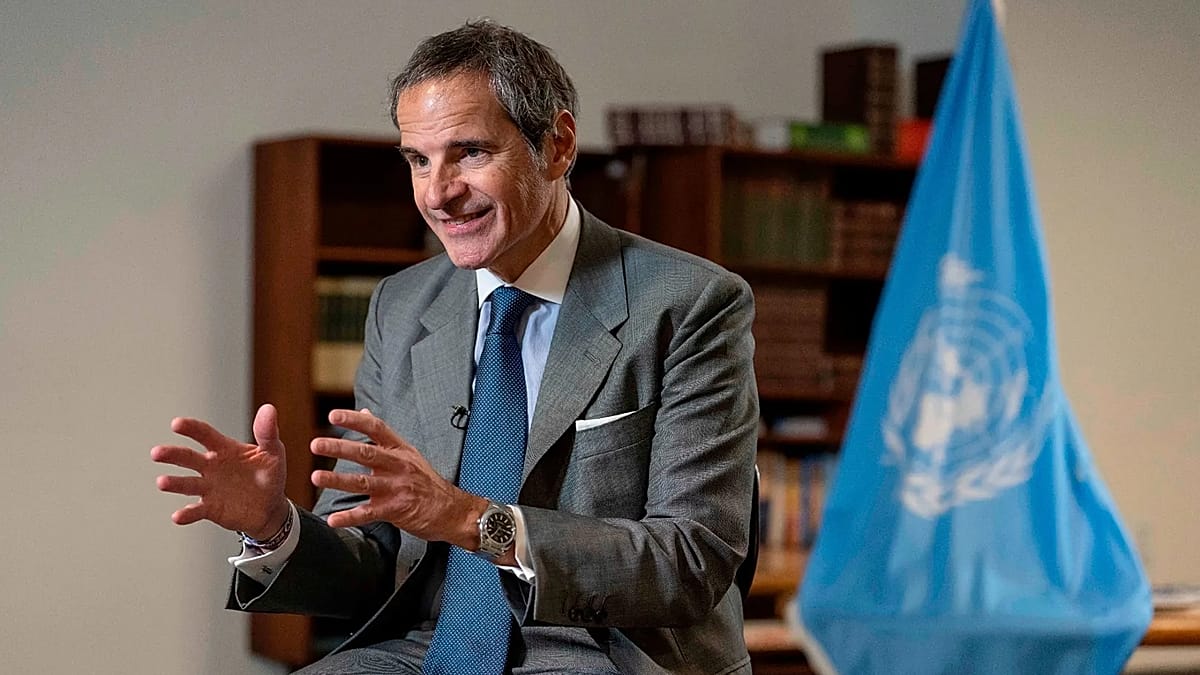
Rafael Grossi, the director general of the International Atomic Energy Agency (IAEA), has delivered his most unequivocal statement yet that international inspectors will gain access to Iran's uranium enrichment facilities. Speaking at the Fukushima Daiichi nuclear power plant in Japan on Wednesday, Grossi directly contradicted claims from Tehran that no agreement on inspections exists, pointing to the signed memorandum of understanding between the United States and Iran.
"I can understand political statements, they are part of the reality, but the fundamental thing I would like to remind you and draw your attention to is that there has been a Memorandum of Understanding, signed by both presidents," Grossi told journalists. The framework deal, he said, "says explicitly that the nuclear activities that are going to be carried out with regard to the nuclear material facilities will be supervised by the IAEA — in all letters."
"Obviously, to do that, we will have to inspect. Whether this happens the day after tomorrow or in one week or in 10 days, it's important, but not essential. This is going to happen," he added.
A Deal Clouded by Contradictions
The framework deal, signed separately last week by US President Donald Trump and Iranian President Masoud Pezeshkian, opened a 60-day window for negotiations toward a final peace agreement. However, the question of IAEA access to enrichment sites has quickly become one of the most contentious fault lines. On Tuesday, Iran's Foreign Ministry spokesperson Esmail Baghaei told reporters in Tehran that UN inspectors were not scheduled to examine the nuclear sites struck by the US and Israel last year, directly contradicting remarks made the day prior by US Vice President JD Vance.
Since the 12-day conflict between Israel and Iran in June 2025, the IAEA has been blocked from accessing enrichment sites where Tehran is believed to hold enough highly enriched uranium to potentially construct up to 10 nuclear weapons, should it choose to move in that direction. Iran has consistently maintained that its programme is peaceful. Its stockpile is believed to be largely buried under the rubble of its three main facilities bombed by the US during the June conflict. The IAEA has been permitted to visit some unaffected sites, such as the Bushehr nuclear power plant, but without access to enrichment facilities, it says it cannot verify the status of Iran's uranium stockpile or inspect the centrifuge cascades used for enrichment.
Both Iran and the IAEA say Tehran has not been enriching uranium to weapons-grade, but non-proliferation experts remain concerned that the Islamic Republic may be moving its stockpile to undeclared locations. Iran holds the distinction of being the only country in the world to have enriched uranium to 60% purity without a declared weapons programme, with purification to weapons-grade considered to be a step away. To be considered weapons-grade, uranium should be enriched to 90% or more, although a nuclear explosive can technically be made with concentrations of 20% and above.
Why Inspections Are Central to the Deal
Grossi has previously warned that IAEA involvement is not optional in any meaningful nuclear settlement. "So all of that will require the presence of IAEA inspectors; otherwise you will not have an agreement, you will have an illusion of an agreement," he said at an April press conference in Seoul. Under the terms of the framework deal, Iran reaffirmed it would never produce nuclear weapons, while the US committed to lifting sanctions and supporting a reconstruction fund of at least $300 billion (€258.5bn). But sanctions relief is tied to nuclear compliance, according to Washington, while Tehran insists the opposite is true and that any nuclear concessions by Iran would come only after sanctions are lifted.
The IAEA has said it observed regular vehicle movement in satellite imagery around the entrance to an underground tunnel complex at Isfahan, where uranium enriched to 20% and 60% is believed to be stored, and has stressed the urgency of gaining access without further delay. For European capitals, the stakes are high: a nuclear-armed Iran would reshape security dynamics across the Middle East and beyond, potentially triggering a regional arms race and threatening the non-proliferation regime that Europe has long championed. The EU has already released a €3 billion loan to Ukraine as the US-Iran nuclear talks falter, highlighting the geopolitical ripple effects of the negotiations.
Some former diplomats have suggested that Iran may allow IAEA inspections during talks, but the current standoff underscores the fragility of the process. As the 60-day window ticks down, the IAEA's insistence on access remains a critical test of whether the framework deal can translate into a verifiable, lasting agreement.