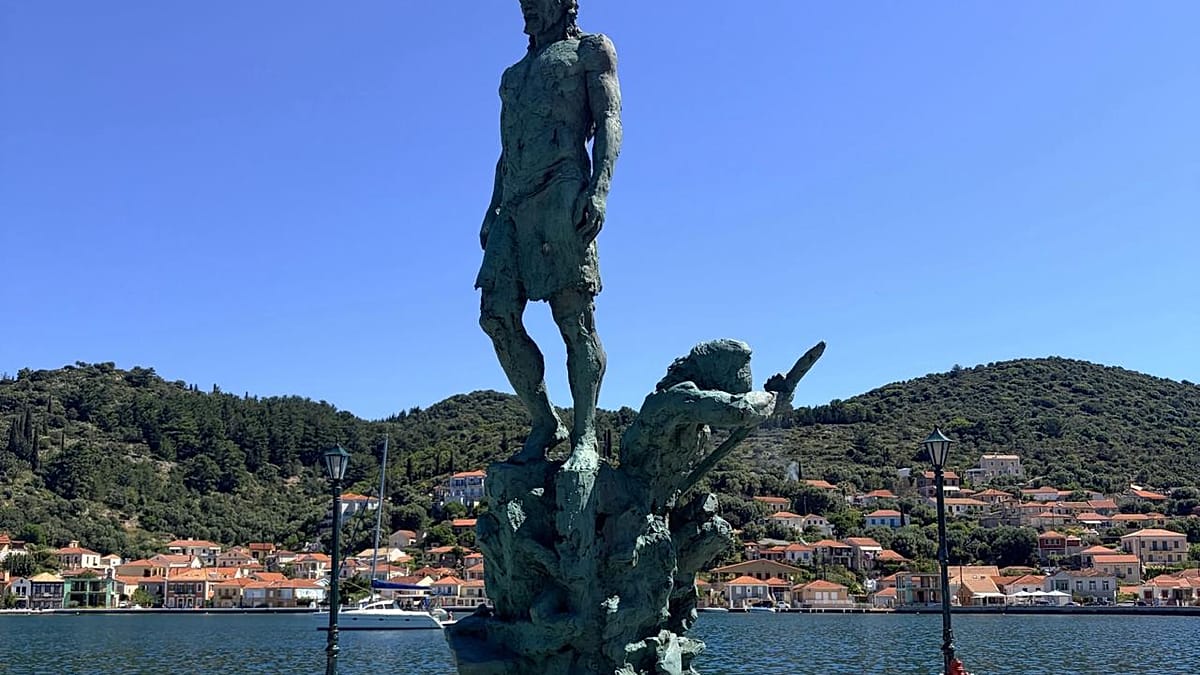
For decades, Ithaca has remained a quiet outlier in the Ionian Sea, a short ferry ride from the better-known shores of Kefalonia and Lefkada. Its coves and clear waters have never drawn the crowds that flock to Santorini or Mykonos. But that may be about to change, thanks to a Hollywood blockbuster that has put Homer's hero back in the spotlight.
Christopher Nolan's The Odyssey, released in cinemas across Europe and North America, has sparked a wave of interest in the mythical homeland of Odysseus. On the island itself, residents and officials are cautiously optimistic that the film will bring a lasting boost to local tourism.
A slow burn, not an overnight surge
Mayor Dionysis Stanitsas is measured in his expectations. "There still isn't a large increase in visitors to the island because of the film," he told European Pulse. "We think people will start planning from next year, as the film will gradually be released around the world. And that way everyone will start considering a trip to the island."
The film's staggered international release means that the full impact will only be felt in the 2026 season. Still, some business owners say the buzz is already tangible. Xhimi Hotza, who runs a local enterprise, noted that tourists are talking about the film and its connection to the island. "Although the film has not yet been released in all cinemas, it has already started to showcase the island and raise its profile," she said.
For many visitors, the draw is not just the scenery but the literary heritage. Ioanna Griva, a souvenir shop owner, has long known why people come. "People come because they know the legend of Odysseus and of Homer, who wrote the Odyssey," she said. "I think that is the main reason, but it is also a very beautiful, small island."
The permanent exhibition 'Light on Homeric Ithaca' in the village of Stavros presents archaeological finds that connect modern Ithaca with the homeland of Odysseus. Tegan Messing, a visitor, acknowledged that the film is not a faithful adaptation of the epic poem. "I think it's a good way to get more people interested in Homer and in mythology more generally," she said. "But the film certainly isn't faithful to the original text."
Philologist and archaeologist Spyros Kouvaras is optimistic about the island's prospects, but he insists that Homer remains the true protagonist. "From next year we expect a significant increase in visitor numbers," he said. "This will also affect the months that are usually dead—October, perhaps even November, as well as March and April, which are normally quiet months on Ithaca. Behind this, first and foremost, is Nolan's film, but behind Nolan's film stands Homer."
The potential influx is part of a broader pattern across Europe, where film and television have become powerful drivers of tourism. From Marbella's experiential tourism hub to the UK's foodie staycations, destinations are increasingly leveraging cultural ties to attract visitors. For Ithaca, the challenge will be to manage growth without losing the very character that draws people in.
Local authorities are aware of the risks. The island's infrastructure is limited, and a sudden surge could strain resources. But for now, the mood is hopeful. As one resident put it, "We've always known we have something special. Maybe now the world will see it too."
The film's release has also coincided with a rise in pirated copies spreading malware across Europe, a reminder that the digital buzz comes with its own pitfalls. Still, for a small island that has long lived in the shadow of its mythical hero, the spotlight is a welcome change.