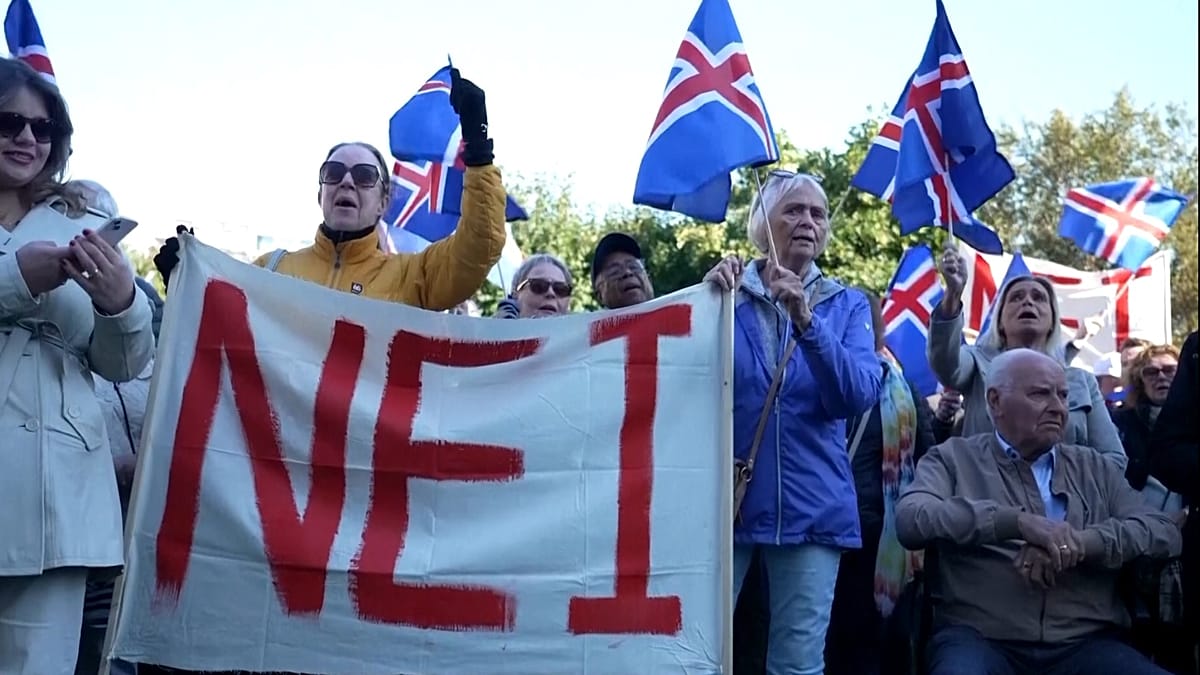
When Icelandic voters went to the polls on 29 August, they delivered a clear verdict: 52.8% said no to resuming EU membership negotiations, keeping the island outside the bloc for the foreseeable future. The campaign was intense, and as with many recent high-stakes votes across Europe, it was also clouded by inaccurate and conflicting claims that may have influenced the outcome.
The most contentious issue was fisheries. Several media outlets reported that Foreign Affairs Minister Þorgerður Katrín Gunnarsdóttir had discussed a special exemption from the EU's Common Fisheries Policy with Dutch Prime Minister Rob Jetten. These reports suggested that Gunnarsdóttir claimed such exemptions were on the table, while the Dutch government strongly denied her version of events. Gunnarsdóttir later rejected those claims, and the press admitted the story had been largely misreported.
Yet the episode touched a raw nerve. Control over fishing grounds is fiercely guarded in Iceland, a country that fought a series of confrontations with the United Kingdom in the 1950s and 1970s — the so-called Cod Wars. Joining the EU would likely mean ceding part of its quota under the Common Fisheries Policy, though there is no consensus on how much Iceland would actually have to give up.
Fisheries: The elephant in the room
Some experts argue that the quota loss would be minimal, mainly affecting pelagic species like herring, sardines, and mackerel that migrate across international waters and are not permanently stationed in Icelandic territory. But the failure to address this sensitive issue early on may have dulled voters' enthusiasm, according to international relations expert Arno Minasian.
"Iceland didn't get to negotiate fisheries and agriculture in 2009, either," Minasian told Euronews' fact-checking team, The Cube. "The EU and Iceland never actually got to those chapters, which is concerning, because those are the really big, important chapters for Iceland."
The stakes are high: fisheries employ about 4% of Iceland's workforce and account for roughly 8% of its GDP. "So fisheries have a lot of economic and political weight," Minasian added. "If Iceland and the EU cannot negotiate this in the first place, it's quite unrealistic that Icelanders would agree on imposing these quotas through the Common Fisheries Policy."
All the obligations, none of the benefits?
Another misleading claim concerned Iceland's rights as a non-EU member. Some, like former Prime Minister Sigmundur Davíð Gunnlaugsson, now leader of the Centre Party, argued that since Iceland is already part of the European Economic Area (EEA), it already enjoys all the benefits of EU membership. Joining the EU, he said, would only add obligations and downsides without any extra advantages.
While it is true that as an EEA member, Reykjavík already follows much of the EU's economic rulebook, it has no seat at the table when those rules are written. Iceland has no votes in the European Parliament, no role in the European Commission, and misses out on certain EU subsidies and funds.
The cost of EU membership was also a battleground of conflicting figures. The "No" camp claimed membership would cost as much as €1 billion a year, while prominent pro-EU voices said it would be just over €50 million. Such a wide discrepancy left voters with little clarity.
The referendum's outcome has broader implications for the EU's enlargement strategy. As Iceland's No vote complicates the EU's enlargement plans, Brussels must grapple with a member state that is deeply integrated economically but unwilling to take the political leap. The result also undercuts the EU's security-driven enlargement pitch, which has gained urgency since Russia's invasion of Ukraine.
For now, the EU membership bid appears frozen. As Iceland's No vote freezes its EU bid for years, the underlying issues — particularly fisheries — remain unresolved. The referendum may have settled the immediate question, but the debate over Iceland's place in Europe is far from over.